
The True Meaning of Non Nobis Solum

FarhaFoundationNon nobis solum … As a newcomer to the LCC community, a few short weeks ago those words were nothing but latin to me.

On the 20th September, myself and several of my Pre-University classmates took part in a walk for the Farha Foundation to raise money for the prevention and treatment of AIDS; a vicious incurable disease, sweeping through Africa and many parts of the developed word.

The fight against AIDS has always been of interest to me. As an incurable disease that affects the entire world, it represents, in my opinion, one of the greatest challenges that mankind has to face in the modern day.

The day was sunny, and the walk was calm and pleasant. I was surprised to find that many of my Grade 12 ‘fellows’ had already completed their obligatory community service hours, going as much as 25 hours above the call of duty.

It occurred to me at that point that the value of mandatory community service is not in the immediate value it has for society, but in the values it promotes in the individual. To give a student a sense that it is important to help others for no direct personal gain is not only good for his/her social development, but also good for society as a whole in the long term, as the amount that he/she will eventually contribute to society will far dwarf the 20 hours of service spent over one year. By pushing students to help others, it seemed to me more that LCC was encouraging them to help themselves.

Leon Dunkley-Clark (Pre-U ’10)
CAIS Soccer Ends on High Note

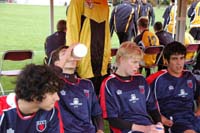
CAIS2009_03Day two of the tournament brought some fresh legs and hopes for participation in the Gold Division. After our one win, one loss performance on day one, we needed a win against St. John’s Kilmarnock to earn a wild card spot in the top group. They had given the division leader, Crescent, a serious run for their money and were certain to be a strong opposition.
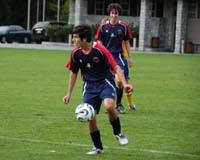
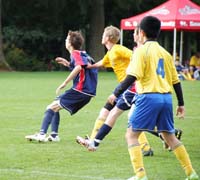
The skies cleared for us on the excellent St. George’s pitches, and we hit the field running, scoring a resounding 4-0 victory with goal keeper Arthur Brown earning the shutout. The team was showing sure signs of improvement both in their individual skills and in team play. The result put us through to the Gold Division to play a big, physical Shawnigan Lake Team in the Quarter Finals.

CAIS2009_05

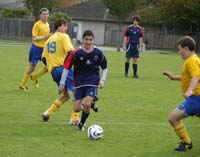
Our smaller, skillful side was starting to suffer in the war of attrition. Several players were now out of the lineup, others nursing bumps and bruises. Shawnigan scored first and then again, taking command of the game. Our smaller, more skilled side slowly reestablished themselves, scoring a goal to come within one goal. In the second half, Shawnigan Lake took control and won the game to move on to the semi-finals. Our side was now on the friendly side of the draw, set to play Country Day School the next day.

CAIS2009_04

An overnight deluge promised a wet, uncomfortable final game on the turf at UBC, but true to form, the rain stopped in time for our noon match. After falling behind 2-0, it seemed the script was set for a collapse, but our boys dug in, scoring three unanswered goals to pull ahead. A late goal by Country Day evened the score and that’s where we finished.

CAIS2009_02

All of the teams in the tournament congregated back at St. George’s to watch the final, where UCC lost to Ashbury, 2-1. At the award ceremonies, St. George’s’ retiring Headmaster, Nigel Toy, spoke of the excellent competition, and their concert band played for the players and coaches. LCC’s captain, Ryan Lehman, arguably one of the best players at the event, earned the team’s spirit award through his indomitable athleticism and excellent ball distribution.

CAIS2009_06

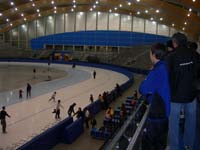
After a quick trip back to the hotel to eat and change, we were out and on our way to the Richmond Skating Oval, where alumnus LCC Peter Webster ’60 had set us up for the evening. This spectacular Olympic venue, where the boys skated and played some soccer on the interior of the oval, was a perfect exclamation point on a very successful trip.

Our Lions return home a better side, setting us up hopefully, for a strong run into our GMAA season playoffs.

Greenism – A New Religion?

GreenismTo buy into the Green Movement is like buying into a religion. It has the structure, the values, the tithing and even the god, Mother Earth. Heck, for now let’s call it Greenism.
In truth, most religions have very much in common in terms of structure. Firstly, there is always a prophet or a guru. Someone to follow, someone with divine knowledge, someone to lead us, someone that can predict what will happen in the future. It sounds a lot like the environmental experts nowadays. Think of Al Gore or David Suzuki. They’re practically worshipped. People follow them from city-to-city, begging for solutions and salvation. Which brings me to the next, most essential aspect of any successful religion: followers. Now the religious followers of Greenism prove to be very widespread and devoted. They are active members in their religious community. They take on the lifestyle that a good Greenie should. They have a hybrid, they save water and they recycle. There are even fanatics in this new religion. There are people who spike trees, to prevent logging; sabotage and sink illegal whaling ships; and set big SUVs ablaze. Structurally, the Green Movement is a religion.

Now many of you are probably thinking that structure is not what makes a religion: it is creed. Greenism has many creeds. Firstly, there is the idea of eternal life or salvation, in other words sustainability. Greenies have set rules for their lifestyle as well. From composting to reusing a bag and sometimes, for the fanatics, buying those hideous eco-friendly socks, include many of the acts practices by the Greenies. They even exude this exclusivity, this idea of holier than thou that is often associated with a religion. Amazingly, even tithing is practiced in Greenism. Greenies forego luxuries and demand that the big bad companies pay up. It even has the idea that our future is decided by our behavior. It has the same self-importance. Our generation is the centre of time. Our actions will decide the future of the human race. Weren’t they saying that like 30 years ago? Greenism most definitely has a creed.

So the big question is: is it so bad? As I said before, religion gives an abstract understanding of life. It guides us in times of indecision. And look at what good it has done for the world. It has truly united us in a way that seemingly only religion can. It has brought us together to save ourselves, to save each other and to save the world. I suppose that I am proud to say that, without a doubt, I am a true believer of Greenism and will include it in the other creeds in which I engage.

—Ingrid Hagen-Keith ’09 (Pre-U ’10)

Writers Work with Students @ LCC

Stuart Maclean with LCC Reads Committee

Stuart Maclean with LCC Reads Committee

Every year writers impart their words of wisdom to LCC students in numerous presentations and workshops. From the most world-renowned writers, like Colm Toibin (Booker-Mann Prize nominee), Alistair MacLeod (IMPAC Dublin Literary Award-winner) and LCC alumnus Stuart McLean (Stephen Leacock Award-winner), to local writers, like Heather O’Neill (Canada Reads selection Lullabies for Little Criminals), Ian McGillis (A Tourist’s Guide to Glengarry) and Carmine Starnino (A. M. Klein Poetry Prize-winner), LCC endeavours to expose students to the craft of writing and to the world of the imagination.

This year, Stuart McLean, Montreal journalist and poet Robyn Sarah and Montreal novelists Jeffrey Moore and Ami Sands-Brodoff have been invited to work with our Middle and Senior School students. Thanks to the work of past parents Ewa Zebrowski and Lori Schubert (QWF Executive Director), LCC has been blessed with a spectrum of talented writers who have stimulated students for the past eight years. In addition, a cross-section of students annually attend the Blue Metropolis Student Literary Festival where they work with writers in more intimate workshops.

If you have suggestions for writers who could work with our students, please contact me: Brian Moore (English Department Head).

Brian Moore
Senior Department Head: English Language Arts, Communications Studies and Literacy Programs;
QAIS Curriculum Representative

November to Shed Light on Technology & Students

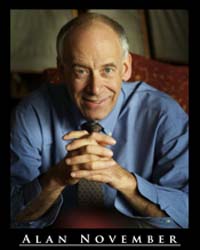
ALANNovemberI firmly believe that we are on the cusp of an incredible paradigm shift in education – the results of which may not be fully appreciated for decades. In the past 20 years I have witnessed incredible changes in the ways that students acquire and retain information. Technology has radically changed the ability to access and communicate ideas. It has probably also changed the way that our brains retain information and may actually impact the way that we think. I recently read an article about McMaster University and their concerns about incoming mathematics students. The university is conducting a study to find out the impact of multi-tasking on a student’s ability to focus on a problem for sufficient time to come up with a solution. At the same time, we are seeing students take far more control over their learning and produce work of an unprecedented quality.

Alan November has been studying the implications of technology for years. He is an engaging speaker who can show many examples of the best uses of technology in the classroom to enhance a myriad of skills. He can also address some issues that may be raised through the use of technology in the classroom and beyond.

We are hosting a presentation by Alan November, followed by a panel discussion involving educators from across Canada, on November 12th. You may be well advised to come by and see what is happening in the modern classroom so that you can decide for yourself what the future has in store.

–Patrick Peotto, LCC Assistant Head of Academics