
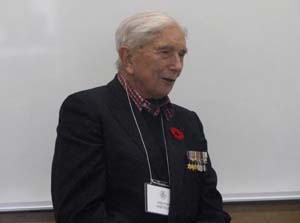
 Grade 6 students were honoured to welcome two World War II veterans, Mr. Alan Canavan ’39 and Dr. Peter Roper, to their classrooms during Remembrance Week. Their contributions to our curriculum have enriched the children’s experiences in a way no textbook ever could.
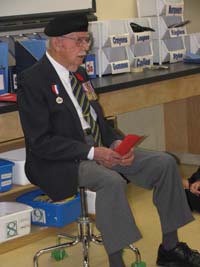 Mr. Alan Canavan, an LCC “old boy,” has been sharing his war-time stories with LCC grade 6 students for many years. He selflessly devotes his time to educate youngsters with his first-hand experiences. Mr. Canavan held his audience captive as he regaled the children with his exploits in Europe. He also took the time to reinforce the need to immortalize the fallen with the continued support of the memorials in Vimy Ridge and Juno Beach. Mr. Canavan has become an integral part of our Remembrance Day observances. His presence is greatly appreciated.
Dr. Peter Roper’s recount of his experiences in the Air Force resulted in wide-eyed curiosity and thoughtful questioning by his audience. Having been shot down at the young age of 18, he was first rescued by a French farmer then later captured by the Germans. After spending two months in a prisoner-of-war camp, he managed a daring escape with the aid of a young boy who hid him in a straw-filled cart. You can well imagine the children’s interest when they learned that this same cart had to make it past enemy sentries!
Part of the grade 6 curriculum allows the students to explore the meaning of the word “hero.” Without a doubt, these two brave warriors, Mr. Alan Canavan and Dr. Peter Roper, definitely classify in the eyes of our youngsters.
— Belinda Rother, Grade 6 Language Arts and Social Studies
 The
The  This mini-conference was hosted by Agence Ometz, Shaare Zion Congregation and Centre de santé et service Sociaux Cavendish on October 6, 2009. The focus was on the lives of boys and men and the concerns about violence. Jackson Katz was the highlight of the conference speaking in terms all of us could understand. Other speakers (Gilles Tremblay and Hal Hannaford) contributed valuable ideas as well.
 The sustainability committee is proving to be a very useful clearing-house for ideas on how to make our operations at the School more efficient. There are many different points of view and it’s a good reminder (for me at least) that there are many different reasons why people want to help reduce our impact on the environment.