
Teaching

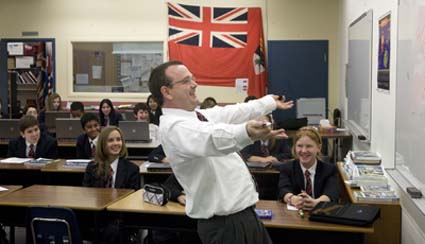
teachersCreate, push, pull, inspire, repeat, repeat, repeat —

Lead, laugh, discover, introduce, complete.

Develop, compare, contrast, critique, follow-up,

Be brutally honest, hone, amaze, focus, analyze,

Grow, advise, envision, coach, tutor, assess, nurture….

… and bid farewell. Job well done!

Thank you LCC Faculty. Congratulations graduates of 2010!

— Chris Shannon, Headmaster

Supporting Your Child During Exams

StopStressHere are a few very pragmatic suggestions, which will provide support to students preparing for exams. The goal related to these suggestions is to minimize stress and to maximize health.

The atmosphere in a home contributes to the stress level of all family members, so it is possible that a family could try to change the atmosphere in the home during exam time. Obviously most parents provide support by asking how it’s going, etc., and pushing the child to study harder. However, if it falls into the category of “nagging” then it is probably not very beneficial. Assume that exam time is different; therefore the atmosphere of the home might be a bit different, too.

There are three very pragmatic things, which I suggest to students: the appropriate amount of sleep, regular exercise and good food. You could ensure that there is a really large supply of “good” food in the house and not much of a supply of “bad” snack-like food. Snacking on nutritious food (especially teenagers) while studying can help. It improves concentration, makes the studying less boring, and feeds the brain with good nutrients.

Exercise: Perhaps family members can help ensure that the student gets exercise during heavy study days (e.g., go for a run together, do a fitness class, etc.). Similar to the food suggestion, this helps restore the brain and helps ensure better sleep.

Sleep: Well, some people just have a harder time than others to sleep, but staying up late to study is a bad plan. Many students have trouble with this suggestion but one can deal with this by studying well in advance so that last minute studying is not about covering material for the first time the night before an exam.

Finally, while it is good to encourage our children to work hard to do their best, too much of this “encouragement” can inhibit top performance because of the pressure.

I am sure that you realize all of this, but sometimes my suggestions serve as gentle reminders. –John Gordon, School Counsellor

Bilingualism to Multilingualism

multilingualismLast week, the downtown QAIS schools (Quebec Association of Independent Schools) held a special conference entitled “Le Fait Français,” a celebration the high quality of French taught in our independent school system. It was an impressive collection of speakers: experienced teachers, alumni, community members and the former Premier of Quebec, Pierre-Marc Johnston.

All presenters spoke about the critical importance of French fluency in Quebec. It is an essential for day-to-day life and success in professional careers. We were reminded that outside Quebec there are some 65 countries around the world who are members of “La Francophonie,” so French competence also has its use well beyond the borders of our own province.

What resonated most with me were the comments from an LCC graduate. Amrick Bansal ’98 is a young lawyer who practices in Montreal. He recounted how he was in Advanced French at LCC and felt pretty confident about his language skills when he graduated. After college and university education in English in Montreal, he felt that his French skills had declined somewhat. He decided to remedy this by attending law school in French at l’Université de Montréal. The nuances of language made this a challenging, yet satisfying, experience. Mr. Bansal solidified his French skills by spending a full year of legal studies at a university in France. Proud with his achievement at refining his French fluency, Mr. Bansal then spent a year at university in Holland, completing a graduate certificate in international law. However, upon arrival he noted that that most of his classmates from Europe and around the world arrived with the capacity to confidently speak four or five languages.

The important message here is that bilingualism is essential for all of us in Montreal. However, in an interconnected world with the domination of global forces, the knowledge of multiple languages is what most young people should strive for to gain a competitive edge. Bilingualism is a necessity, but multilingualism is what we all should aim for. I hope you have already begun to broaden your linguistic fluency.—Chris Shannon, Headmaster

Dealing with Too Much of a Good Thing

TooMuchGoodThingLast week dozens of Assistant Heads from independent schools from across the country gathered in Montreal to share and learn during an annual four-day conference. On one of these days this group of educational administrators had the privilege of working directly with Dr. Dan Kindlon, a renowned clinical and research psychologist and professor at Harvard University in Boston. Dr. Kindlon is also a reputed author. His first book, Raising Cain: Protecting the Emotional lives of Boys saw both he and his co-author, Dr. Michael Thompson, jump to the top of the NY Times Bestseller List. It was published around the time of the tragic Columbine high school shootings in Colorado in 1999, and tens of thousands of parents bought the book in an effort to better understand what could trigger such violence among teenage boys.

Dr. Kindlon’s latest book Too Much of a Good Thing: Raising Children of Character in an Indulgent Age presents some simple but key messages to parents today. He spoke at LCC last Thursday evening, and I would like to pass on a few key takeaways.

As the title of Dr. Kindlon’s book indicates, he is concerned about the degree to which today’s parents indulge their children. His clear advice: don’t give children or adolescents everything they want, set clear limits and stick to them. This sounds simple, but Dr. Kindlon’s research shows that an absence of appropriate boundaries and too little delayed gratification have had a negative impact on young people across North America. He also noted that in our busy lives with demanding schedules for work and activities, family time has decreased by half since the 1980s—a rather startling development. Evidence shows that regular family activity, in particular family dinners, has a direct correlation to keeping children focused and positive.
This actually leads to better results at school.

Finally, Kindlon reiterated the impact of the North American crisis in youth sleep deprivation. The average teen now gets less than seven hours of sleep per night, while needing at least eight and ideally nine hours to function effectively. He noted that the cumulative physiological effect is equivalent to the teen smoking one pack of cigarettes a day, with a host of harmful effects, including a diminished capacity to embed learning after a day of schooling.

This may not be new information. However, it’s important to remember the importance of boundaries and limits, family time, and sleep in the growth, development and good health of our children. For all parents, awareness is important, but acting on our knowledge is critical if students are to meet their true potential. —Chris Shannon, Headmaster

Student Exchange SA: Exploring Cape Town

Capetown1After a short two-hour flight, we arrived in Cape Town where we would spend five days touring the city and its surroundings.

The first day, we took the cable car up Table Mountain and had the chance to see amazing views of the city. From the lookout, we were able to see Robben Island, where Nelson Mandela was imprisoned, the Cape of Good Hope, the southernmost point of Africa and even the new soccer stadium that is being used for the upcoming FIFA World Cup Tournament.

The following day, we drove along the coast of the Cape and stopped at the Victoria and Alfred Waterfront, one of the main working harbors of Cape Town, and wandered through the many shops and historic streets.

Capetown2Next, we drove to Stellenbosch, the second oldest European settlement in the province after Cape Town. While we were there, we saw many vineyards, as Stellenbosch is the center of the South African wine industry and even the site of the first school in South Africa that accepted girls!

The next few days were spent exploring the rest of the city and parts of the Western Cape. —Emily Black