Conférence sur le bilinguisme

imagesVoici des commentaires d’élèves qui ont participé à la conférence sur le bilinguisme dans les écoles du QAIS, le 29 avril, 2010.

J’ai aimé la conférence sur le bilinguisme car c’était intéressant d’entendre les histoires des anciens étudiants. Ils ont dit que c’est très important de continuer le français après l’école secondaire car les langues aident tout le monde à communiquer et à s’exprimer avec plusieurs personnes du monde entier. Je suis d’accord avec ce message et je vais continuer de parler le français pour le restant de ma vie! —Alexandra Bélanger, 10e programme accéléré

Je crois que la conférence était d’une importance capitale pour ma perception de la coexistence des langues française et anglaise au Québec. Je sais maintenant qu’il est primordial de savoir et de maîtriser les deux langues et de ne pas passer trop de temps sans pratiquer l’une des deux. Aussi, j’ai découvert qu’être bilingue n’est pas si exceptionnel qu’on pourrait le croire. —Benjamin Dawson, 10e programme accéléré

Je suis très heureuse d’avoir eu la chance d’aller à la conférence sur le bilinguisme. Je pense que cette expérience m’a vraiment aidée à réaliser que maîtriser plusieurs langues est très important dans la vie. —Gabrielle Gendron, 10e programme accéléré

Bilingualism to Multilingualism

multilingualismLast week, the downtown QAIS schools (Quebec Association of Independent Schools) held a special conference entitled “Le Fait Français,” a celebration the high quality of French taught in our independent school system. It was an impressive collection of speakers: experienced teachers, alumni, community members and the former Premier of Quebec, Pierre-Marc Johnston.

All presenters spoke about the critical importance of French fluency in Quebec. It is an essential for day-to-day life and success in professional careers. We were reminded that outside Quebec there are some 65 countries around the world who are members of “La Francophonie,” so French competence also has its use well beyond the borders of our own province.

What resonated most with me were the comments from an LCC graduate. Amrick Bansal ’98 is a young lawyer who practices in Montreal. He recounted how he was in Advanced French at LCC and felt pretty confident about his language skills when he graduated. After college and university education in English in Montreal, he felt that his French skills had declined somewhat. He decided to remedy this by attending law school in French at l’Université de Montréal. The nuances of language made this a challenging, yet satisfying, experience. Mr. Bansal solidified his French skills by spending a full year of legal studies at a university in France. Proud with his achievement at refining his French fluency, Mr. Bansal then spent a year at university in Holland, completing a graduate certificate in international law. However, upon arrival he noted that that most of his classmates from Europe and around the world arrived with the capacity to confidently speak four or five languages.

The important message here is that bilingualism is essential for all of us in Montreal. However, in an interconnected world with the domination of global forces, the knowledge of multiple languages is what most young people should strive for to gain a competitive edge. Bilingualism is a necessity, but multilingualism is what we all should aim for. I hope you have already begun to broaden your linguistic fluency.—Chris Shannon, Headmaster

The “Corvée du Mont-Royal” and the “Castor Humain”

CorveeThe Corvée du Mont-Royal is an annual event put on by Les Amis de la montagne where groups of people help beautify the mountain by picking-up garbage and planting new trees. On May 2nd, a few students from our Green Team got involved.

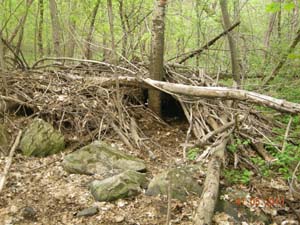
The instructions were simple: pick up garbage and, for safety reasons, dismantle campfire pits and shelters. Temporary shelters or lean-tos, right? Not so. These shelters were intricate winter homes made from twigs, tree trunks, and other foliage. They were constructions made by “des castors humains,” as our guide stated.

The shelter that we happened upon had two rooms; crawling space only. This shelter was built for real survival purposes and not some “survival in the woods” contest. Supposedly, the mountain is home to many homeless in the winter time. So, why was I helping to dismantle someone’s home? We were told that it was for safety reasons since the occupants leave their homes in the spring and the unoccupied “shelters” can then be ill-used by others (e.g., the building of bonfires).

The spot was marked for another team to finish the “clean-up.” As we were leaving a heavily laden man was approaching the shelter. He stopped and stared at us. Not a word was spoken. Obviously, this homeless person was not ready to leave his winter home just yet…

The Corvée du Mont-Royal will become one of the Green Team’s regular annual events. We hope you can join us next year. —Vilma Scattolin, Faculty Advisor to the Green team

Student Exchange AUS: We are All the Same

AnzacDayIt was my third week of school since the break, not to mention a very fun and meaningful one, not only for me, but also for everyone in Australia, and even New Zealand. Anzac Day was celebrated this week. It is a nice tradition held by Australians and New Zealanders to commemorate the fallen soldiers who fought for peace. It was meaningful for me because I was able to be part of the service, which was very similar to the one held by LCC to remember our friends and family who fought for world peace as well.

It was truly amazing to discover that the Australian army, although so far away from Canada, fought in the very same wars we did; the world wars, Vietnam and currently in Afghanistan. They lost countless brave soldiers, as we did. They may have kangaroos and koalas, while we have squirrels, but we are really all the same!

This week is my last full week of school; I hope to make the best of it. I will truly miss my new friends and family in Ballarat. –Nick Lighter ’12

Dealing with Too Much of a Good Thing

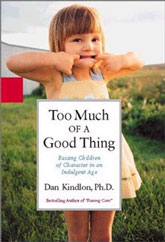
TooMuchGoodThingLast week dozens of Assistant Heads from independent schools from across the country gathered in Montreal to share and learn during an annual four-day conference. On one of these days this group of educational administrators had the privilege of working directly with Dr. Dan Kindlon, a renowned clinical and research psychologist and professor at Harvard University in Boston. Dr. Kindlon is also a reputed author. His first book, Raising Cain: Protecting the Emotional lives of Boys saw both he and his co-author, Dr. Michael Thompson, jump to the top of the NY Times Bestseller List. It was published around the time of the tragic Columbine high school shootings in Colorado in 1999, and tens of thousands of parents bought the book in an effort to better understand what could trigger such violence among teenage boys.

Dr. Kindlon’s latest book Too Much of a Good Thing: Raising Children of Character in an Indulgent Age presents some simple but key messages to parents today. He spoke at LCC last Thursday evening, and I would like to pass on a few key takeaways.

As the title of Dr. Kindlon’s book indicates, he is concerned about the degree to which today’s parents indulge their children. His clear advice: don’t give children or adolescents everything they want, set clear limits and stick to them. This sounds simple, but Dr. Kindlon’s research shows that an absence of appropriate boundaries and too little delayed gratification have had a negative impact on young people across North America. He also noted that in our busy lives with demanding schedules for work and activities, family time has decreased by half since the 1980s—a rather startling development. Evidence shows that regular family activity, in particular family dinners, has a direct correlation to keeping children focused and positive.
This actually leads to better results at school.

Finally, Kindlon reiterated the impact of the North American crisis in youth sleep deprivation. The average teen now gets less than seven hours of sleep per night, while needing at least eight and ideally nine hours to function effectively. He noted that the cumulative physiological effect is equivalent to the teen smoking one pack of cigarettes a day, with a host of harmful effects, including a diminished capacity to embed learning after a day of schooling.

This may not be new information. However, it’s important to remember the importance of boundaries and limits, family time, and sleep in the growth, development and good health of our children. For all parents, awareness is important, but acting on our knowledge is critical if students are to meet their true potential. —Chris Shannon, Headmaster