
Teen Mantra: I am Enough

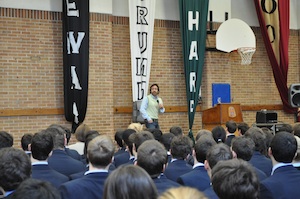
Fried_Blog_03Feb2011Scott Fried is a professional motivational speaker who had a positive impact this week on all of our students from grades 6-12.  He also met in the evening with a large group of engaged parents.  His primary focus was coping with the challenge of life for pre-teens and adolescents and the importance of mutual acceptance.

Scott stressed that words do hurt and can have a lasting and negative impact.  While urging students to be respectful and accepting of peers, he reminded his audiences that all children feel pain on the long and often lonely road to adulthood. As children grow and change, we adults need to acknowledge the pain that teens sometimes feel because inevitably life does hurt; indeed, life itself can be a bully.  Scott urged us to openly acknowledge the feelings of our students and children and not neglect hurt feelings or try to wash them away.

What seemed to resonate most with our students was the phrase “I am enough.” Scott wants us to meet, accept and cherish young people in the moment for who they are.  We should not bury them in a sea of seemingly endless expectations. This only reinforces the implicit message that they are never good enough. Teens also have secrets during this critical period of “becoming” on their journey to adulthood.  Mistakes will be made along the way, which is normal.  As teachers and parents, our role as key adults in their lives is to help children develop a healthy posture of self-acceptance before they can move on confidently toward a path of self-improvement.

I had an opportunity to speak with Scott at the end of a very long day.  He strongly complimented our school and the initiatives we are taking.  I noted that our success is rooted in a faculty of dedicated educators who generally see our students as “more than enough.”  We have many trusted adults here. They proactively bear witness to the hurdles and challenges of so many young people.  When we team and partner with our parents in a positive way; that’s what truly makes a difference! – Chris Shannon, Headmaster

Round Square: Every Day a New Adventure in South Africa

Waking up to a poolside breakfast followed by 18 holes of golf under the hot African sun seems like a suitable way to start off your day. Well, it’s how I begin most of my days here in South Africa. The air is warm, the sun always shines and life is good.

I am 23 days into my journey and have already seen more animals than most people would in their entire lives. From leopards, lions, elephants, hippos, crocodiles, and rhinos, to even small creatures like snakes, lizards, and turtles, not to mention hundreds of different exotic birds. You name it and there’s a good chance I’ve encountered it in one instance or another.

The family I am living with is wonderful and I’d like to say that I am ever grateful for them taking me into their home. I am treated with great hospitality and living on the luxurious side of life. Even though I am living in a high-class community, I am very aware of the social and economic problems that surround me. South Africa is actually one of the most affluent countries in Africa, but it is still a developing country. About a quarter of the population is unemployed and lives on under $2 a day. Crime, sexual assault, and corruption within the government are major issues that face South Africa.

I began school at St Stithians College on January 16. St Stithians College is a Methodist, all boys’ school. The campus is over 105 hectors, and holds almost 3000 students. It may be hard to imagine, but it is over 226 football fields in area. Some students board in dorms on campus, while others live quite close. Apart from the fantastic classes and teachers, St Stithians provides a variety of sport teams and clubs that are open to everyone. I have the privilege of participating in the Chess Club, Photography Club, the Music Club, the Track and Field team, and the Fitness team. St Stithians has been very welcoming to me and the other few exchange students. There are two boys from Columbia and one from England who I’ve been spending quite a bit of time with. The four of us are going on a special trip to the Apartheid Museum tomorrow, the first of many places that we will be visiting.

It has been quite the experience so far, with over a month to go. I learn new things everyday, and am grateful to be a part of Round Square. Who knows what I will do next? Every day is a whole new adventure. – Liam McMahon ’14

Preoccupied Montreal

IPhoneI spoke to students recently about a phenomenon I call “Preoccupied Montreal.” Exactly what is ”Preoccupied Montreal”? It is my way to describe our collective obsession with cell phones, smart phones,  BlackBerries—or “CrackBerries” as the slang goes. Cell phone/smart phone use can actually be addictive and I have some concerns; in my view too many teenagers and adults are suffering and need to change their habits.

This generation of teenagers has a timeless desire to do what every teenager has ever wanted: to be closely connected to friends. It’s cool and feels good to be “in the know.” So carrying a cell phone makes sense; they quite simply help to make our lives a little easier.  However, the temptation to carry the phone wherever you go and check it incessantly rules way too many lives in ways that have become unhealthy.

With the capacity to contact anyone, anywhere anytime comes the odd compulsion among many teens to text, tweet or post statements, opinions, observations, photos or videos on social media, just because they can. The feedback is instant, so clearly someone is listening: someone cares.

Recent studies show that teenagers across North America send on average 100 texts/day, more than double just a few years ago. Most teens surveyed say that the cell phone is now the key to their social lives.  In fact, data shows that on average, when out of school, teens spend just as much time texting as they do talking with friends.  In fact, texting has become so second nature, about 60% of teens surveyed claim to be able to text blindfolded.

However, the 24/7 compulsion to connect without boundaries is unhealthy and can steal balance from young lives.  Some of these digital addicts are even losing sleep, even though sleep is one of the most important elements of their lives they can control. Notably, sleep has a direct correlation with better performance in school.  Eight or more hours of sleep per night can translate into a 10% improvement in achievement simply because sleep stabilizes and protects memory and other brain functions.

There are now a lot of studies that show that a lack of “down time” is detrimental to us—teens and adults alike.  We all need to be out of reach sometimes and avoid being interrupted. This shield of protection should also extend to family meals, quiet discussions with friends, outdoor activities.

I don’t suggest we throw away the technology.  We need it. I think it can really help out lives.  But who’s “driving the bus“ here, you or the cell phone?  We’ve allowed it to seep into every corner of our lives.  It’s time to create some no-go cell use zones and times in our lives beyond school.  Limit its use and call back later.  By then you’ll have something more interesting to say anyway.

Seize the now.  Be in the moment. This applies to adults as well. We adults are often the worst offenders. Blurring borders between work and family/personal time generally means more stress and more unwanted cranky moments.  So take steps to define better  boundaries.  Make this the topic of discussion at tonight’s family dinner table.  But first, turn off the “CrackBerry” more often in 2012 and enjoy not being interrupted! —Chris Shannon, Headmaster

LCC’s Girls Hockey & Basketball Teams Journey to Boston

Lower Canada College’s girls hockey and girls basketball teams recently travelled to Boston on a trip that included four days of touring, bonding and some games against local area teams hosted at 2011_12_Boston_GirlsHockeyBasket_002Pingree School. While both teams had an opportunity to share some time together, their differing tournament schedules also necessitated the pursuit of distinct itineraries. (See photos)

Following an afternoon check-in at their hotel on Thursday afternoon, both teams headed to downtown Boston where players had an opportunity to browse the various shops and boutiques of Newbury Street, followed by dinner at the original ‘Cheers’ near Boston Common. The next morning, both teams headed out early for a full day of activities and games. The girls hockey team visited the New England Aquarium, where they pet sharks and kissed sea lions–developed a flash mob dance routine, had clam chowder in a bread bowl for lunch at Joe’s followed by cannoli for desert from Mike’s Pastries in Little Italy. Their afternoon also included a tour of the Holocaust Memorial and an afternoon reprieve at Quincy Market. After a full day of touring, they headed out to their first tournament match against Marblehead High School, where they played a closely fought match against a tough opponent.

Meanwhile, the basketball girls had started their day out at the Boston Museum of Fine Arts, followed by an extensive tour of Boston College, with the day culminating in a basketball game against Pingree School.

On Saturday, both teams spent the bulk of their days playing exciting, competitive hockey and basketball against local teams. Once again, the hockey team broke out into their dance routine, much to the entertainment of the local crowd, while Desiray Desousa impressed us all during the skills competition with her 100-km/hour slap shot! The day ended with both teams having dinner together at the Cheesecake Factory in Danvers.

On Sunday, the hockey team started its day with a march up to Bunker Hill, followed by an extensive tour, on all decks, of the still active 1797 battleship, the USS Constitution. The hockey team then headed back to Little Italy for lunch at ‘Lucia’s’, and ended their Boston Expedition with a final ‘flash mob’ dance routine at Boston’s Quincy Market, which was full of holiday shoppers. (See video) Meanwhile, the girl’s Basketball team toured the New England Aquarium and ended their day with some shopping at Quincy Market.

Players and coaches had an outstanding time. There was a lot of laughter and many lifetime memories were forged. Both teams represented LCC exceptionally well. A very special thanks goes out to our bus driver at Coach Canada, Franco, who was always accommodating, pleasant and professional. –  Christian Auclair, Girls Hockey Team Coach

Discovery Day at the Montreal Neurological Institute

Last Tuesday, LCC’s grade 11 enriched physics and chemistry class went to the Montreal Neurological Institute for an exciting day of seminars and presentations given by doctors, researchers and grad students. Along with approximately 300 students from Montreal-area schools, we participated in the annual regional edition of the TD Discovery Day. The Discovery Day is a program funded by TD Bank that gives students from across Canada, who are interested in pursuing careers in health sciences, the opportunity to visit hospitals and also talk with doctors and other health care professionals to get a better sense of what the field is actually like.

In the morning, upon our arrival, we sat down in a large auditorium at the Neuro to listen to the chairman of the Discovery Days program tell us about the goals of the program. She then introduced the first keynote speaker, Dr. Phil Gold, who talked about his career as a doctor and about how he got into medicine. After that, we attended our first seminar session, of which there would be two. My first seminar was called “Anatomy of the Human Brain,” and it proved to be very interesting. It was taught by four McGill neurology students and for an hour and a half they lectured about the brain and the various functions of the different cortexes, or zones. At the end of the seminar, we even had the chance to touch a real human brain and see what the different cortexes actually look like in real life. That was really cool!

After lunch, we attended our second seminar, which was given by a speech pathologist who spoke about speech impediments and, more specifically, how to treat them. We got to see and touch all of the various devices that speech pathologists use to do their jobs, such as artificial larynxes and text to speech converters, which was very interesting. When that was over, we returned to the auditorium for a final keynote. It was a panel of five health professionals who talked about their jobs and listened and responded to questions asked by the audience. This was cool because we got to hear about the daily lives of real health professionals and ask them questions about their jobs.

At the end of the day we returned to school, wiser, more experienced, and, for some of us, more passionate about what we want to do with our futures. — Giulian Etingin-Frati ’12