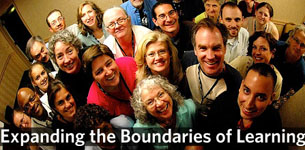
 À la fin juillet, j’ai eu la chance de participer au congrès d’Alan November mieux connu sous la banière BLC (Building Learning Communities).
What defines a learning community you may ask? And why is it important? We know that in the 21st Century, one of the skills we need to teach children is to share resources and seek information through their various networks. As teachers, we must put ourselves through the same process and develop our own learning communities and teach children how to go about building theirs.
Ce congrès portant sur l’intégration des TIC a lieu tous les ans à Boston. Le congrès comme tel se déroule sur trois jours avec la possibilité de participer à deux journées pré-congrès
The BLC conference brings together classroom teachers, educational researchers, consultants and philosophers from North America and beyond which I thought allowed for a great balance between more theoretical sessions and practical workshops.
Below are links to some great teaching resources to integrate ICT into your classes and to help you and your students in developing a digital identity:
I attended two sessions with Marc Prensky, and ICT consultant. Prensky coined the terms “digital natives” (our students) and “digital immigrants” (us). His first session was titled “Partnering with your digital natives” where he talked about engaging students as being key to 21st Century learning. He reminded us that learning must be connected to passion and discipline (see http://www.marcprensky.com/).
Bob Perlman de la Californie et Thomas Daccord de Boston ont offert des pistes intéressantes en ce qui concerne les habilités necessaires pour le 21ième siècle (see http://www.21stcenturyskills.org/ and http://www.bie.org/index.php).
Daccord talked about asynchronous learning (textured literacy). It is the idea of multimodal text that really interested me (i.e., reading, writing and video texting). By storyboarding, students are able to read and write images which defines this new textured literacy. Daccord also stressed that we MUST teach critical thinking as kids are indeed tech savvy but, all too often, they don’t analyze content and search properly. Asynchronous learning gets students to create and teach one another (see http://www.edtechteacher.org/ and http://iearn.org/).
Autres sites et trucs intéressants à partager :
Twitter
I don’t spend a lot of time on social networks, but have found it very informative to follow some of the abovementioned presenters on Twitter and encourage you to do so!
More about professional staff
–Nathalie Lemelin
Interim Junior School Director
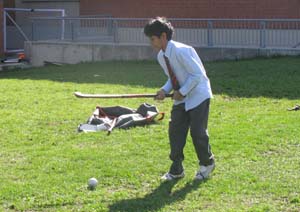 Today’s activity was a real experience for me. Ms. Wearing told us we had a surprise assignment. After recess she told us we were playing field hockey. We have been reading a book that takes place in Afghanistan and in the book they talk about field hockey. She showed us a video on it and then we had to go outside and we had a chance to play.
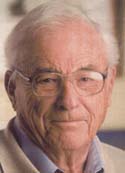 The Royal Swedish Academy of Sciences announced today that LCC’s Willard Boyle ’41 has been awarded the Nobel Prize in Physics for his work in developing the sensor used in digital cameras. Dr. Boyle shares this award with George E. Smith & Charles Kao.
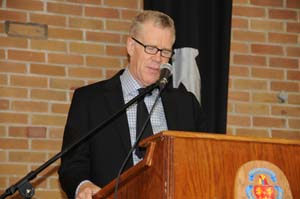 A failure by LCC standards, Canadian short-story author Stuart McLean ’65 showed off his grade 11 marks at the student assembly only a few short days ago. In the Memorial Gym, a few gasps could be heard as his 20%s, 30%s, and 40%s from his old report cards were shared with the audience.