Read University of Western Ontario Professor of Education Wayne Martino’s views on why all-boys’ schools aren’t the answer. This article was published in the October 30th issue of the Montreal Gazette.
All Boys’ Schools Aren’t the Answer
Reply
Read University of Western Ontario Professor of Education Wayne Martino’s views on why all-boys’ schools aren’t the answer. This article was published in the October 30th issue of the Montreal Gazette.
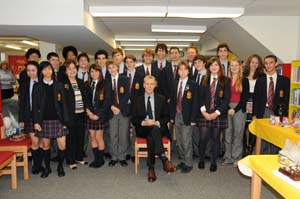
Stuart Maclean with LCC Reads Committee
This year, Stuart McLean, Montreal journalist and poet Robyn Sarah and Montreal novelists Jeffrey Moore and Ami Sands-Brodoff have been invited to work with our Middle and Senior School students. Thanks to the work of past parents Ewa Zebrowski and Lori Schubert (QWF Executive Director), LCC has been blessed with a spectrum of talented writers who have stimulated students for the past eight years. In addition, a cross-section of students annually attend the Blue Metropolis Student Literary Festival where they work with writers in more intimate workshops.
If you have suggestions for writers who could work with our students, please contact me: Brian Moore (English Department Head).
— Brian Moore
Senior Department Head: English Language Arts, Communications Studies and Literacy Programs;
QAIS Curriculum Representative
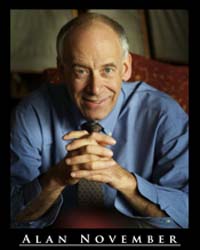 I firmly believe that we are on the cusp of an incredible paradigm shift in education – the results of which may not be fully appreciated for decades. In the past 20 years I have witnessed incredible changes in the ways that students acquire and retain information. Technology has radically changed the ability to access and communicate ideas. It has probably also changed the way that our brains retain information and may actually impact the way that we think. I recently read an article about McMaster University and their concerns about incoming mathematics students. The university is conducting a study to find out the impact of multi-tasking on a student’s ability to focus on a problem for sufficient time to come up with a solution. At the same time, we are seeing students take far more control over their learning and produce work of an unprecedented quality.
Alan November has been studying the implications of technology for years. He is an engaging speaker who can show many examples of the best uses of technology in the classroom to enhance a myriad of skills. He can also address some issues that may be raised through the use of technology in the classroom and beyond.
We are hosting a presentation by Alan November, followed by a panel discussion involving educators from across Canada, on November 12th. You may be well advised to come by and see what is happening in the modern classroom so that you can decide for yourself what the future has in store.
–Patrick Peotto, LCC Assistant Head of Academics
 Have you ever been randomly chosen from a circle of adults to create a monologue on the spot? Have you ever had to convey the text of a Greek myth without saying a word? Or maybe, you have been asked to create a documentary drama in two hours with a group of strangers? That was the nature of the “Power of Leadership” theatre conference that I attended in Anaheim, California, recently. Hosted by the Educational Theatre Association of America (EDTA), this professional development opportunity offered hands-on workshops ranging from commedia dell’ arte, how to create a documentary drama, Disney costuming secrets, to even a master’s class in the Michael Chekhov psychological gesture technique.
As an educator, these conferences offer many benefits. Firstly, I become a student again. I am able to learn new teaching and acting techniques from world class, international instructors. These workshops reawaken the sense of being a student and enhance the curiosity, excitement and apprehension that come from taking a risk and trying something new. This keeps me current and enables me to understand the perspective of my LCC students.
As a result, this experience helps my students in that the curriculum is in infused with fresh new ideas. This year, we will explore the art of Italian comedy through the mask work of commedia dell’ arte in my grade 10 theatre arts class. In grade 9 theatre, I will incorporate the “monologue orchestra” as part of my acting unit.
Secondly, since I find myself surrounded by like-minded thespians, these conferences provide an invaluable support network in my field of expertise. I have always been the only teacher in my field in all of the schools in which I taught. This networking time is therefore important for me because it helps situate my work within a larger community. We are all setting out with the same objectives, passionate about theatre education and are creative observers of the human condition.
Thirdly, each conference has a keynote speaker whose task is to inspire and mobilize new ideas and passions in theatre education. This year’s keynote speaker was Jason Alexander who is best known for his character, George Costanza, on Seinfeld. Not only is Jason Alexander a gifted actor, he is also an intelligent writer and director who has a lot to say about leadership in the arts. He sits on an advisory board for the arts at Boston University and has a compelling argument for theatre education. He highlighted new research that shows how theatre, music and art stimulates and develops the right side of the brain. Secondly he conveyed the notion that it is the artists’ job to go against that which has been established in order to create something new. Experimentation, creativity, risk taking as well as understanding your culture and critiquing it, is a profound way in which the arts shapes us to become more evolved human beings.
—Natasha Hart, LCC Department Head of Fine Arts
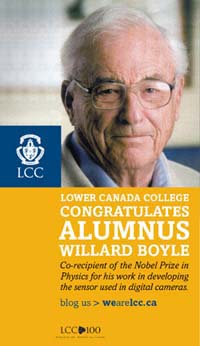 Many schools can boast producing Rhodes Scholars or Olympic athletes. But it is not often that a school has the distinction of including a Nobel laureate among the ranks of its alumni.
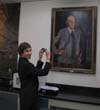
It’s incredible to think that someone who was once in my place, studying in the same classrooms as I am right now, could go on to make such an impact on our everyday lives. Willard Boyle, LCC’s first Nobel Prize winner, is certainly an inspiration and an indication of the immeasurable possibilities awaiting each of us in our future.
This all just solidifies in my mind the strength of the education that LCC offers its students. In my six years at the school, I have realized the wealth of opportunities available to foster curiosity and creativity, leaving me feeling prepared for life “after LCC.” One never knows what the future holds, but it never hurts to hope that I will someday follow Willard Boyle’s example and do my school proud.
— Jordy Fraser ’09 (Pre-U ’10)