Very “Lekker” South Africa

I am delighted to report that after two weeks in South Africa, I have accumulated remarkable vocabulary—at least a dozen words in Afrikaans, which rivals the vocabulary painstakingly learned during six years of Hebrew day school! I now know how to say dankie (thank you), baie (very), and lekker (a nice Dutch word which means nice). It is a word used verryyyyyy often. It is used to describe a beautiful place, food that tastes good, and anything enjoyable. For example, “My time in South Africa has been very lekker. Very lekker indeed.”

January 2, 2013

I arrived in South Africa after a 20-hour trip. I am not sure what I expected. I had dimly thought that, since I was arriving from sunny Florida and not from buried-under-metres-of-snow Montreal, I would not be disoriented. I was wrong. I right away noticed that the country- lush, green, HOT- was very different from any place I’d ever been before.

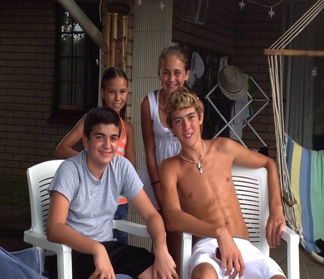
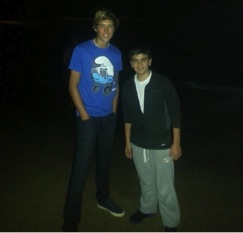
My host family, Hannelie, Dirk, Jessica and Rickus Van Biljon picked me up in Durban. I knew right away that the difference in height between Rickus and I would be an endless source of amusement for my family and friends. In spite of that, Rickus and I instantly got (and still get) along exceptionally well. The whole family was welcoming, warm, just lekker. It’s a funny thing, that. You travel half way across the world, farther than Timbuktu even, and you find that people are just people.

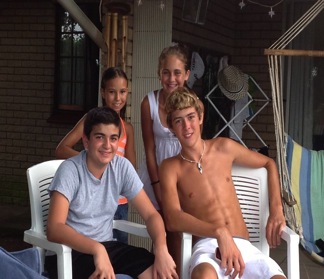
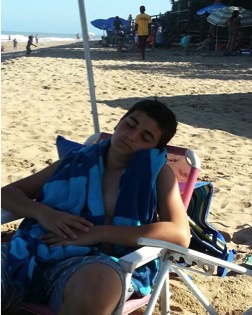
I spent the next few days getting acclimatized and spent the balance of my winter holiday in one of the most beautiful countries in the world. The Van Biljon’s summer beach house is just 30 km from Durban, in Zinkwazi beach. I went to the beach the very first day, swimming in an ocean at once refreshing and warm, lazily talking with Rickus. I enjoyed myself very much, especially when I paused to think about home and what I would have been doing in Montreal. Napping at the beach is the best way to get over jet lag. During that first day, I met the Van Biljon’s family friends, Gustav, Sanelle, and their children Emma and five-year-old Duncan. They say that you can know a person by the company that he keeps. Well, Gustav, Sanelle, Emma and Duncan are extremely nice, which confirmed my opinion that the Van Biljon are great people.

The next few days—still my vacation—were just as “taxing” as the first. We took long walks on the beach, swam at least three times a day, debated the relative merits of American football and South African rugby. Rickus and I are both fluent in sports talk. I was introduced to cricket when the family watched the South African-New Zealand game. I must have been in hockey withdrawal, because I totally enjoyed that.

January 5, 2013

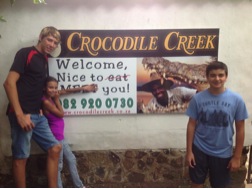
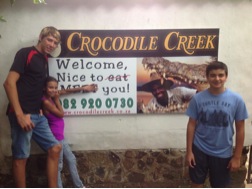
We went to Crocodile Creek, where the welcoming sign “ Nice to eat you” has been thoughtfully corrected to read “ nice to meet you,” no doubt to soothe the tender sensibilities of tourists like me. The crocodile farm was la lot of fun (and instructive too). When our tour guide wanted to introduce us to a crocodile that was hiding in the water, he would tap the crocodile in the face until the crocodile would try to bite him and in effect leap out of the water. South African crocodile tour guides are a different breed. I was able to hold a newly hatched crocodile, and a four-year-old crocodile. It was a little scary, but pretty cool too. The bottom of crocodiles is unbelievably soft, which, as the guide thoughtfully pointed out, explains why people want shoes, handbags, and belts made of alligator skin. We then went to check out the snakes, a definite highlight for me. Snakes are just soooooooo cool. My favourites were the black and green mambas. The inside of their mouths is black, and when they attack, it is truly scary.  When they move, a full third of their body is off the ground. Just the stuff nightmares are made of. Another favourite is the vine snake, the most poisonous snake in South Africa.  The vine snake is so good at camouflage that it took me a full five minutes to spot it. I had a fantastic time, but then I thought of all the times that I visited zoos in Montreal. I’d always think, “ thank goodness those snakes and animals are not indigenous to Montreal. Thank goodness they live in far away places like South Africa.”  Of course, my very next thought was “Um. But right now, I’m in South Africa”… Like I said, just the stuff nightmares are made of.

I am so comfortable here, so happy, that I am always a little surprised when I realize that there are endless differences, some subtle, some not so subtle between South Africa and Canada.  This is the coolest thing about this trip, the way I at once feel adventurous, disoriented, foreign and comfortable and familiar. It sounds like an oxymoron, but it is not. It is just great. But definitely, not every cultural reference that we take for granted in Montreal is a reference here. Les Miserables is not a classic here, but is simply a very new movie, and To Kill A Mockingbird is unknown. Robert Munsch does not exist here. Imagine that! As for me, well, I cannot tell you all the things I don’t understand. I very smoothly try to pass my ignorance for jet lag.

Right after the crocodile farm, we went to see The Life of Pi (very, very good). Just when I think that there are too many cultural differences between our two countries, I see something that reminds me that there are plenty of universal interests, like any Hollywood movie.

I also saw a movie called Spud, which is also a story about a kid going to a boarding school in SA

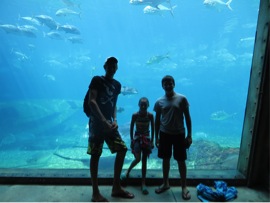
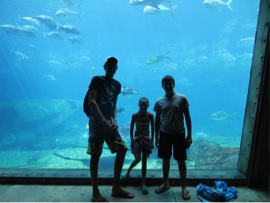
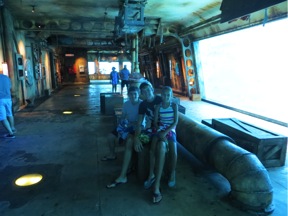
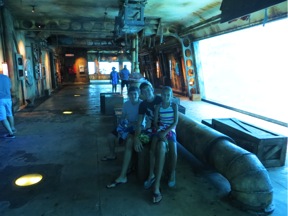
On one of our last days on the coast, we went to Ushaka Marine Land and Water Park in Durban. That was extremely fun. The aquarium was a vast shipwreck, very original. The fish were fantastic. We went to see a seal show, which was good, and a dolphin show, which was really VERY cool. The dolphins threw balls, and even played basketball under water. Very impressive. I heard that from the Van Biljon’s deck in Zinkwazi, you could catch dolphins swimming. There are things like that, which make me so happy to have chosen South Africa for my exchange.

January 9, 2013

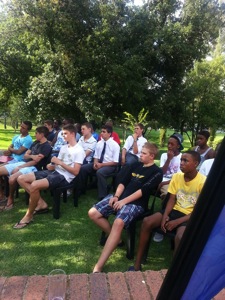
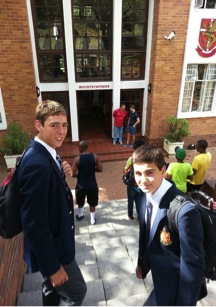
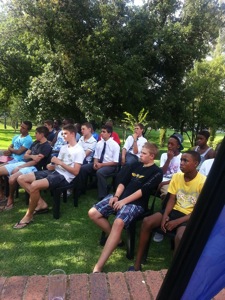
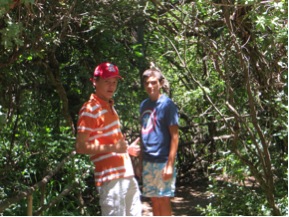
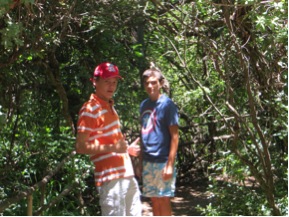
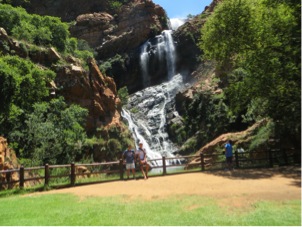
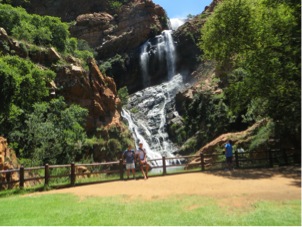
Back in Jo’burg. I met Rickus’ friends from St. Stithians, explored the neighbourhood, and went on a hiking trail in the botanical gardens around the estate. I had a really amazing time on the hike. The scenery on the hike was amazing. I went with Rickus and on of his friends Kyle who is also extremely nice and with whom I get along very well.

January 14
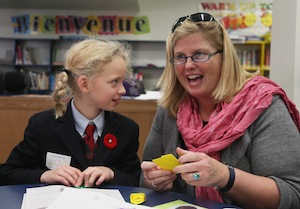
Going to pre-tea at St. Stithians before the first full day of school starts. Definitely an adventure. Tomorrow, I’ll be sleeping at the Mount Stephens boarding house, and Wednesday, I’ll actually start school. It is all a little surreal, very exciting, and a little daunting. I’ll keep you posted.—David Elbaz ’15
The Power of the Word

I saw something special in his eyes yesterday… something that was not there before.  In a word, I would call it resolve… a kind of confidence by American President Barack Obama to be a little grittier, a little edgier, perhaps a little wiser in the next four years. President Barack Obama has now officially begun his second term in office and analysts are already debating what we might see from Obama 2.0.  On the heels of reading the public opinion tea leaves, I believe Obama will show resolve on gun control—and carry his election mandate for health care, education, the environment and support to the middle class confidently into the messiness of the American political policy arena.

The official inauguration actually took place in the “Blue Room” of the White House on Sunday —January 20th as outlined by law. Yesterday was a repeat of the oath to office that has been uttered by all presidents, but more symbolic and ceremonial… outdoors in Washington on Capital Hill, looking out over what’s called the “Mall” leading down past a host of monuments, museums and statues to the Lincoln Memorial.  Close to a million people are estimated to have attended yesterday’s ceremony.  Events began on Saturday with a National Day of Service, including service by the president and his family at a renovation of a local elementary school.

Obama is the 44th American president and the 20th two-term president. Interestingly, Obama actually won more votes in his second term than any president in the past 50 years. The first since Eisenhower in 1956 to earn at least 51% of voter support in both elections.

A US president’s second term can be challenging, as by law Obama cannot continue beyond this term and politicking will begin in earnest in three years, so he has a short window to affect notable change.

Some critics question the importance of the pomp and circumstance of inauguration days. Yes, I agree it can go overboard, but I believe that the symbolism and the ceremony are actually important. The Americans do this part very well.  But it is also a public display of the peaceful transition of political power: orderly, celebratory—even in the face of great complexity with so many important issues at stake.

In terms of symbolism, note that yesterday’s ceremony occurred 150 years after the emancipation proclamation that freed American slaves and yesterday was also Martin Luther King Day—an American civic holiday—exactly 50 years since the famous civil rights march on Washington under the leadership of Dr. Martin Luther King. Both of those iconic American leaders have been very influential in President Obama’s life and thinking.  For that reason Obama used three bibles for the swearing of the oath of office—the Obama family bible, Lincoln’s bible and Martin Luther King’s Bible— reinforcing Obama’s modern vision and hope for a nation where freedom and equity of opportunity reign.  Also note that Abraham Lincoln (also from Illinois – as is Obama) was a two-term president. During his first inauguration the Capital Dome was unfinished due to the strife of the Civil War between the north & south. Lincoln decided to finish it in the middle of the Civil War – completing it in 1863 as a symbol of the strength of the American Union in difficult times.

There are many unfinished jobs in America, and much of Obama’s speech yesterday stressed the need for belief in possibility, innovation and faith in America’s future. Obama stressed Americans to seize the moment and asked all citizens to define hopes of this generation and capacity for more equality in America and less economic inequality.

Obama chose as Inaugural Poet Laureate Richard Blanco: a gay Cuban immigrant.  Obama asked him to write three poems and Obama chose one entitled  “One Day.”

Blanco says being named poet laureate for the inauguration personally validated and stitched together several ideals against which he long measured America… the essence of the American dream: how a little Cuban-American kid on the margins of mainstream America could grow up with confidence, have the opportunity to become an engineer thanks to the hard work of his parents who could barely speak English, and then go on, choosing to become a poet who was asked to speak to, for and about the entire nation.

I know you all read poetry in your English classes.  So in honour of the power of words, I would like to share Blanco’s inspired poem to his fellow citizens and the world:

—Chris Shannon, Headmaster

_______________________________________________________________________________

One Today

One sun rose on us today, kindled over our shores,
peeking over the Smokies, greeting the faces
of the Great Lakes, spreading a simple truth
across the Great Plains, then charging across the Rockies.
One light, waking up rooftops, under each one, a story
told by our silent gestures moving behind windows.
 
My face, your face, millions of faces in morning’s mirrors,
each one yawning to life, crescendoing into our day:
pencil-yellow school buses, the rhythm of traffic lights,
fruit stands: apples, limes, and oranges arrayed like rainbows
begging our praise. Silver trucks heavy with oil or paper — bricks or milk, teeming over highways alongside us,
on our way to clean tables, read ledgers, or save lives — to teach geometry, or ring up groceries as my mother did
for twenty years, so I could write this poem.
 
All of us as vital as the one light we move through,
the same light on blackboards with lessons for the day:
equations to solve, history to question, or atoms imagined,
the “I have a dream” we keep dreaming,
or the impossible vocabulary of sorrow that won’t explain
the empty desks of twenty children marked absent
today, and forever. Many prayers, but one light
breathing color into stained glass windows,
life into the faces of bronze statues, warmth
onto the steps of our museums and park benches 
as mothers watch children slide into the day.
 
One ground. Our ground, rooting us to every stalk
of corn, every head of wheat sown by sweat
and hands, hands gleaning coal or planting windmills
in deserts and hilltops that keep us warm, hands
digging trenches, routing pipes and cables, hands
as worn as my father’s cutting sugarcane
so my brother and I could have books and shoes.
 
The dust of farms and deserts, cities and plains
mingled by one wind — our breath. Breathe. Hear it
through the day’s gorgeous din of honking cabs,
buses launching down avenues, the symphony
of footsteps, guitars, and screeching subways,
the unexpected song bird on your clothes line.
 
Hear: squeaky playground swings, trains whistling,
or whispers across cafe tables, Hear: the doors we open
for each other all day, saying: hello, shalom,
buon giorno, howdy, namaste, or buenos días
in the language my mother taught me — in every language
spoken into one wind carrying our lives
without prejudice, as these words break from my lips.
 
One sky: since the Appalachians and Sierras claimed
their majesty, and the Mississippi and Colorado worked
their way to the sea. Thank the work of our hands:
weaving steel into bridges, finishing one more report
for the boss on time, stitching another wound 
or uniform, the first brush stroke on a portrait,
or the last floor on the Freedom Tower jutting into a sky that yields to our resilience.
 
One sky, toward which we sometimes lift our eyes
tired from work: some days guessing at the weather
of our lives, some days giving thanks for a love
that loves you back, sometimes praising a mother
who knew how to give, or forgiving a father
who couldn’t give what you wanted.
 
We head home: through the gloss of rain or weight
of snow, or the plum blush of dusk, but always — home,
always under one sky, our sky. And always one moon
like a silent drum tapping on every rooftop
and every window, of one country — all of us –
facing the stars
hope — a new constellation
waiting for us to map it,
waiting for us to name it – together.

MS Pride: New Beginnings, Nouveau Départ

Before our winter vacation, M. Maurice chose a few Middle School Pride representatives for an at-home conference experience. Liaising with Appleby College and St Mary’s Academy, I, along with a few other students will be getting to know students from these schools over Skype. But the project doesn’t end here. As well as having video conferences with them, we also must define an activity that will be completed and evaluated by the end of June 2013. We have already been given our first task, which is making an iMovie to present ourselves. In a two-minute video, anything that we love doing inside and outside school will be put into this presentation.

Par ailleurs, l’idée du Café Équitable est de retour et est sur la bonne voie. Avant les vacances, Ryan et moi avons frappé un mur, mais nous sommes prêts à recommencer et à essayer encore. Dans la première version du projet, les élèves du Middle School Pride devaient cuisiner des muffins aux bananes, vendre du chocolat chaud et du café équitable. Maintenant, notre projet sera coordonné avec celui du Bake Sale, pour qu’il y ait plus de personnes impliquées et moins de difficultés. L’activité se déroulera en février. – Christina Papageorgakopoulos ’16

Courage

Blog_Courage_17Jan2012“What makes a king out of a slave? Courage! What makes the flag on the mast to wave? Courage! What makes the elephant charge his tusk in the misty mist, or the dusky dusk? What makes the muskrat guard his musk? Courage! What makes the sphinx the seventh wonder? Courage! What makes the dawn come up like thunder? Courage! What makes the Hottentot so hot? What puts the “ape” in apricot? What have they got that I ain’t got?—Courage”

These are the words of the Cowardly Lion from the famous film & play, The Wizard of Oz.

Another memorable quote from the Cowardly Lion goes like this:

“All right, I’ll go in there for Dorothy. Wicked Witch or no Wicked Witch, guards or no guards, I’ll tear them apart. I may not come out alive, but I’m going in there. There’s only one thing I want you fellows to do.”

“What’s that?” ask both the Tin Man and the Scarecrow.

“Talk me out of it!,” begged the Cowardly Lion.

The Wizard of Oz was produced in 1939, but the film’s core messages remain timeless. In the end, all the major characters got what they wanted:  Dorothy returned safely home. The Scarecrow got a brain, the Tinman received a heart – and the Lion was given the gift of courage.

Like the TInman with his heart and the Scarecrow with his brain, the Lion discovered that he already possessed courage. He simply needed to focus on it more and develop it, just like each of our students.

Courage is defined by the Oxford Dictionary as “the ability to do something that frightens – a form of bravery.” It’s a fantastic quality, something we all need and something we all possess in varying degrees. In fact, each of us needs to draw on courage sometime every day. But too often we can confuse courage with being tough or being able to fight, as if it’s solely a military attribute. But it’s actually much more important in the context of maturity of character and our capacity to overcome personal fears and obstacles that hold us back in life.

For students, courage includes so much: speaking up in class, reaching out and making friends, trying a new activity or developing a new skill. My personal favourite is developing the capacity to stand up for what you believe in, even when it might mean standing out from the crowd. This is tough for anyone, but particularly difficult for teenagers; they need the time and opportunity to practice.

Are you courageous? Do you surprise yourself or others with your ability to reach out? Is your sense of courage aligned with a well-developed sense of moral fibre and other solid character traits?  Think about it. How might you learn and mature by taking a few more personal risks and employing a little more courage?  Realistically, it begins with baby steps. Every step is just a decision. Slowly but surely, you can help yourself move forward, develop yourself and feel a sense of genuine pride.

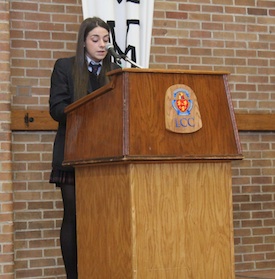
In our student assembly this week, I saw courage in action. Grade 11 student Claire Greenbaum ’13 spoke to all Middle and Senior School students. She addressed the tragic loss of her mom to cancer and the positive energy she and her whole family have been able to create through establishing a new foundation that raises money for cancer research. I commend her on openly and courageously addressing this important but difficult personal topic in a way that was very motivating to all. Great job, Claire!  —Chris Shannon, Headmaster

Happiness Quotient

Blog_HappinessQuotient_10Jan2013Happy New Year – and welcome to 2013!

Despite endless media tales of corruption and doomsday scenarios, I believe that we are very fortunate as Montrealers and Canadian citizens. There are also many benefits from being part of our caring and supportive LCC school community.

On our last day of school in December I was struck by a report in the Globe & Mail of a notable good news story reporting that 80% of Canadians have a great day most days. This comes from an international poll of people in 148 countries.  They were asked if they had been treated with respect the day before, whether they had done a lot of laughing and smiling, whether they had experienced positive feelings and had enjoyed their day.  Eighty per cent (80%) of Canadians felt positive about most of these elements of their lives – which tied for 11th out of 148 countries worldwide, tying us with Colombia, Malaysia, the Netherlands and Ireland. We were ahead of countries like the UK, the United States, Australia and France (all in the mid to low 70’s).

Notably, all of the countries with the highest rate of positive responses – the top 10 – are all in so-called “developing nations,” and eight of those are in Latin America, led by Panama, Paraguay, Venezuela, and followed by Trinidad and Costa Rica.

So on this scale – what I will call a “Happiness Quotient” – it appears that above a certain level, the old adage is correct: “money does not buy happiness.” Singapore, the 5th wealthiest nation on earth, earned the lowest score at 46%, while Panama which only ranks 90th in income per person tied for 1st.

The pollster, Gallup, cited the research of two Nobel laureate economists (Daniel Kahneman & Angus Deaton) of Princeton University who concluded that earnings only have a positive impact on emotions up until $75,000.  Beyond that, additional income does not appear to make any difference at all – an important message for all of us in our money-obsessed culture.

So why do Latin Americans stand out at the top of the pack? It appears that a significant emphasis in Latino culture on the value of family & friends contributes to a particularly positive outlook on life. This was affirmed in my very unscientific straw poll of one person. I recently spoke with LCC Spanish teacher Señora Navarette , who is originally from Chile. She knew nothing about the poll, but she was not surprised when she heard the results for Latin America. She affirmed immediately that general happiness in Latin America is closely associated to family, friends and community as most important in life.

So why is Canada among the happiest of the world’s wealthiest countries?  Well, we enjoy a great deal of personal freedom, our crime rates are low and we have government policies and programs that reduce social inequality compared to other peer countries. It is also believed that immigration is likely an important factor.  At 250,000 people per year, on a per-capita basis, Canada has more people arrive on its shores than any other developed country in the world.

So diversity and a genuine comfort with multiculturalism as a norm, likely have a positive impact on the way we see the world and feel about our daily lives in Canada. As the Globe & Mail article on this poll stated in December, perhaps we should not over-analyze the data, but instead, focus on some of the feelings we all no doubt felt over the holidays when we looked back at 2012.  We are lucky to live in a beautiful country with a diverse and generally upbeat population.

In many ways Canada is a beacon to the world – civil, prosperous and safe. I hope you count yourself among the contented.  I also hope that for the rest of this year you will appreciate your many blessings and do your best to celebrate family, friends and our school community – for therein lies our greatest riches and relationships that are the seeds of true happiness. —Chris Shannon, Headmaster