La classe de droit de 10e année rencontre l’Honorable Anne-Marie Trahan, Me Shea et Me Lemoine

Blog Trahan

Dans le cadre du concours Jeunes du monde organisé par Éducaloi (un organisme de vulgarisation juridique québécois), les étudiants jouent le rôle d’un avocat et doivent donner un conseil juridique à un jeune de 13 ans. La classe de droit a eu le privilège d’écouter l’Honorable Anne-Marie Trahan, ancienne juge à la Cour Supérieure du Québec, Maitre Shea et Me Lemoine spécialistes du droit collaboratif. Le sujet de la conférence était la convention relative aux droits de l’enfant.

Voici quelques extraits de ce que les élèves ont écrit à propos de cette conférence:

«J’ai aimé quand la juge Trahan nous a dit que nous sommes l’avenir, mais aussi le présent. Il y a toujours des gens qui disent seulement que les enfants d’aujourd’hui sont le futur du Canada. C’était agréable d’entendre que nous sommes aussi les enfants d’aujourd’hui et que nous avons une importance dans la société actuelle.» — Jennifer Ben-Menashe ’13

«Les deux présentatrices étaient des femmes très charismatiques et cela m’a donné plus de confiance. J’espère aussi apporter des changements dans le monde du droit comme elles l’ont fait.» — Arielle Supino ’13

«Honnêtement, je ne me suis jamais ennuyé durant la présentation. Les anecdotes, les histoires personnelles ainsi que les informations générales ont vraiment créé une présentation géniale.» — Thomas Boucher ’13

«J’ai appris que le droit n’est pas tout noir ou tout blanc, mais que tout change d’un cas à l’autre.» — Brian Brotto ’13

«Une chose que j’ai apprise pendant la conférence est le caractère légal du respect des enfants envers les parents. Je ne savais pas que dans le code civil du Québec, ce sont les articles 596 et 598 qui le décrivent.» — Luca Saputo ’13

«J’ai beaucoup appris sur le rôle d’une juge. De plus, je ne savais pas que si un enfant voulait voir une juge, elle était forcée de voir cet enfant. J’ai appris plusieurs choses sur les droits et les devoirs des enfants envers leurs parents.» — Nicholas Tabet ’13

«J’ai beaucoup aimé la façon dont madame Trahan a parlé. Honnêtement, c’est une des présentations que j’ai le plus appréciée, car elle connaissait très bien son sujet. Quand quelqu’un a confiance en ce qu’il dit, les personnes y portent attention.» — Eric Tellier ’13
Round Square: Thrilling Experiences in South Africa

LCC students have travelled to South Africa to attend the International Round Square Conference. Before activities get underway, the group has taken the time to learn a little about the country. Here are some reflections:

_______________________________________________________________________________________________________________

September 23, 2012

Today we woke up after a few hours of sleep plagued by raging thunder showers, ready to face the chilly 5:00 am air. After a hearty breakfast, we headed to the Ann van Dyke Cheetah Breeding Centre, where we witnessed cheetah’s run at 75 km/hour speeds. This was followed by petting a live cheetah, which, thankfully, we all survived!

The rest of the morning was spent touring the breeding centre; we saw various animals including ostriches, wild dogs, vultures and feisty honey badgers. We even had a grass spitting competition, in which Mrs. Shadley participated by spitting the masticated grass as far as she could…

Upon our return to the expansive game reserve we enjoyed a picnic lunch. After lunch, the group packed into two safari trucks and drove into the gated “predator” section of the park. There were wild dogs, lions and cheetahs roaming the untamed grasses and relaxing in the sun. Our jaws dropped in awe while watching several lions feast on an animal carcass.

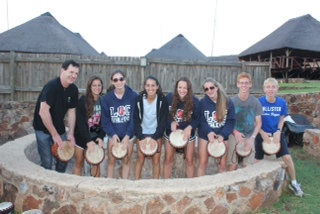
As the sun started to set into the scenic African landscape, we gathered for a drumming session. Most of us felt unsure about our drumming talent, but the instructor kindly taught us some really cool beats. Once everyone caught on we played games and even sang and danced!

For our final activity of the evening we were split into groups of five to cook “Potjekii”, a special South African stew. After the meal was prepared, we got together for dinner before heading back to our tents for the night. So far, we’ve been having an amazing time and we can’t wait for the days ahead! — Sarah Salzman ’13

Round Square: Eye Opening South Africa

LCC students have travelled to South Africa to attend the International Round Square Conference. Before activities get underway, the group has taken the time to learn a little about the country. Here are some reflections:

______________________________________________________________________________________________________

Blog_RoundSq_SA2012_Rhino_]September 22, 2012

The first thing that is noticeable are the fences. They literally surround everything. Although oddly enough, the only place that wasn’t fenced in was the Porsche dealership! Crime is a huge issue here, and the reason why we won’t be going into the city.

South Africa may be on the rise with a growing middle class, but severe poverty, unlike anything we see in Montreal, is still running rampant. There’s the rush hour traffic of workers commuting to Jo’burg, passing right by little shantytown-like huts with broken tin roofs and no doors.

After about an hour’s drive out of Jo’burg, we arrive in The Cradle of Humankind, a UNESCO world heritage site and the home of one of the most important archeological dig sites on the planet.

We also visited a non-operative gold mine. As the owner was explaining a few things, we saw monkeys climbing in the trees around us. Needless to say we couldn’t focus much after that. The cave was pretty cool, we saw a few bats and, fortunately, no spitting cobras.

We then toured the museum, which houses several important Hominid fossils. The artist’s reconstructions of the fossils caught all our attention. Despite minor physical differences, they all looked undoubtedly…human.

After lunch, we headed out to the reserve where we were staying, observing rhinos, ostriches, antelope and wildebeest on the way. After a traditional “braii” (BBQ) and a lesson on the local astronomy, we headed off to bed. An early 5:00 am start tomorrow! — Zachary Dionisopoulos ’13

LCC and the Relevance of Digital Innovation

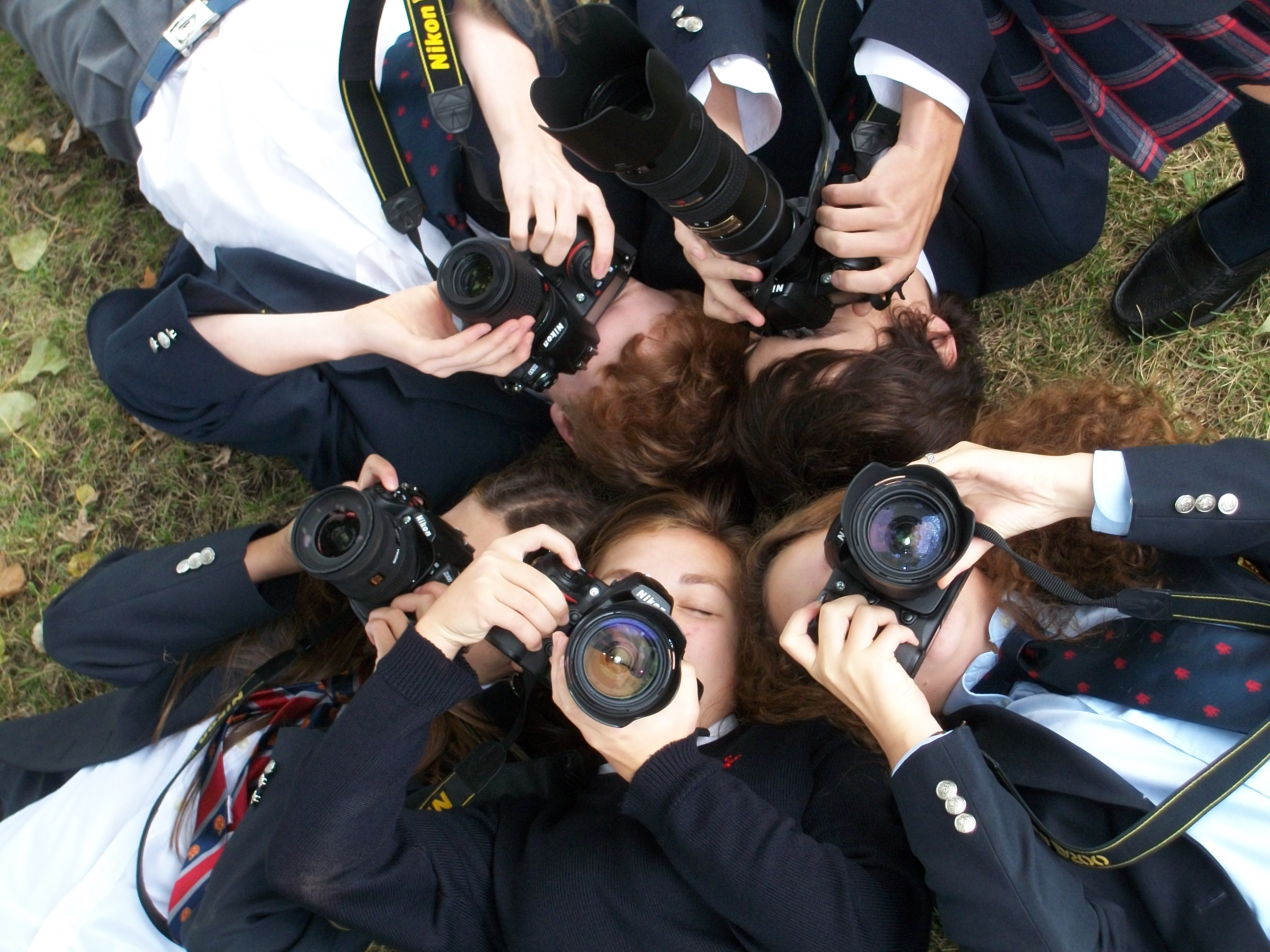
CamerasUpThey say that a picture says a thousand words. In essence, images are very powerful and can have great impact.  In the words of Sociology Professor Martin Hand at Queens University in Kingston, “we live in an age of unprecedented visuality.”

Last weekend I attended the World Press Freedom Show at the Marché de Bonsecours in Old Montreal.  It’s a collection of powerful images from some of the world’s most newsworthy or hidden places—images of the revolution last year in Libya, the extraordinary devastation in Japan from the nuclear disaster and tsunami, stunning nature shots, photos of forgotten prisoners in some of the world’s most overcrowded jails.  There are also images that capture scenes that are funny or silly and those that express moments of amazement and surprise.  In short, it’s a powerful and moving photography display, and definitely worth seeing (open until September 30).

As I left, I realized that virtually all of those photos were digital—images built on pixels rather than film. This reflects an extraordinary evolution that has occurred in recent years, even among the world’s best professional photographers.

In the sweep of history, photographs are a relatively recent invention. The first photo of a person was only taken on film in 1839 (black & white of course). Kodak released its first film camera about 50 years later in 1888: it took almost another 80 years, until 1963, for Polaroid to invent the first instant colour film camera.

The next revolution in photography was the advent of the digital age in which we all now live. The world’s first digital camera was invented in 1975 and was about the size of a toaster. The first commercial digital camera was only released in 1991.  At the time, they made less than 1,000 cameras at the cost of about  $20,000 each.

Since 2000, with the advent of the digital phone and small digital cameras, we have all jumped into the digital age with both feet.  The digital cameras are now commonplace. They are built into almost all cell phones, and cameras now sell for less than $50.  We have seen tremendous innovation and progress. Also interesting is that about 3500 photos are now posted to Facebook every second.

With this little lesson and reminders about the evolution of photography, note that the one individual most credited with inventing the digital camera was an LCC graduate by the name of Willard Boyle ’41.  Dr. Boyle was a scientist and researcher who won the coveted Nobel Prize in Physics in 2009. Unfortunately, he passed away just last year.

Willard became globally famous for his achievements working with NASA, preparing for the moon landing in the early 60’s, and his invention of the CCD Sensor that allowed for clear photo images to be sent back to earth from space —and eventually the creation of the digital camera.

But Willard Boyle was once just like our students. The foundation for learning and innovation was laid on Royal Avenue in Montreal, and he always appreciated his affiliation with our school.

As a research scientist, he didn’t wait for others to direct him. He innovated, invented and significantly changed our world, pulling us into the digital age.

Maybe another student at LCC today will have a similar impact one day.  Why not?

As our students become proficient—even expert in some fields, I hope they do what Willard Boyle did: stay both humble and hungry to innovate and have impact on their community.

Remember that Kodak released the first camera in 1888. Unfortunately, after more than a century as a leader in the field of photography, Kodak filed for bankruptcy this year because it didn’t adapt and innovate enough.  That’s another important lesson: take nothing for granted. Indeed, today nothing stays the same and to be successful, no individual and no organization can rest on its laurels, reputation, or press clippings! –Chris Shannon, Headmaster

Middle School Pride: Environnement

Bonjour, je m’appelle Alexandra Gardilcic et je suis la responsable de l’environnement au Middle School Pride cette année. Pour ceux qui ne le connaissent pas, c’est un groupe d’étudiants qui se rencontre chaque mercredi à 7h30 du matin pour planifier des activités pour le Middle School.

My goal as the environment head is to raise awareness about the environment in the Middle School. Cette année, j’espère planifier plusieurs activités pour vous, par exemple, une collecte de bouteilles et de piles. Si vous avez des idées, des commentaires ou des questions vous pouvez me contacter à cette adresse : [email protected].

Last meeting, Holly Faria ’15 came and talked to us about how PASSION+ISSUE=CHANGE. This basically means finding your passion and applying it to real world issues to make a change. For example, if your passion was athletics, you could apply it to an issue such as homelessness. And with this you could make a change. Such as last year there was the Hockey for the Homeless, a tournament that raised money for people in need. Si vous avez une passion pour la musique et que beaucoup de personnes âgées souffrent de la solitude dans les maisons de retraite, vous pourriez peut-être organiser un concert de musique pour eux.

Don’t forget to look at the new announcement board in the Middle School corridor to see any school events that are coming up. All in all, I hope that you have a great year! Thanks! – Alexandra Gardilcic ’16