 Earlier this month our faculty and parents had an opportunity to hear from well-known American educator, Alan November. Years ago he predicted that the most pronounced changes in generations were coming to education because of advances in information technology – both hardware and software. Students now have the capacity to collaborate with peers across the room and also around the world. As a result, students are empowered more than ever before.
What were some of the key takeaways from Mr. November’s presentation?
Students need to remember to be responsible. What they write on the Internet, in particular social network sites such as Facebook, can be read by tens of thousands. So information should never be posted unless it is appropriate and will not hurt the author or others. It’s not a good idea to mix private information with these kind of public channels of communication. After posting or pressing “send,” teenagers need to be ready to face the consequences of their actions.
We need to focus more on the “grammar” of the Internet to find interesting and relevant information. Google works in such a way that the best information does not always land on the first page of a search. However, studies show that 85% of the time, teenagers never go beyond the first page and simply settle for second-rate sources. We need to teach them how to dig deeper and to want to dig deeper.
Are students being deceived? A simple search for information on Martin Luther King Jr. on Google USA can actually bring up some questionable sites. Among the top ranked is one that is written and sponsored by a white supremacy group intending to spread hatred and diminish young people’s sense of tolerance and respect for diversity. Internet sites need to be seen and read with a critical eye. What sources are our children using?
At one time or another, many teenagers have placed unsavoury comments or photos on the Internet. They need to know that something called the “wayback machine” retains every Internet site ever posted. Essentially, the material never disappears – it’s there forever. Teenagers need to think of the ramifications for the future, especially when it comes time to apply for university or a job. Institutions are now going to the Internet for a 21st century character check.
It’s time for a new literacy. We all possess powerful tools for creativity and global communication. Students need to think critically, possess the capacity to navigate the Internet with confidence, and show good judgment and respect for these powerful tools. At both school and home, adults need to guide and support student growth – and help children avoid pathways to trouble.
–Christopher Shannon, Headmaster

 Several of LCC’s P.E. classes have dabbled in one of the School’s long-lost traditions – Cricket. Cricket is a bat and ball game played on large fields with a rectangular “pitch” in the centre. LCC’s fields had a cricket pitch into the early 1990s. In recent years, a resurgence in the game has occurred, with some modifications, introducing it as a viable indoor sport.
 Several LCC P.E. classes have been given a quick, classroom history lesson and introduction to the rules using YouTube, then brought to the gym for a modified game. To date, three grade 9 classes and two grade 7 classes have played.
 The journey began bright and early on Monday, November 9, 2009. Giving up our ped. day sleep in, our team—comprised of Greg Sigler, Noah Schouela, Elsa Schlemm, Chloe Collier, Tiffany Chamandy, Lauren Piccoli, Alysha Fedele and Blair Hardiman—arrived at the Mackay Center to pack up the bus and get the ball rolling. Once organized, we headed to the handicap-friendly Camp Massawippi in the Eastern Townships. From that moment on the fun did not stop. We were kept busy by the kids’ desire to remain active, bond with their new friends and experience nature to its fullest.
 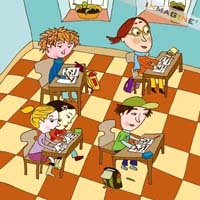 The Ministry of Education has made dramatic changes to the grade 11 English Language Arts assessment for 2010.
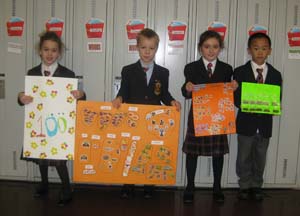 Every week, LCC’s grade 1 students receive a “Math Problem of the Week,” which is made up of several math activities that they need to solve.