
The Wonder of Mr. Machai Viravaidya

mechai_bioI recently attended the annual Round Square international conference in Thailand along with six LCC student-delegates. This international association of 80 schools from across the globe continues to focus on key values and IDEALS we promote regularly in our school (Internationalism, Democracy, Environmentalism, Adventure, Leadership, Service). Active learning experiences such as the annual international conference connect students, teachers and administrators and open eyes to major issues and challenges far from home. In addition to a host of excellent keynote speakers, discussion groups and cultural activities, I had the opportunity to participate in two separate service days, including a memorable day connecting with young children and babies at a Thai orphanage run by the Catholic church.

Although there is much to reflect on from this eye-opening experience, I will share my impressions of a single speaker. Mr. Machai Viravaidya is an impressive and humorous Thai man who has led an incredibly accomplished life of service and initiative, mostly dedicated to improving public health at the broadest level in Thailand. Known as Thailand’s “Condom King,” Mr. Viravaidya has spent decades distributing condoms across the country—years before it was being done widely in most countries. This was a big deal in Thailand as it is a very conservative and traditional country. He made the topic of family planning fun, distributing free board games which educated people, giving taxi drivers and police thousands of condoms to distribute to the general public and holding an annual condom blowing championship. He also started a chain of restaurants called “Cabbages and Condoms,” hoping that condoms would some day be as common as cabbages. He joked with student delegates at our conference to remember that condoms aren’t dangerous, they are what he calls useful “weapons of mass protection.”

As the founder of PDA, Thailand’s largest non-profit development association, Machai Viravaidya has played a key role in developing Thailand’s immensely successful family planning initiatives. This has led to one of the fastest reductions in birth rate anywhere in the world—falling from an annual increase of over 3% in the mid 1970’s to merely half of one percent today. During that time the average number of births per woman in Thailand fell from seven babies to less than two.

Mr. Viravaidya has also been instrumental in building Thailand’s comprehensive national HIV/AIDS prevention policies, radically reducing new HIV infections. In 2005 the World Bank estimates that these prevention measures helped save nearly 8 million lives and saved the Thai government over $18 billion in treatment costs alone. Amazing achievements resulting from one man’s vision and determination!
For his service toward improving Thailand’s public health, Mr Viravaidya has received many major awards, including the United Nations Gold Peace Medal and was acclaimed by Time Magazine as one of “Asia’s modern heroes.” Most recently he was recipient of the Bill & Melinda Gates Global Health Award and a prize called the Skoll Award for Social Entrepreneurship, with each prize having a value of $ 1 million—significant funds that he immediately put back to work fighting public health issues in Thailand.

Despite this success in family planning and fighting the spread of HIV, Mr. Viravaidya has not taken time to rest. Now he has turned to education, poverty reduction, and the promotion of creative solutions to complex problems in his country. He sees education as the key to success and has started a school called the “Mechai Pattana Bamboo School” which boasts the world’s largest geodesic bamboo dome (30 meters across), a climate change centre, a design and innovation centre, a democracy education centre, and what he calls a “Barefoot MBA and Philanthropy Academy” dedicated to teaching young Thai villagers how to make money and how to give it away. The students designed their own uniform, they sit on hiring committees for the selection of teachers, and there are no textbooks, just the Internet.

It was impressive to meet Mr. Machai Viravaidya personally and hear him speak. He is a global leader, an innovator and someone whose life motto could very well be “Non Nobis Solum.” His final message to his audience in Thailand was simple yet profound….. “If the educated and the wealthy don’t help with the world’s many problems, then who’s going to help? Go out and do something decent.” That’s a mantra we all should follow.

Check out his organization’s web site at: www.mechaifoundation.org –Chris Shannon, Headmaster

The Advantages of Bilingualism

by Dr. Kathie F Nunley (June, 2010)

Many of our students may be unaware that they bring with them, one of the strongest cognitive advantages to learning. They are fortunate enough to be bilingual. The ability to speak more than one language is one that offers many cognitive rewards now and into old age.

People who speak more than one language fluently throughout their life have better problem solving skills, better attention, improved executive function and reduce the risk and severity of Alzheimer’s, dementia, and other brain deterioration issues. (Bialystok, 2004, 2010) Children who are bilingual may have some benefit in learning to read due to a stronger working memory. (Swanson, 2006)

Speaking more than one language is more complex than we first thought. Bilingualism requires a fundamental reorganization of the entire language system in the brain. Having more than one language housed in the brain puts tremendous pressure on the pre-frontal cortex, that area of our brain that deals with working memory and executive function. For this reason, brains of persons who are bilingual have a constant mental workout in this particular brain region, (Penn, 2010). The result is no different than what happens when you work out any area of the body – strength and increased efficiency.

The reasons for this appear to be multiple. First, if you are fluently bilingual, the areas of the brain that operate both languages are operating all the time. This is true, even if you remain in a mono-linguistic environment. For example, if you speak both Portuguese and English fluently, but work in an English speaking school and live in an English speaking community so that all day long you hear and speak nothing but English, the area of your brain responsible for Portuguese is still running as you speak and listen to English. Both areas run in tandem.

The areas of dual language are very much intertwined and organized by the brain region responsible for executive function. Apparently the lexicons of the languages are partially shared and handled by the prefrontal cortex. We can see this in instances of aphasia. Aphasia is a condition where language, or parts of language are lost, usually due to a head trauma. Occasionally the aphasia results in a very select deficit in just one area of lexical processing. For example, a person may lose the ability to speak nouns or just verbs, or even just past tenses of verbs. When this type of injury happens to a bilingual person, they lose the specific grammatical class in both languages. In other words, if you speak both French and English and can no longer say any nouns, you have lost that ability in both languages. (Mozzo, 2010) I’ll mention here too, that recovery is faster and more complete for this condition if you are bilingual. (Penn, 2010)

New research is also showing us how critical language is to the formation of cultural self. A person’s cultural belief system and autobiographical recounts are influenced and accessed differently through different language. Bilingual children who were interviewed in both of their languages had different stories, memories and personal reports based on which language was used in asking the question. (Wang, 2010)

So, what does this mean for bilingual students in our classrooms? Help them understand this incredibly valuable gift they bring with them to school. Encourage them to continue to use, speak and read, whenever possible, in both of their languages. Ask them questions that they can respond to in either language. Have them share stories, recall information and learn in both languages: “Tell me in English what you remember learning about the water cycle, and then tell me again in Luganda.” Encourage their bilingualism. Help them celebrate their gift.

Citations
Bialystok, Ellen. (2010). Global-local and trail-making tasks by monolingual and bilingual children: Beyond inhibition. Developmental Psychology, Vol 46(1), 93-105.

Bialystok, E.; Craik, F.; Klein, R. & Viswanathan, M. (2004). Bilingualism, Aging and Cognitive Control. Psychology and Aging, Vol 19(2), 290-303

Miozzo, M.; Costa, A.; Hernández, M; Rapp, B. (2010). Lexical processing in the bilingual brain: Evidence from grammatical/morphological deficits. Aphasiology, Vol 24(2), 262-287

Penn, C.; Frankel, T.; Watermeyer, J.; Russell, N. (2010). Executive function and conversational strategies in bilingual aphasia. Aphasiology, Vol 24(2), 288-308

Swanson, H., Saez, L. & Gerber, M. (2006). Growth in Literacy and Cognition in Bilingual Children at Risk or Not at Risk for Reading Disabilities. Journal of Educational Psychology, Vol. 98(2), 247-264.

Wang, Qi; Shao, Yi; Li, Yexin Jessica (2010). “My way or mom’s way?” The bilingual and bicultural self in Hong Kong Chinese children and adolescents. Child Development, Vol 81(2), 555-567.

Kathie F. Nunley is an educational psychologist, author, researcher and speaker living in southern New Hampshire. Developer of the Layered Curriculum® method of instruction, Dr. Nunley has authored several books and articles on teaching in mixed-ability classrooms and other problems facing today’s teachers. Full references and additional teaching and parental tips are available at: http://Brains.org

How to Combat Reading Lags

ReadingAccording to reading specialist Paul Kropp (Canadian author of How to Make Your Child a Reader for Life), children tend to experience reading lags as they begin elementary school, again around grade 4 and, finally, when they enter high school. Although the reasons for these lags are not absolute, several variables are at play.

When children undergo significant transitions, e.g., parent-child separation upon school entrance or moving to a new school, daily routines like reading at bedtime may become disrupted. In the case of boys, peer influences may supersede activities like reading. Around ages eight to ten, boys begin to view reading as “uncool” and prefer to engage in physical and tactile activities, like sports and video games. In early adolescence, when boys and girls are going through puberty, their interests turn to one another and away from books.

Parents often ask me what they can do to combat these reading lags. Rest assured, children who live in literate households where the printed word is valued will pass through these reading lulls and return to their love of books with very little prompting from their parents. If your child falls into this category, I would recommend patience, some gentle prodding, like recommending books, and continuing to practice the literate approach you have already cultivated. Trust me, they will come around in mid- to late-adolescence. Forcing the issue too much may backfire, as teenagers are more likely to do the polar opposite of what their parents suggest. As a father of four and a teacher of many over the years, I can also advise you against reverse psychology. Our children are far too smart to be taken in by our legerdemain.

The following concrete suggestions should help you combat the dreaded reading lag.

1. The first step is to create a home atmosphere where books, magazines and newspapers are the norm, not the exception. Even though all newspapers are available online, subscribe to a daily paper. The newspaper is often the only print our children see us reading for pleasure during the day. Eventually, they will become curious enough to read the paper themselves. Doing the daily puzzles and reading the cartoons, especially with your children, are also fun ways to interact with the paper. The Gazette offers a weekly page for young students that includes word games and puzzles. In addition, subscribe to magazines for yourself and your children. Just as you may be fascinated by current events and read The Economist, your child may be passionate about sports and read Sports Illustrated (there is even a Sports Illustrated for Kids).

2. Engaging in literate activities outside the home is also extremely important. The cheapest and easiest way to do this is to take advantage of your local library. Going to the library with your child on a regular basis is a great way to cultivate the love of reading, not to mention a very pleasant parent-child experience. Libraries also offer cultural activities, reading clubs and competitions that may stimulate your child. Although they may be more expensive, occasional trips to a bookstore are imperative. Letting your children purchase their own books indicates that you value books and respect their interests. As teenagers often do not want to be seen with their parents, you may want to just make sure their library card is current and give them gift certificates to Chapters on an annual basis, for example.

3. Although this may seem odd to you, continuing to read with and to your children throughout adolescence is a positive way to combat the reading lag. Share the books you are reading, but do not foist them on your unwilling children. When you are commuting or going on family road trips, listen to audio books. Talk about books, current events and popular culture at the family dinner table. Show your children that you are interested in their passions. Above all, be an active reader yourself and leave plenty of reading material lying around the house.

Knowing and cultivating your children’s interests will reap life-long benefits. Supplementing their passions through reading, whether it be books about the sports they play or their favourite singer or actor, is an excellent way to show them you care about what they care about and to get to know your children on a deeper level. If you sense a reading lag, do not despair or overreact, simply follow the guidelines I have outlined above. However, whatever you do, do not tell them I said so. Remember, they are intelligent beings who sense overt attempts to improve them. Nonchalant subterfuge is often the best approach. —Brian Moore (Senior Department Head, English Language Arts, Communications Studies and Literacy Programs)

A Balancing Act for the Environment

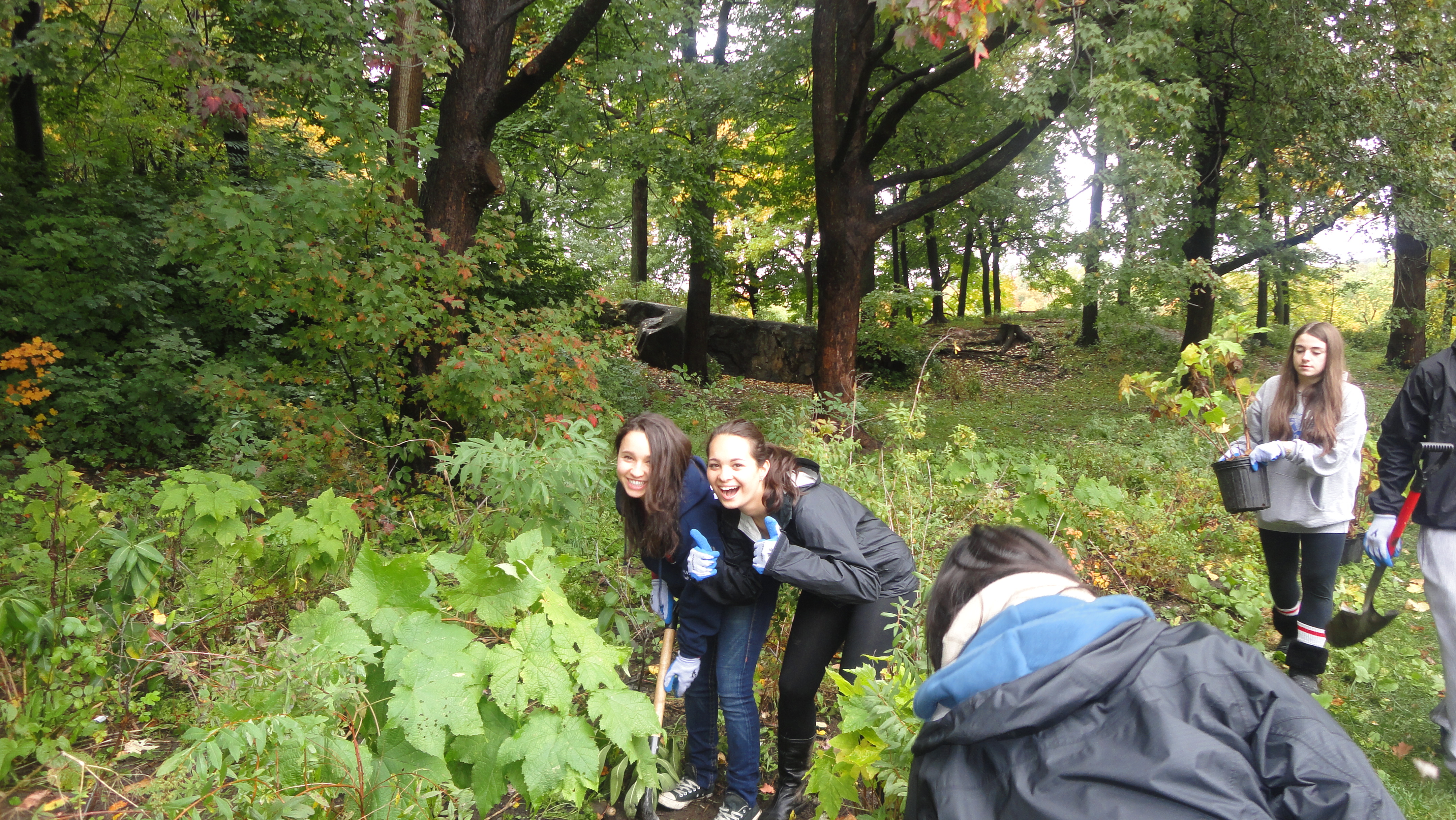
SpeakforthetreesOn October 1, a handful of Green Team students and I had a wonderful day helping the environment. How did we help the environment? We spent the day at Mount Royal at a “Speak for the Trees” workshop.

The day started with an introduction to two grassroots organizations Roots and Shoots and Evergreen. Then we were engaged in activities that focused on eco-systems. We learned that when one species or habitat of the eco-systems dies or is harmed it affects all members and leads to unforeseen complications. We then got together in our school groups and brainstormed ideas of the kind of changes we wanted to make throughout the school that would benefit the LCC community and make us more eco-friendly. One of our ideas was to help create a student lounge that would serve local and fair-trade produce, house a recycling/composting centre and have posters that would encourage “Green” thinking. All schools got a chance to present their ideas. After lunch we got down to business. We had two outdoor activities that connected with the balancing of the eco-system. We helped to get rid of the invasive buckthorn plant, and we planted wild raspberries with the aim to introduce native species to the mountain. –Claire Greenbaum ’13

Walking and Smiling Together in Thailand

Enthusiastically greeted by young orphans proudly waving the Greek flag, King Constantine followed by his wife and daughter walked through the doors of the Pattaya Orphanage. Joined by Mr. Shannon and other delegates, the six of us entered the orphanage excited to begin a day of service alongside the King. We were split into different groups to work with assigned age groups. The groups consisted of babies, toddlers and pre-school children. We were blessed to have the opportunity to interact with them through a series of different games and activities.

Greg, Hutch and Elle began the day with the pre-school children and had an amazing experience playing with them. Elsa, Caroline and Mr. Shannon started off with the babies. They helped the caregivers of the orphanage prepare the babies for bed and comfort them. Sasha had the chance to be placed with a room of toddlers who were all ecstatic because they had a new playmate.

We were extremely moved by the children’s warmth and affected by the lack of attention they receive. We could feel the impact we had on their day—not to mention their futures—and how much they appreciated our company.

In keeping with the conference theme “We Walk Together,” this day could be subtitled “We Smile Together.” The laughter and joy throughout the orphanage was infectious and we made them feel like they too were a part of the conference. We hope to have many more experience like this to follow.

Keep smiling LCC, and spread laughter! —Sasha Cukier ’11 and Caroline Maughan ’11