
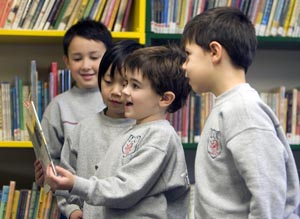
The Value of the Library

Lower Canada CollegeWhile in Toronto recently I was struck by the front-page headline in the Toronto Star: “Ontario Schools shelve libraries.”

In a controversial decision, the Windsor-Essex Catholic District School Board recently laid off all but four of its 39 librarians and is now dismantling all of its libraries. The board intends to revamp the use of space and use it more as student centres with computers and reference materials, or open it up for arts activities. This move has been attributed to two main factors: First, the ongoing shift to digital technologies resulting in declining use of books and journals by students. The second factor is cost savings, as that particular school board faces declining enrolment and an $8 – $10 million deficit in the next school year. So tough choices have to be made to avoid further financial losses.

Interestingly, that school board in Ontario is actually reflective of a broader trend across Canada. Although schools have not necessarily taken the drastic step of closing their libraries, very few are still staffed with a qualified librarian. To put things in perspective, understand that we have three full-time librarians here at LCC to staff our Junior and Senior libraries. In the public school system in the province of Nova Scotia there are none, there are only three left in all of New Brunswick, and numbers have declined notably in Alberta and BC’s public school systems as well. In Ontario primary schools, only 12% have full-time librarians.

In the face of this discouraging trend in Canada, studies have actually shown a strong relationship between professionally-staffed libraries and student achievement in school, including better scores on standardized tests (as much as 8%) and much more positive attitudes toward reading.

Meanwhile in Europe in the past decade, the trend has been the opposite of what’s happening in Canada. Europeans are investing in and developing libraries as a force to improve education. So in the Canadian context, I guess here at LCC we are “countercultural” relative to our Canadian counterparts and have aligned ourselves more with Europeans.

Although we have been proactive with the use of digital media at LCC, we also believe in the value of the book. We support the importance of the library as an information centre and oasis of calm in a noisy world. In the library students can read quietly, reflect and harvest the seeds of their creativity.

We have a reading week in our Junior School and our LCC Reads initiative in Middle/Senior School remains an important and interesting activity in our annual calendar. As the broader debate on libraries continues, one thing is for sure, the level of literacy that each student develops during their time at LCC will likely define much of their success in university studies and likely in professional life. So despite a host of other attractive options in their busy lives, young people need to make time to read; it will definitely make a difference in their futures.

Keeping our LCC libraries open is our priority and we will continue to actively support the development of literacy across all grades. By the way, our annual Book Fair is around the corner: May 26-27. Be sure to pick up a copy of the new LCC Reads book, The Heart Specialist. I hope you find something there that tweaks your interest. –Chris Shannon, Headmaster


Motherhood and Warfare

Last weekend we all took time to acknowledge and reflect. For most of us the focus was on something very important and valuable – motherhood. Last Sunday was Mother’s Day, and I hope that at your home mom was truly pampered. We all have mothers, and the work that mothers do to nurture, support and guide is one of the great pillars of society. So every year we take one day to acknowledge mothers and their important work as the glue in most families.

I was struck by a report last week on the eve of Mother’s Day that an annual calculation of the value of unpaid work done by mothers. Even though men now do much more domestic work at home than a generation ago, women still do the lion’s share. Researchers for online publication MSN Money recently found that the time Canadian mothers spend on what they label as “mom” jobs translates into about $132,000/year for stay at home moms and $82,000 for working moms, in addition to their professional jobs. The assessment gave a market value for time spent on laundry, cleaning, childcare, chauffeuring, psychologist, tutor, and cook as some of the many roles women continue to play in families. In Canada it is estimated that unpaid work accounts for $300 billion of annual GDP with most of it done by women; a very high value, indeed. This has important implications for government policy-makers in terms of tax policy and so forth. The study claims the average mom works 96 hours/week, including full time employment. This is an increase of 4 hours from last year. So Moms appear to be busier than ever.

The other occasion/anniversary last Sunday was less visible to most of us. It was the 66th anniversary of VE Day, marking the end of the Second World War in Europe in 1945 and the surrender of Hitler’s forces. I’m not sure how many of us took much notice, as here in Canada our remembrance focus is mostly in November. But we need to acknowledge that WWII transformed the world. Consider that WWII cost approximately 60 million lives, trillions of dollars and created millions of refugees who spent years in temporary camps across Europe between 1945-1950. WWII brought with it the Holocaust, the start of the nuclear age with the dropping of the atomic bomb in Japan, and the beginning of an era known as the “Cold War,” when superpowers USA and USSR faced off in an a dangerous and expensive ideological struggle for decades.

We lost 45,000 Canadians in WWII – a significant loss given our population of about 11 million at the time.

In Russia marking what Russians call the “Great Patriotic War” was most at the forefront this past weekend. Whereas Canada lost a significant 4/10ths of 1% of its total population during the war years (1939-1945), the Soviet Union lost an astounding 14% of its population, losing close to 25 million people. These are astounding numbers – 25 million dead – by far the worst suffering of any country during WWII. That’s why what’s called “Victory Day” – victory over the Nazis – with parades and great fanfare occurred virtually everywhere across the former Soviet Union this week. It is a national holiday – much more prominent than here in Canada.

Motherhood and wartime sacrifice – two celebrations that are at opposite ends of the spectrum. But it’s important that we remember find a way to acknowledge them both. —Chris Shannon, Headmaster

South Africa: Becoming Part of the Community

StudeExchange_SA_Safari_May2011I guess I should start by saying what a wonderful country South Africa is. The people here are full of spirit and joy. My host family treats me very well and is a lot of fun to be around. The first couple of days were a little difficult but the Evans family made it very easy for me to fit right in. Tim is my exchange student. He has a sister named Giordy and his parents are Clive and Dee. I have seen quite a lot of the country already and there is much more planed.

The first week that I was here was the weekend of the rugby festival at St. Stithians, which was a perfect way to introduce me to the school. When I arrived, the school was still on break so after the rugby festival we packed our bags and went to Hluhluwe Umfolozi Game Reserve. We stayed at the camp for three days and went on numerous game drives. During my stay I saw the “big five” witch includes lion, buffalo, rhinoceros, elephant and leopard. I also saw many different bucks, giraffes, zebra, monkeys and hippopotami. Next we drove to the city of Durban, which is on the coast, just north of Johannesburg. In Durban I spent most of my time surfing and sightseeing. Unfortunately when we returned to Johannesburg I got very sick and missed the first few days of school. But thankfully I got better in time for spirit evening. Spirit evening is a gathering that the students have after school where we all practice the war cries in preparation for the big game against St. Johns, one of St. Stithians most significant rivals. That weekend we watched the game and I participated in the school’s numerous war cries and cheers. That weekend I also had the pleasure to go bungee jumping at the Orlando Towers. Afterwards, I had tried a traditional South African corn-based meal called Pap.

I’ve visited many great parts of South Africa and so far am very impressed. I’m very glad I embarked on this trip and I hope that future LCC students will have the chance to go on exchange visit South Africa. –Charles Laframboise ’13

What’s in a Number? Pre-U Results…That’s What!

CONCORDIAThe results are in! Well, most of them, and the members of the Pre-U Class of 2011 have a lot to be proud of.

With so much of the Pre-U year focused on applying to university, awaiting the inevitable admission decision is an unnerving time for our students. The last month has been a whirlwind of highs and lows, with the crush of a refusal and the exhilaration of a university acceptance sometimes being experienced within minutes of each other.

But once the emotions settle down, it’s time to for that major, life-changing, decision – where am I going to be next year?

Not everyone has finalized their university decision yet, but when our 25 students cross the stage on May 19th at their graduation ceremony, this is what I know:
• 52% of the students will be attending university in the United States
• 38% of the US-bound students were accepted at universities that have admission rates under 15%
• 75% of our students who applied early to US universities were accepted
• 100% of the students who applied to UK universities were accepted
• 87% of the class has been offered admission scholarships
• 50% of one of the most prestigious scholarships at a top Canadian university were offered to our students (4/8)
• 100% of the Pre-U students will join the Class of 2015 at a university somewhere in the world beginning September 2011

The Pre-U Class of 2011 may be small in number, but they are mighty in many ways. And although, I’m not one to quantify the Pre-U experience—after all, Pre-U is about so much more than just getting into university— the numbers do speak for themselves and are a great reflection of the overall success of our Pre-U students this year.—Kim Tulloch, Director of University Advising

Ethics Dilemma – Politics and Leadership

I want my political leaders to do a lot of things for me. I want them to manage the economy; to deliver good educational programs; to provide health care, pensions, good highways, museums, parks, etc. But, often not considered—I want the politicians to be leaders of “character.” We can argue about how effectively one political party supports health care or highways, and we can differ in opinions about who is a good politician or not. Unfortunately, however, it’s pretty clear that most politicians don’t provide us with behaviour representing good character. This is especially true during an election campaign.

I think that as educators and parents we have a problem. Politics do not emphasize civility. Civility is behaving politely, calmly and reasonably even during heated debates. Civility means that we do not engage in personal attacks or harassment. Civility means we should treat each other with consideration and respect.

Yet our politicians speak in very disrespectful ways to, and about, their opponents. They stretch the truth and pretend ignorance when their misrepresentations are pointed out. They would have us believe that their opponents could ruin the country. They support “attack” ads. They continually represent bad character.

We teach our children/students to speak civilly to one another. We teach them to problem solve when relationships come into conflict. We have honour codes in schools emphasizing respect and consideration towards others. At home we don’t allow our children to speak disrespectfully to us as parents. We teach students about tolerance of opposing points of view. We work very hard in schools to shape a civil environment. We want our homes to be civil as well.

How are we to explain to our children/students that our leaders do not have to adhere to the same expectations that are required of us as children, students, co-workers, spouses, employees, etc? Do we say: “that’s politics?” Do we tell our children that this is not the way one should behave? One student pointed out to me that if students behaved the way that politicians behave they’d be sent to the office for a discussion about appropriate behaviour and if that behaviour persisted they might face disciplinary actions.

If the lack of civility in politics bothers me and if I want good characters to lead our country, whom do I vote for? I will exercise my right to participate in this democracy, but this ethical dilemma is challenging.—John Gordon, School Counsellor