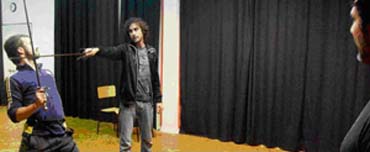

Critique 20 000 lieues sous les mers

20000J’ai beaucoup apprécié le spectacle 20 000 lieues sous les mers. Premièrement, j’ai trouvé que les acteurs ont joué leur rôle d’une façon animée ce qui a stimulé l’audience. Aussi, les effets spéciaux (le son, la lumière) étaient excellents pour une pièce de théâtre. Ils ont contribué grandement à la qualité du spectacle. Cependant, à certains moments, les acteurs parlaient très vite, et c’était difficile de les comprendre. Malgré cela, 20,000 lieues sous les mers était une pièce de théâtre que j’ai trouvé très bien faite en plusieurs aspects.

Jon Victor (8è année accélérée)
——————————————————————————————–

La pièce de théâtre qu’on a vu : 20 000 lieux sous les mers était très intéressante à regarder. Il y avait beaucoup d’effets spéciaux, mon préféré était celui de la bibliothèque. C’était une illusion d’optique où on pensait que la bibliothèque était en 3D, c’était très amusant de regarder cette partie. Je pense aussi que les acteurs étaient très bons et qu’il y avait beaucoup d’humour dans la pièce. Mon personnage préféré était l’homme canadien car il était très bon dans son rôle. Chaque scène était tellement bien planifiée, mais la fin était un peu confuse. L’histoire qu’il a essayé de mettre en scène était très difficile à faire, alors je pense que c’était très bien fait.

Alissar Karam (8è année accélérée)
———————————————————————————————————-
Voyez ce que la nature peut offrir lorsque l’homme y est absent. On dit souvent d’un monde vierge,qu’il est sauvage, mais (…) qui est le plus sauvage ? L’homme ou la nature ? –– Capitaine Nemo

J’ai beaucoup apprécié le roman et j’ai été impressionné par la pièce. Comment reproduire l’atmosphère d’un sous-marin dans une salle de théâtre ? Comment faire participer les spectateurs ? Comment avoir le mal de mer en étant confortablement assis dans un fauteuil du théâtre Denise-Pelletier ? Voici quelques questions que je me posais avant d’aller voir la pièce. Grâce à une ellipse métallique suspendue au milieu de la scène, Jean-Guy Legault nous fait naviguer dans différents univers. Aidé d’animations visuelles sur grands écrans (un devant, un derrière) et d’effets sonores hors du commun, ces 20 000 lieues sous les mers ne m’ont pas paru durer les deux heures du spectacle.

–JF Maurice

Vow of Silence Reflection

VowSilenceNovember 20, 2009

Today marks the twentieth anniversary of the signing of the UN Convention of the rights of children. By taking part in the Vow of Silence, we restricted ourselves from speaking, e-mailing, going on Facebook or texting. We cut back on these methods of communication to raise awareness about the millions of children around the world whose basic rights are non-existent and who do not have a voice to speak out about the injustices they live with. These children live in a world where food is a commodity and where most things are simply unattainable. We, as representative of LCC’s Free the Children committee, have decided to take it upon ourselves to raise awareness about these injustices and try and comprehend the amount of difficulty it is not to be heard and unable to convey basic necessities and personal thought. A change needs to be made and it is our commitment to not only raise awareness but also eventually make a difference.
— Noah Schoula ’11
_________________________________________________________
This feeling of frustration is overwhelming. Having so much to say, but no words to express yourself. Having a solution to all of the problems, without the ability to tell anyone how things must be done. It’s impossible to imagine how one can handle this in everyday life. Seeing the faults in the world around you, but not being able to breathe a word. Impossible.

Student Council this morning was just the beginning. A very productive day in the Board Room, although devoid of any grade 10 input. All four of the grade 10 representatives have taken the vow of silence, and we were all chomping at the bit to propose our valid solutions to the pressing issues in the school. But we had no voice.

Walking through the halls to class was equally dreadful. Not being able to return any good mornings or hellos, walking by pretending not to hear anyone. I felt guilty not replying to any of their greetings, for I didn’t want anyone to be upset. But if the hundreds of millions of children around the world don’t get to have their voice heard, why should I?

Imagine conducting a 6-station chemistry lab without being able to communicate to your partner. As you may infer, not a lot of production was yielded. My partner, Jordan, had taken the vow of silence as well, so any questions we had for our teacher were locked inside of our minds.

Skip ahead to French class. Our teacher explains how the new French government exam will be conducted. All of the questions dying to break free from my lips are trapped. To be saved for another day. So many answers left unknown.

Recess. Everyone is in a relentless pursuit to get me to speak. Taunting. Tickling. Anything they can try. They won’t break me. I’ll just pretend they’re not there. I fear that they’re not properly interpreting the message we’re trying to spread.

English class. Essay is due. Internet isn’t working, and I need to print. But of course, I can’t communicate this problem. I feel so powerless. So frustrated. So tempted. But I cannot speak. If they can’t be heard, why should I be? Poetry discussion. Robert Frost, one of my favourites. But I cannot participate. I have no voice.

Math. Step function word problem. Who got the answer? “I did!”, I am dying to yell. But I can’t. For I have no voice.

Lunch wasn’t very easy. The same question, over and over again. “Why are you doing this?” I just show them the message on my back, and no more needs to be said.

History. Class debate. Enough said.

All in all, my day at school was enlightening to say the least. It really made me think about the unfathomable repression one without the ability to be heard must feel. However, no matter how hard I try, I will never be able to fully appreciate the silence of those deprived by hunger or a lack of education. My frustration with not being able to talk to my friends, or speak my opinion on Robert Frost’s The Road Less Taken, is incomparable to those forced into child labour that are punished for speaking out against unsafe and unfair work conditions. The evil, so rampant among them, chokes out their voice, leaving them trapped in a perpetual silence. It was my goal to spread awareness about this, in the proper way, and it is my hope that I have succeeded. Only time will tell.

— Greg Sigler ’11

Quel soufflet!

LeCidEn cette belle journée,
Avec les 10e année accélérée,
Nous sommes allés d’un pas décidé,
Voir le Cid au théâtre Denise-Pelletier.
Afin d’en comprendre l’intrigue,
Les élèves ont étudié les personnages auparavant,
Ils savaient qui étaient Chimène et Rodrigue,
Sans oublier Don Gomez, Don Diègue et Don Fernand.
En classe, ils ont interprété les plus grands moments,
Compris et apprécié le dilemme cornélien amplement,
Nous partîmes vingt-neuf, chevauchant notre bête mécanique,
Nous revînmes le même nombre, à LCC sans le moindre hic.
–JF Maurice ’11

The Student’s Voice

One of the goals of being digital literate citizens is to be involved and share thoughts on issues that impact each one of us. One of the recent assignments in the Digital Media Communications course was to have every student add their thoughts, via an audio file, after viewing a single photograph.  As each student adds their opinion regarding the image, the program continually records their voice to build an archive on this issue. Each student now has an audio record of their thoughts,  leaving a Voicethread on this topic.  Take a moment to listen to what they had to say.

Each student has a voice and only when they are willing to express their concerns on environmental or global issues will they impact change.

Vincent Jansen – Director of Information Systems
Instructor – Digital Media Communications

Vimy Scholarship Brings Remembering to Life

VimyLogo_BlogThe Vimy Foundation Scholarship trip was fantastic. I learned so much and was extremely moved by everything we saw and took part in, notably the stunning monuments and the vast cemeteries in which anywhere from eight to tens of thousands of soldiers were buried. Seeing the shell-torn fields, still undulated, but now covered with vegetation and with sheep peacefully grazing the grass carpeting them, was truly touching. Then, of course, there was speaking to the veterans. It was incredible to hear them talk about their experiences in WWII and hear their emotions when they were speaking about the different aspects of war. I still get chills when I think about it. These are all experiences that will stay with me for the rest of my life. –Liane Bernstein ’10