
 I’ve spent a fair amount of time since September watching LCC teams compete at all levels, and since January, it’s been mostly boys and girls basketball and hockey. This is a busy school on the athletic front—with teams from grade 4 through grade 12—and close to 80% of our student body competes on a team at some point during the year. In fact for many students that means two or three terms. I think there’s a lot of value related to competing athletically in school sports, wearing the LCC jersey, feeling the pride and the rush of adrenaline in competition.
This past weekend most people I know spent some time watching our fabled Habs go 1 and 1 against the Pittsburgh Penguins and Boston Bruins. Or, if not hockey fans, most tuned in to at least part of the Superbowl to see the underdog New Orleans Saints bring the first national championship and a Tsunami of pride to New Orleans, a city which has suffered so much since a devastating hurricane pounded it in the fall of 2005.
Also on the weekend, I read an interesting article on how we are all shaped by sports. Professor Michael Allan Gillespie of North Carolina’s Duke University, has written an essay where he notes the significant impact of sport on moral and ethical training. He argues that there have been three major athletic traditions in all of western history.
First, he notes the ancient Greek tradition where sports were highly individualistic with little focus on teamwork. The focus in Greece was on warrior virtues such as courage and endurance.
Then came the Roman tradition where slaves fought to their death in the arena. Free Romans watched while slaves slaughtered one another. For the free citizens it was all about entertainment and a demonstration of the awesome power of the state and the government of the day.
Finally, there was the British tradition. In the Victorian era—in the 1800s—elite schools used sports to form and develop a hardened ruling class with a tremendous emphasis on team play and sportsmanship. There was great emphasis on honour and group loyalty; key attributes for young British aristocrats who were trying to manage the vast British Empire that wrapped all around the globe.
Professor Gillespie argues that we are now witnessing an era dominated by American sport ethos; a fusion of the three older traditions… the Greek, Roman and British. He notes that the stress on effort leading to victory is important in today’s work-oriented society, helping young people navigate the tension between team loyalty and individual glory. Gillespie maintains that our strong sports culture in North America has actually helped students because it discourages whining and encourages self-discipline; it teaches self-control and also its own form of justice which he claims is a more powerful life experience than anything taught in class.
But Professor Gillespie is not blind. He notes that American college and professional sport have become too “Romanized:” seasons are too long, athletes have become a separate gladiator class, and the recruitment process to big American colleges and the miniscule possibility of signing obscene contracts later in professional sport, have given some athletes an unrealistic sense of their own self worth.
I agree with Professor Gillespie. In the context of school sport, I see great value in involvement, the development of skills, self-discipline and an important tangible experience of being part of a team—something bigger than you alone. I have witnessed on many occasion LCC athletes pushed to the max. I have been impressed and surprised by athletic performance on the court, the rink, and the fields of this school. As we enter our last two weeks of athletic competition for the winter, I wish all athletes well. I know a few championships are within our grasp. Whatever transpires, it’s the journey, the excellent coaching, the friendships, the skill development and the memories-built that will endure.
As student-athletes prepare for the final push in winter athletics, I urge them to find inspiration in the Winter Olympics that open this Friday in Vancouver. What an awesome experience—Canada as host to the world—and I have a sneaking suspicion that our athletes are ready to compete at the highest level, like never before. Go Canada – Go LCC – and as the saying goes, just BELIEVE! —Chris Shannon, Headmaster
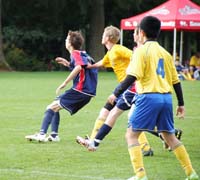
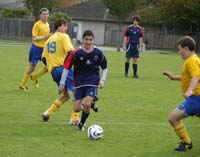
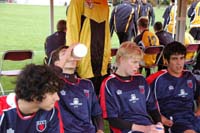 Day two of the tournament brought some fresh legs and hopes for participation in the Gold Division. After our one win, one loss performance on day one, we needed a win against St. John’s Kilmarnock to earn a wild card spot in the top group. They had given the division leader, Crescent, a serious run for their money and were certain to be a strong opposition.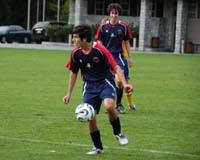
 I firmly believe that we are on the cusp of an incredible paradigm shift in education – the results of which may not be fully appreciated for decades. In the past 20 years I have witnessed incredible changes in the ways that students acquire and retain information. Technology has radically changed the ability to access and communicate ideas. It has probably also changed the way that our brains retain information and may actually impact the way that we think. I recently read an article about McMaster University and their concerns about incoming mathematics students. The university is conducting a study to find out the impact of multi-tasking on a student’s ability to focus on a problem for sufficient time to come up with a solution. At the same time, we are seeing students take far more control over their learning and produce work of an unprecedented quality.
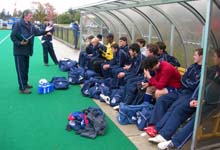 Day One
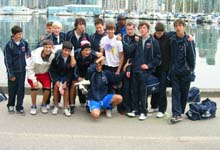 We woke to rain showers and dressed for the worst. By the time we got the the lobby it had subsided. Our first game, played on field turf at the impressive UBC sports complex versus Hillfield-Strathallan College, went very well. Approaching the game with a new alignment, we were able to make some space for our captain, Ryan Lehman, and he distributed the ball well; striker Francesco Capretti netting two goals and narrowly missing his hat trick. The final score was 4-1.
 This week in Vancouver, British Columbia, the Canadian Association of Independent Schools (CAIS) National Senior Boys Soccer Tournament takes place, hosted by St. Georges School. This is a premiere sports event for Canadian independent schools, having taken place for almost 30 years. Twenty teams from Canada’s east to west coast will be in Vancouver, host of the coming Winter Olympics, for the event.