Students Compete to Support Local Charities

YPI2011_Winners_WebLast night, six groups of grade 10 LCC students made presentations on behalf of six grass roots charitable organizations in Montreal. Their purpose was to convince a panel of four judges that their chosen charity was deserving of a $5,000 donation provided by the Toskan Foundation through an active learning project called the Youth and Philanthropy Initiative. Students in grade 10 had been working since the starting week of school, learning about the need for charitable organizations, the role of philanthropy in our society and doing actual volunteer work at various charities. They then researched each organization to find out about their mission and history, impact on the communities that they serve, and the nature of the volunteer experience. Working in small groups, the students then put together intricate presentations with the sole purpose of convincing the judges that their respective organizations were deserving of the donation. The presentations took place in the Chamandy Auditorium.

Once again I was amazed at the abilities of the students and the good work that takes place all around Montreal. The students used their oral presentation skills to convey the passion that they felt for their chosen charities. They also seamlessly wove the use of technology, including still images, music and stirring videos to make their respective cases. All six groups were amazing, but the judges had to choose some winners.

Due to a generous donation from members of the Class of ‘85, the usual $5,000 donation from the Toskan Foundation was to be doubled. For the first time we would now be able to give $3,000 to the second place charity and an additional $2,000 to the third place finisher. It is really hard to talk about “winners” because all of the groups did an exceptional job. One day we hope to be able to give donations to any group that makes it to the finals.

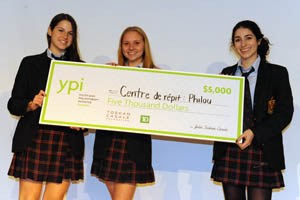
Congratulations to all of the students, and a special nod goes out to Centre Philou, which took away the $5,000 donation from the Toskan Foundation, Generations which will receive $3,000 and Share the Warmth which will receive the $2,000 donation, both of which come courtesy of the Class of ‘85. –Patrick Peotto, Assistant Head – Advancement

    This Year’s YPI Finalists:

Taylor Hodhod, Yvonne Hercun & Gabby Rappaport (Centre Philou)
Alix Faraggi & Alex Sinor (Generations Foundation)
Alexa Weiser, Helene Osterman & Valerie Rivest (Share the Warmth)
Christie Heseltine, Chelsea Voronoff & Chloe Stroll (Welcome Hall Mission)
Emily Tiberi, Olivia Auclair & Alexandra Masella (The Friendship Circle)
Julian Miller, Max Rabinovitch & Greg Wainberg (NDG Food Depot)

The World At Lunch

worldlunch_3One of my most powerful memories from my grade seven year at LCC was an event planned by Grad Pride called, “The World at Lunch.” We had been told that instead of having our 5th and 6th period classes we would be going to the Velan Gym for a special event. Upon entering the gym, my hand was marked with a red dot and I was told to sit down at a table at the back of the room. A few other students from different grade levels soon accompanied me—around 12 students. Roughly four or five times as many students were marked with blue dots and told to sit at separate tables along the sides of the gym. The majority of the students sat on the floor in the middle of the gym. The sounds of periodic snapping could be heard, approximately every three seconds. Among the crowd could be heard a distinct sense of confusion and wonder to the meaning of such an odd procedure. We were soon told that the select students sitting at my table, represented first world countries and that we would be served a three-course meal. The blue tables represented second world countries and they would be eating pizza. As for the rest of the students, they inevitable represented the majority of the human population; the third world countries, and they would be served rice and dyed water. It was only later that we discovered that the periodic snapping that rang in our ears was the representation of a single child dying due to lack of food, resources, care and money.

It was only a fluke that I had been chosen to sit at the first world countries’ table. I couldn’t fathom the reasoning behind it. Why me? Why had I been chosen? Why was it fair that I lived a life of surplus in Canada and not others? Listening to the guest speakers, hearing devastating facts, and being tormented by that ever-lingering series of snaps, a single question rang in my mind: what could I do to help? The money that would be gathered from the upcoming free dress would be designated to helping children living in poverty. Even knowing that the school was making an effort to help such a great cause, I somehow felt personally connected, I felt like I wanted to do more than donate the mere $2 and move on. For that free dress I had gathered over $100 to donate to the organization. It seemed as if I was not the only person who was touched by this assembly and many students decided to bring more than the required minimum. Perhaps it was a sense of guilt that compelled us to bring more. However, I would like to think that a sense of widespread community was felt that day.

The Grad Pride of grade 11 chose to hold a “World At Lunch” this year that took place on Friday, March 25, 2011. We felt that it was our responsibility, being the last year that would have experienced the initial “World At Lunch,” to share with the rest of the school the event that, for many of us, allowed us to truly feel a sense of global identity and responsibility. One of the major values that LCC tries to pass onto its students is the sense that, due their luck in having been born in such a great country, it is their responsibility not to turn their back on the majority of the people in the world that find it hard to live day-by-day with the money and food that they have. It is our responsibility as a prosperous community, to look out into a world where people struggle to get by and realize that we have the potential to, in some way, improve their standard of living. It would be unrealistic to think that this single event would drastically have any major impact on child poverty or human rights, however the point of this event isn’t to make a single change. The reason behind the event is to allow students to begin wondering about their role to play in a world that they are just beginning to discover.—Noah Schouela ’11

Community Service Reflection in Lima, Peru – Duke of Edinburgh Gold Trip 2011

Blog_Peru2011_StairsEver since I was first introduced to the concept of community service in grade 7, I have attempted to draw a closer connection to why students were asked to allocate 15 hours minimum every year to help their community. With so many community service opportunities available to students, as well as such a busy extra-curricular life, it seemed to me that students often felt unattached to the reasons behind their efforts. When I was told that as part of my Duke of Edinburgh Gold trip I would have to complete four days of grueling community service in a small community named Las Palmas, I had no way of predicting that this experience would mark me and radically force me to rethink my preconceived notion of what it meant to help another.

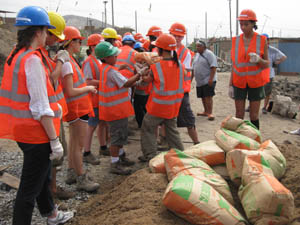
The day after our arrival in Peru, we met students from Markham College, in Lima, who had volunteered their time to help us perform our community service, building a set of stairs upon a steep hill, which would allow the members of said community to reach their houses and get around with ease. It all seemed like a valiant effort on our parts. The arrival of the Canadians would improve the lives of the people in need. Little did we know that the next fours days would probably have a larger effect on our lives than of those people in Las Palmas. Upon our arrival at the work sight, we debriefed, talked about the needs of the community and what we expected to gain from our experience and, very soon after, we commenced what I’m sure was the most grueling work any of us had ever undertaken.

Our stay in Las Palmas challenged us to reconsider our reasoning behind why we chose to take part in this project. Working alongside the locals who took pride in the work that we were to accomplish in the next few days, we gathered sand and stone, carried enormous bags of cement up steep, sandy hills, made concrete and poured it into molds that we had previously created for the stair, prepared the platform for the stairs, etc. I can honestly say that this was the most demanding work that we had ever undertaken and although many of us questioned why we had accepted to perform such exhausting work, there was a single moment that for many of us, made it all worthwhile. After the first series of steps were built and dried, the students from the nearby school, all under the age of 10 years, joined us to relish in our accomplishments. Amazed by our work they began to run up and down the stairs with a look of sheer joy plastered on their faces.

I am sure that all of the students lucky enough to go on this trip will never forget their experience and how much they were affected by the chance to help a community in need. The work was not pretty nor was it prestigious, but never have I taken part in something so gratifying. It was so evident to us how much the community had appreciated our work and although our time was limited, how much our relationships with the people we encountered will sculpt our upcoming years.

Looking upon those steps on the last days, I could not help but feel a sense of pride, not only in our work, but in our attempt to learn about a new culture, to unquestioningly be prepared to undertake any of the work that needed to be completed, but most importantly, I was proud in our readiness to leave all comfort zones aside in the effort to create something so much bigger that a few flights of stairs in a small community in Peru. –Noah Schouela ’11

Service Learning

ndgfeeddepotIt was a great opportunity to spend some time with students last week at the NDG Food Depot. It is a short distance from LCC in the heart of NDG. We have worked in partnership with the food bank for several years, raising funds and sending student volunteers. This past December our senior students impressively brought food here for the food bank in large quantities: more than 100 large boxes, compared to only 35 only two years ago. This is an impressive outreach for families in need prior to the onset of winter.

In the past couple of years demand at the food depot has increased. So who are the individuals and families in need? Along with a group of Middle School students from the Round Square Conference we hosted, I learned that we are often misguided by our assumptions/biases about those who are in need. The homeless who sometimes beg on our street corners are not the primary customers of our local food bank. The regular clientele is actually somewhat surprising. There are a host of categories: recent immigrants who are having a tough time adapting to Quebec culture and language requirements, refugees from all over the world who have desperately fled countries that are politically dangerous, the elderly on small incomes, the disabled, unemployed, and the working poor.

In fact, before the students helped to sort and pack food into single baskets, the people at the food bank had our students complete a very effective exercise to learn more about the food bank’s regular clientele. In teams, the students reviewed the small incomes of various categories of clients and were asked to make choices about how they would budget their money if they were to find themselves in the same circumstances. This meant looking at a chart of costs for essentials: apartment rental, food, heating, basic transport and other expenses. The students attempted to budget, and interestingly, not one group was able to get by on the small monthly incomes that reflect the real incomes for many people in our community, but not the visible homeless who struggle on our streets. Most striking perhaps for all of the students was the realization that if you have a full time job at minimum wage in Montreal ($ 9.50/hr.), your total income per month after tax and other deductions is below $1,400/month—which is considered to be below the poverty line. In doing their calculations, students realized that even those working people are trapped in a cycle of poverty where they cannot afford nutritious food—and what we might consider as basics. Phone, Internet, computer, and TV were not part of their budgets as they are unaffordable.

Why are so many people become dependent on handouts twice a month from the NDG Food Depot. They are the old, the lonely, the disabled and minimum income earners with children who cannot get by on what they earn, even though they do their best and have full-time employment

We cannot live in a bubble here at LCC. Within in our local community there are many needs, and we have the energy, disposition and capacity to help assist in many ways. Also, as students there is much to be gained by being exposed to the difficult challenges faced by so many in our city. What can our students learn from the resilience of others? What are the social challenges of hunger, housing shortages, youth disconnected at school? These are the realities you see when you are at the NDG Food Depot or one of the other 40 agencies our students are currently involved with through active service learning. There is much to be gained from this curriculum of life and extending a welcoming hand in service of others. “Non Nobis Solum” —it was the founding ethos of our school. I believe we need to recommit to it today as an essential educational principle to help students develop as aware, capable and involved citizens.

Service learning is surely about opening eyes, and it is perhaps one of the most important pillars of our curriculum at LCC. I hope our extended school community will fully embrace the opportunities that service learning offers. —Chris Shannon, Headmaster

Getting to Know Ourselves Through Others

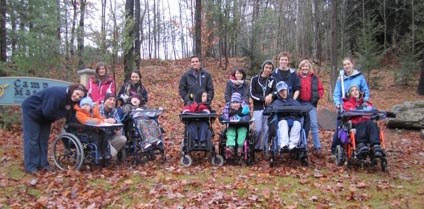
Mackay2010On November 8, 9 and 10, seven students from Lower Canada College were given the privilege of travelling to Camp Massawippi with six severely disabled children from the Mackay Centre. It turned out to be an unforgettable experience for everyone concerned.

We had previously spent two mornings at the Mackay Centre getting to know the children who would be coming with us on the trip. However, as we boarded the bus bright and early on the morning of our departure for the camp, we were excited, but also not too sure of what to expect. One thing we certainly had not expected was that the bus would break down about an hour outside of Montreal! Unfortunately, we found ourselves stranded at Tim Horton’s for an hour as we waited for a replacement bus. One hundred and twenty (120) Timbits and 20 chicken nuggets later, we were once again on the road to Camp Massawippi.

Because the weather did not lend itself to outdoor activities on the first day, we had fun painting pumpkins with the kids, and playing a game of Monsters Inc. After a great spaghetti dinner we had open mic night. By the end of the evening, everyone was feeling much more comfortable in the new surroundings, and we headed off to our bunks for a good night’s sleep.

The next morning we woke up and had breakfast, then went out for a hike in the woods. The rain made it hard to push the wheelchairs up the hills, but it didn’t dampen our spirits. We managed to come back to the camp with a Christmas tree for the classroom back at the Mackay Centre. We had lunch and then started an arts activity, which consisted of painting a mural to be hung up back in the Mackay classroom. We used leaves gathered on the hike to decorate the painting. We had an amazing roast beef dinner, followed by a talent show during which we sang a song that we had composed the night before about each of the Mackay students we were with. Once the song was finished we gathered at the campfire on the shore where we enjoyed smores, chocolate-filled bananas and attempted to sing campfire songs.

On the last morning, we made a huge brunch for everyone. It was comprised of 40 pieces of bacon (which wasn’t enough), 35 eggs and home-fried potatoes. We had a face-painting session and then before we knew it, we had to leave.

This was truly an amazing experience, and one that we will never forget. Each of us learned so much, not only about what it means to have a disability, but about ourselves and the importance of appreciating everything we have.

Noah Schouela ’11
Thalia Nghiem ’11
Isabelle Thibeault ’11
Jennifer Motter ’11
Alix Faraggi ’12
Sam Ergina ’12
Kevin Fraser ’12