Operation Veteran

cdn_war_museumA normal November 11th for LCC students would involve missing an hour of class to take part in a Remembrance Day ceremony in the Memorial Gym. During this time, the younger generations try to imagine what it would be like going off to war, not knowing the outcome or if they would ever return. Fortunately for five LCC students, the outcome of their day exceeded their expectations in every way.

Arriving in Ottawa, teachers and students alike were curious to see what the day had in store. It began with a brief meet and greet with distinguished guests who were taking part in the ceremony at the Tomb of the Unknown Soldier. These students had the privilege of taking part in an initiative started by a generous couple that believes in the importance of teaching younger generations the need for peace. They created an organization that permits veterans to have a fresh hot meal four days of the year at the War Museum in Ottawa, as well as bringing students to Ottawa on November 11th. This year in particular marked a significant event for Operation Veteran; it is the first year where they have received enough donations to supply hot meals to veterans every day of the year.

Following the meet and greet, the group travelled to the Tomb of the Unknown Solder to watch the ceremony. Many students were surprised to see more then 30,000 people ready to remember the fallen of WWI, WWII, the Korean War and the peacekeeping missions in Afghanistan. Throughout the ceremony, Canadians remembered the soldiers who gave up their lives for their freedom. The students were able to see the impact war has on our society, and the amount of people that were affected by the wars. The most memorable part of the ceremony was the poem written by the ten-year-old daughter of a fallen soldier. It surprised me the most because a ten-year-old isn’t supposed to know anything about war or death. As the ceremony was brought to close with the singing of the choir, many of the 30,000 Canadians in attendance put their poppies on the tomb of the Unknown Soldier.

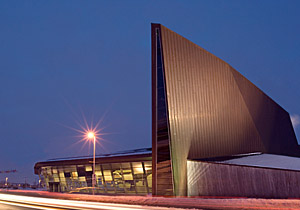
Around noon, we had lunch with two veterans who spoke to us about their time in the war. Although the war seems like a dire subject, these veterans kept their stories light and positive. We were also given the opportunity to see a lecture by an author who has written a book about the Highway of Heroes. As someone who did not know that this was going, I was particularly moved by the idea and of some of the stories she told. Our final activity of the day was a tour of the war museum. The guide gave us some insightful details and information about the architecture of the building and some of its symbolism. In many sections of the building the windows create a sentence in Morse code, for example, Lest We Forget. It was incredible to look at the artifacts from these wars and understand some of the weaponry used during those times. Throughout the museum, many other veterans were there who taught us about their jobs in the war. Being able to talk to many of these veterans was a rare opportunity that we were lucky enough to have.

At the end of the day, the bus ride back to Montreal was quiet. All 40 students had experienced, learned and remembered.

We would like to thank the creators of Operation Veteran who allowed us to go to Ottawa. November 11, 2010, was the first day that I truly understood what it meant to be Canadian. I believe that every student will remember their experience and be forever moved. –Christiane Heseltine ’12
Guinness World Records® Achievement – A Success for LCC!

BeepTest2010_6It started as a department brainstorm to promote Physical Education at LCC, and get students to think of fitness and health outside of classes. in the time that followed, several possibilities were considered, but the “cool” factor of a Guinness World Records® attempt won out. The process began about a year ago with an application to the Guinness Head Office in London.

The ensuing time seemed like forever, as we waited for the Guinness organization to research and consider what until then had never been attempted as a record. In the hope of a timely response, a date was pried into the LCC schedule for the spring of 2010. However, the answer came only after the scheduled date, and we had to push our date with history to the fall.

The response was not without its criteria. The Guinness World Records® people insisted on a number of standards in order to even consider the record. First and foremost, the actual feat was determined. A minimum of 250 individuals had to complete the Bleep (as they call it) test, to Level 5, or 41 bleeps. Secondary to that, there were specific methodologies prescribed for counting, coordinating and running the event, as well as rules for how our record attempt was to be witnessed.

As the event approached, the logistics questions reared their ugly heads. The LCC schedule again had its say, the media was invited (but as of the day before the event, only one group had shown interest), the media lab was mobilized for the sound and video evidence and the maintenance department put down lines at a distance of 20m on our fields. Finally, our teachers and students were given their marching orders for the day. And of course the variable weather of a Montreal autumn was always in the back of our minds.

Answering our logistical concerns were our department heads who supported the initiative without reservation from the start, complete cooperation from the students, faculty, staff, and administration, and finally the expert, gentle shepherding of our competent Physical Education department (with a nod to mother nature for the spectacular fall day we were given.).

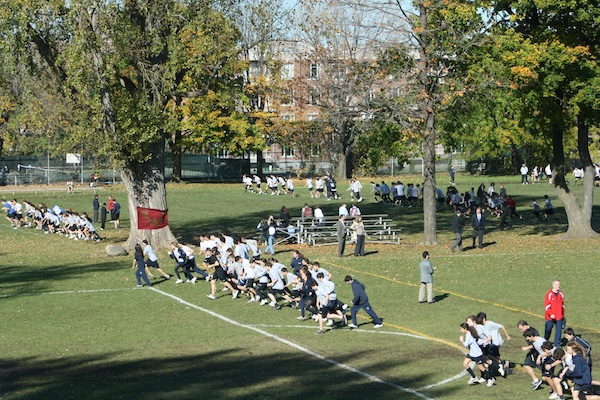
And the day was spectacularly successful. On a cloudless, warm, fall day on our LCC fields 443 people began the test and 324 people completed the Level 5 (41 beeps). We had achieved the feat, and as we collate our evidence to send to the Guinness World Records(R) Organization, we know we achieved the most important thing of all. It was fun to exercise together and exciting to talk about the possibility of being in the Record Book. And if our record is beaten, we could go out again, and still have fun… doing the beep (or “bleep”) test! –Steeve Lee, Physical Education Department Head

The Wonder of Mr. Machai Viravaidya

mechai_bioI recently attended the annual Round Square international conference in Thailand along with six LCC student-delegates. This international association of 80 schools from across the globe continues to focus on key values and IDEALS we promote regularly in our school (Internationalism, Democracy, Environmentalism, Adventure, Leadership, Service). Active learning experiences such as the annual international conference connect students, teachers and administrators and open eyes to major issues and challenges far from home. In addition to a host of excellent keynote speakers, discussion groups and cultural activities, I had the opportunity to participate in two separate service days, including a memorable day connecting with young children and babies at a Thai orphanage run by the Catholic church.

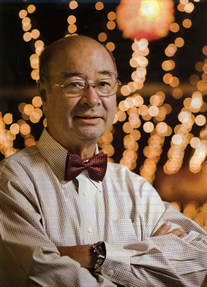
Although there is much to reflect on from this eye-opening experience, I will share my impressions of a single speaker. Mr. Machai Viravaidya is an impressive and humorous Thai man who has led an incredibly accomplished life of service and initiative, mostly dedicated to improving public health at the broadest level in Thailand. Known as Thailand’s “Condom King,” Mr. Viravaidya has spent decades distributing condoms across the country—years before it was being done widely in most countries. This was a big deal in Thailand as it is a very conservative and traditional country. He made the topic of family planning fun, distributing free board games which educated people, giving taxi drivers and police thousands of condoms to distribute to the general public and holding an annual condom blowing championship. He also started a chain of restaurants called “Cabbages and Condoms,” hoping that condoms would some day be as common as cabbages. He joked with student delegates at our conference to remember that condoms aren’t dangerous, they are what he calls useful “weapons of mass protection.”

As the founder of PDA, Thailand’s largest non-profit development association, Machai Viravaidya has played a key role in developing Thailand’s immensely successful family planning initiatives. This has led to one of the fastest reductions in birth rate anywhere in the world—falling from an annual increase of over 3% in the mid 1970’s to merely half of one percent today. During that time the average number of births per woman in Thailand fell from seven babies to less than two.

Mr. Viravaidya has also been instrumental in building Thailand’s comprehensive national HIV/AIDS prevention policies, radically reducing new HIV infections. In 2005 the World Bank estimates that these prevention measures helped save nearly 8 million lives and saved the Thai government over $18 billion in treatment costs alone. Amazing achievements resulting from one man’s vision and determination!
For his service toward improving Thailand’s public health, Mr Viravaidya has received many major awards, including the United Nations Gold Peace Medal and was acclaimed by Time Magazine as one of “Asia’s modern heroes.” Most recently he was recipient of the Bill & Melinda Gates Global Health Award and a prize called the Skoll Award for Social Entrepreneurship, with each prize having a value of $ 1 million—significant funds that he immediately put back to work fighting public health issues in Thailand.

Despite this success in family planning and fighting the spread of HIV, Mr. Viravaidya has not taken time to rest. Now he has turned to education, poverty reduction, and the promotion of creative solutions to complex problems in his country. He sees education as the key to success and has started a school called the “Mechai Pattana Bamboo School” which boasts the world’s largest geodesic bamboo dome (30 meters across), a climate change centre, a design and innovation centre, a democracy education centre, and what he calls a “Barefoot MBA and Philanthropy Academy” dedicated to teaching young Thai villagers how to make money and how to give it away. The students designed their own uniform, they sit on hiring committees for the selection of teachers, and there are no textbooks, just the Internet.

It was impressive to meet Mr. Machai Viravaidya personally and hear him speak. He is a global leader, an innovator and someone whose life motto could very well be “Non Nobis Solum.” His final message to his audience in Thailand was simple yet profound….. “If the educated and the wealthy don’t help with the world’s many problems, then who’s going to help? Go out and do something decent.” That’s a mantra we all should follow.

Check out his organization’s web site at: www.mechaifoundation.org –Chris Shannon, Headmaster

How to Combat Reading Lags

ReadingAccording to reading specialist Paul Kropp (Canadian author of How to Make Your Child a Reader for Life), children tend to experience reading lags as they begin elementary school, again around grade 4 and, finally, when they enter high school. Although the reasons for these lags are not absolute, several variables are at play.

When children undergo significant transitions, e.g., parent-child separation upon school entrance or moving to a new school, daily routines like reading at bedtime may become disrupted. In the case of boys, peer influences may supersede activities like reading. Around ages eight to ten, boys begin to view reading as “uncool” and prefer to engage in physical and tactile activities, like sports and video games. In early adolescence, when boys and girls are going through puberty, their interests turn to one another and away from books.

Parents often ask me what they can do to combat these reading lags. Rest assured, children who live in literate households where the printed word is valued will pass through these reading lulls and return to their love of books with very little prompting from their parents. If your child falls into this category, I would recommend patience, some gentle prodding, like recommending books, and continuing to practice the literate approach you have already cultivated. Trust me, they will come around in mid- to late-adolescence. Forcing the issue too much may backfire, as teenagers are more likely to do the polar opposite of what their parents suggest. As a father of four and a teacher of many over the years, I can also advise you against reverse psychology. Our children are far too smart to be taken in by our legerdemain.

The following concrete suggestions should help you combat the dreaded reading lag.

1. The first step is to create a home atmosphere where books, magazines and newspapers are the norm, not the exception. Even though all newspapers are available online, subscribe to a daily paper. The newspaper is often the only print our children see us reading for pleasure during the day. Eventually, they will become curious enough to read the paper themselves. Doing the daily puzzles and reading the cartoons, especially with your children, are also fun ways to interact with the paper. The Gazette offers a weekly page for young students that includes word games and puzzles. In addition, subscribe to magazines for yourself and your children. Just as you may be fascinated by current events and read The Economist, your child may be passionate about sports and read Sports Illustrated (there is even a Sports Illustrated for Kids).

2. Engaging in literate activities outside the home is also extremely important. The cheapest and easiest way to do this is to take advantage of your local library. Going to the library with your child on a regular basis is a great way to cultivate the love of reading, not to mention a very pleasant parent-child experience. Libraries also offer cultural activities, reading clubs and competitions that may stimulate your child. Although they may be more expensive, occasional trips to a bookstore are imperative. Letting your children purchase their own books indicates that you value books and respect their interests. As teenagers often do not want to be seen with their parents, you may want to just make sure their library card is current and give them gift certificates to Chapters on an annual basis, for example.

3. Although this may seem odd to you, continuing to read with and to your children throughout adolescence is a positive way to combat the reading lag. Share the books you are reading, but do not foist them on your unwilling children. When you are commuting or going on family road trips, listen to audio books. Talk about books, current events and popular culture at the family dinner table. Show your children that you are interested in their passions. Above all, be an active reader yourself and leave plenty of reading material lying around the house.

Knowing and cultivating your children’s interests will reap life-long benefits. Supplementing their passions through reading, whether it be books about the sports they play or their favourite singer or actor, is an excellent way to show them you care about what they care about and to get to know your children on a deeper level. If you sense a reading lag, do not despair or overreact, simply follow the guidelines I have outlined above. However, whatever you do, do not tell them I said so. Remember, they are intelligent beings who sense overt attempts to improve them. Nonchalant subterfuge is often the best approach. —Brian Moore (Senior Department Head, English Language Arts, Communications Studies and Literacy Programs)

A Balancing Act for the Environment

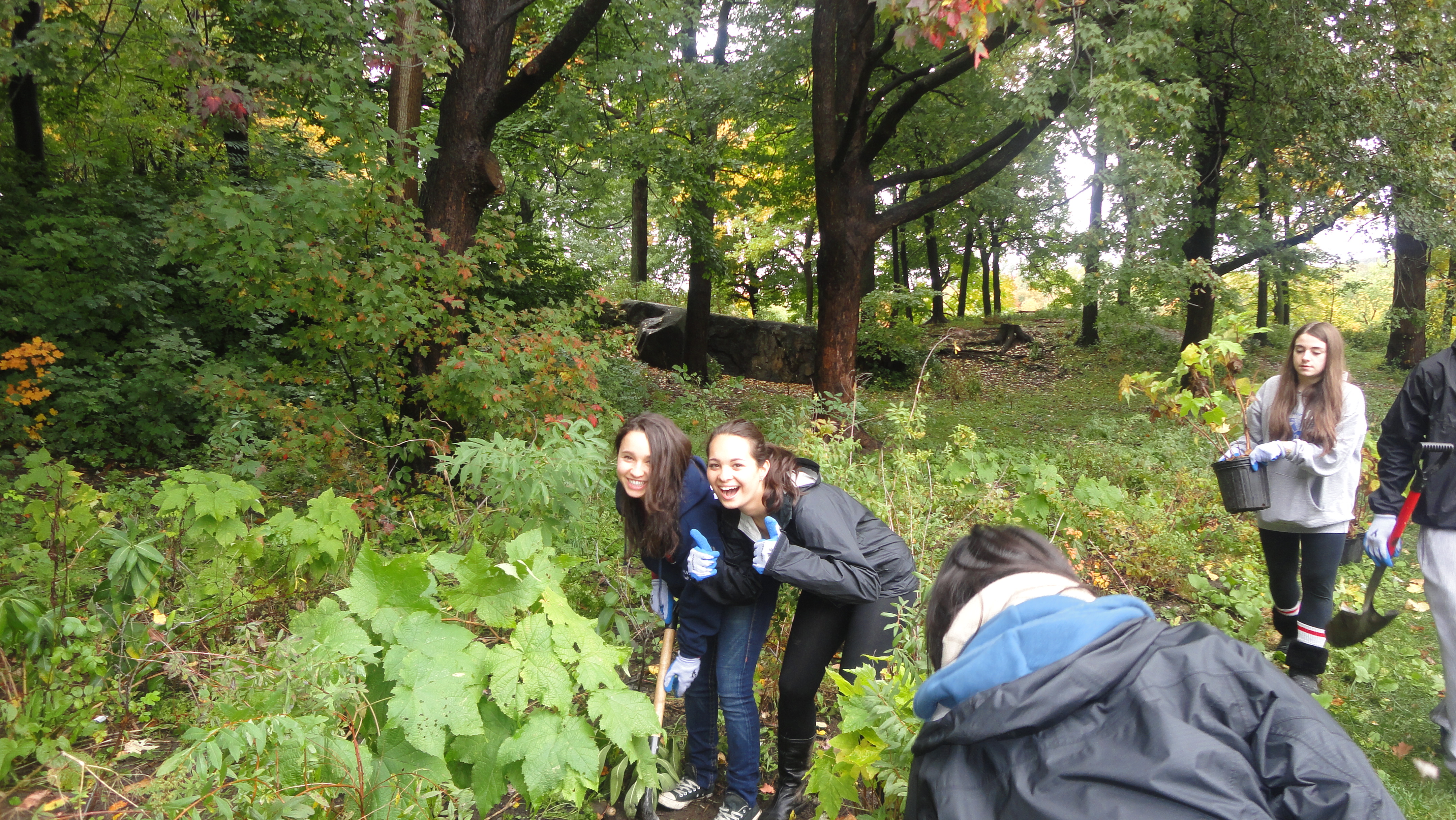
SpeakforthetreesOn October 1, a handful of Green Team students and I had a wonderful day helping the environment. How did we help the environment? We spent the day at Mount Royal at a “Speak for the Trees” workshop.

The day started with an introduction to two grassroots organizations Roots and Shoots and Evergreen. Then we were engaged in activities that focused on eco-systems. We learned that when one species or habitat of the eco-systems dies or is harmed it affects all members and leads to unforeseen complications. We then got together in our school groups and brainstormed ideas of the kind of changes we wanted to make throughout the school that would benefit the LCC community and make us more eco-friendly. One of our ideas was to help create a student lounge that would serve local and fair-trade produce, house a recycling/composting centre and have posters that would encourage “Green” thinking. All schools got a chance to present their ideas. After lunch we got down to business. We had two outdoor activities that connected with the balancing of the eco-system. We helped to get rid of the invasive buckthorn plant, and we planted wild raspberries with the aim to introduce native species to the mountain. –Claire Greenbaum ’13