

QUI SONT NOS ENFANTS DANS LE CYBERESPACE?

digitalfootprintsCeux qui ont assisté à la séance de formation offerte aux parents sur l’utilisation des technologies le mois dernier se joindront certes à moi pour souligner les mérites de son contenu ou du moins la pertinence du sujet.

Je suis de la génération de ceux qui ont vu apparaître les multiples innovations technologiques, les ont intégrées comme outils de travail et continuent à découvrir leurs innombrables utilisations et avancements. Je me réjouis de constater que mes enfants ont pour leur part le bénéfice d’intégrer ce monde digital à leur apprentissage académique, opportunité dont je n’ai moi-même pu bénéficier étant de la génération X, je vous le rappelle! À ce titre, je m’en remets d’emblée à l’expertise et le travail assidu de tous nos éducateurs exceptionnels à LCC.

Toutefois, en ce qui concerne nos enfants le ”caveat” est important; ces technologies constituent également leur outil d’apprentissage social dont la responsabilité ultime nous revient en tant que parents. Il est donc essentiel de bien pouvoir en identifier les enjeux. À cet égard, les points les plus marquants nous ont été présentés sous cinq appelletions principales:

1-“digital print” (réaliser que ce qui est affiché dans le cyberespace laisse des traces);
2-“searchability” (comprendre que chacun est l’artisan de ce qui devient associé à son nom);
3-“replicability” (considérer que ce que nous écrivons peut être réutilisé de façon non conforme à notre intention);
4-“invisible and endless audience” (être concient de la multitude d’interlocuteurs inconnus); et
5-“confidentiality” (connaître les dangers d’utilisation de nos comptes par d’autres).

Le second défi relève de notre capacité d’en transmettre efficacement la sagesse à nos enfants. S’il peut s’avérer opportun d’imposer certaines interdictions, il demeure que l’efficacité de notre intervention sera davantage assurée par une solide éducation des valeurs sous-jacentes. Néanmoins, dans le contexte du cyberespace, des consignes supplémentaires s’imposent et peuvent sans doute être inspirées des quelques astuces simples mais remarquablement ingénieuses qui nous ont été proposées:

1-La “Mom rule”: dans l’évaluation du caractère approprié d’une communication, supposer que notre mère en prendra connaissance. Ma version personnelle enseignée à mes enfants inclut aussi la présomption que leur “headmaster” en recevra une copie, ce qui dans ma perspective commande un plus haut niveau de retenue, non!
2-La “News rule”: cette règle, qui a également pour but d’agir comme censure demande qu’on réponde affirmativement à la question de savoir si le contenu de la communication pourrait sans problème se retrouver en éditorial du lendemain; et
3-La règle d’or: ne jamais dévoiler à quiconque et protéger la confidentialité de ses mots de passe et autres numéros d’identification personnels.

Je ne prétends pas rendre justice à l’étendue de cet exposé qui nous a été présenté et vous invite donc à en prendre connaissance en cliquant sur le lien qui suit: DigitalFootprintJ6
–Anne-Marie Boucher
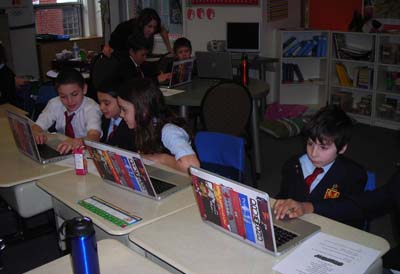
Grade 5s Teach Grade 1s Lesson in Canadian Geography

Gr1_5_LessonOn Monday, February 1, the students of 5A had the pleasure of greeting younger LCC students from grade 1. We felt very grown up and were eager to introduce the program of Google Earth to the younger students to show them our beautiful country.

We looked at British Columbia to show them the sites of the 2010 winter Olympics. Some of the places we visited were: BC Place which is where they are holding the opening and closing ceremonies, the Olympic Oval for speed skating, Whistler for skiing, and many more! Then we also looked at, Iqaluit, since the grade 1 students are working on a project involving the Arctic.

The grade 1 class was very enthusiastic and enjoyed answering our many questions about the places we visited with them. They are all very cute and very bright and it was fun to spend time with them today! –Julia Garfinkle ’16

Staying in Touch with Your Grade 3 Self

playThe more that I have direct contact with our Junior School students, the more I appreciate the imaginations of younger children. There is currently a group of boys in grade 3 who visit with me regularly in my office and have taken to making and presenting me with little gifts made in art class or during their free time. In December it was an imaginary gold brick to help pay for a new building at LCC—a Learning Commons where the old arena stands (it was actually cardboard and foil paper with gold marker in a shoe box). Last week the delegation of boys arrived asking if I often get bored. Just in case I did, they had made me a toy video game, made out of plasticine and cardboard.

What a great reminder to stay playful, find balance, and amid our to-do lists—homework and other responsibilities—find a way to be playful and see the wonder in this world…because it is all around us…..but we sometimes forget when we become too busy. In short, don’t lose your “Grade 3 attitude.” It’s actually an attribute that will serve you in important ways your whole life.

So, what is play? Researchers at the University of New Mexico Family Development program define it as the following: “Play is the way that people of all ages and cultures, discover, create and communicate……Play is the essence of life and learning.” Regardless of the definition, research has shown us how important play is for children’s development—and remains at the root of joy also in both adolescents and adults. Creativity, relaxing, self-expression, having fun, and reducing stress are timeless qualities that need to be exercised throughout life.

Researchers affirm, it’s important to your stress level and your happiness quotient that you have at least one activity that you do regularly just for fun. Hobbies and other fun activities provide an enjoyable way to sharpen skills, express your creativity, or just blow off steam. Also, when you get really engrossed in an activity you enjoy, you can experience a state of being known to psychologists as “flow;” a kind of transcendence which has significant benefits for your for your body, mind and soul.

In a recent lecture, psychiatrist Dr. Stuart Brown, president of America’s “National Institute of Play” in California, emphasized the vital importance of play. Brown opened his talk by showing an incredible series of photographs demonstrating that a huge hungry polar bear can be convinced to play with dogs rather than eating them. Like the polar bear, play also induces an “altered state” in humans. Play is a great leveler: great differences in power can be overridden by play. In fact, the absence of play is dangerous, as demonstrated by the case histories of mass murderers.

However…the study of play is still in its infancy. Historically, this has not been a well-funded area of scientific investigation. Nonetheless, the evidence we already have suggests that play is important for young people to mature cognitively, emotionally and developmentally. We already know from recent brain studies hat “nothing lights up the brain like play.” In fact, the ability to trust is learned through vocal, facial and physical gestures while playing. As the psychologist Dr. Brown indicates, humans are perhaps the species with the most special need to engage in play, whether infants, teenagers or adults.

In fact, life without play seems to lead to depression. When we look at our own personal histories to determine what sorts of activities energized us most when we were very young, we might see that we have strayed from those things that gave us the pleasure of play.
Dr. Brown actually encourages us not to focus on setting aside more time to play. Rather, he advises we should infuse every moment of our lives with play. He argues that play is just as important for humans as sound sleep is for dreaming.

So continue to work hard ….lighten up, play a little, enjoy spirit week—and make sure to include play every day thereafter. We all deserve it! — Headmaster Chris Shannon

La nourriture à Jouvence

ClasseNeige2010C’est maintenant notre deuxième journée à Jouvence, et on désire répondre à une question que tous nos parents se posent : est-ce que nos enfants mangent bien?

La réponse est : Oui, c’est correct, on mange et c’est bon!
Comme tous ceux qui me connaissent bien, je suis un critique très particulier quand on parle de nourriture. Cette fois, je serai gentil pour une bonne raison; la nourriture à Jouvence a la qualité de celle d’un restaurant quatre étoiles! Je vais surement avoir beaucoup plaisir lorsque j’interviewerai le chef pour mon projet de français! Maintenant c’est presque le temps du souper, alors je dois partir. Merci de lire mon article! –Maxim M. ’15

Extraordinary Exchange with Kenya’s Brookhouse

BrookhouseAs I walked out of the Nairobi airport, I expected Brookhouse School to be waiting with a great welcome. Although there was a slight confusion and no one had showed up, the kind and friendly people of Kenya made me feel extremely comfortable.

I have now spent two weeks at Brookhouse attending school and it has been … “AMAZING.” All the students have accepted me as their own, not only in my year, but in all years. I am constantly greeted and asked about my stay on the way to class. This has made the transition much easier for me, not to mention the sports. I have been participating daily in sports such as rugby, basketball, field hockey, and soccer.

I’m currently at my host’s house for the weekend. After only one day of exploring I have so many stories to recount. Just today, (Jan. 30) I was chased by a camel and a guard dog, rode a horse, and was licked by a giraffe! I have also signed up for a 60 km hike, a trip to Mombasa, and to bike Mt. Kenya. I’m very excited!

But, the changes I have experienced here are not what I expected and it’s very hard to explain. Everyone around me is black, yet I do not feel out of place. I think since the people here cannot trust their own government; they cannot trust their own people…

So far, my time here has been extraordinary. I am looking forward to participating in every opportunity and adventure that presents itself. — Jesse Mikelberg ’11