Le blog du MS Pride: Candy Grams Support Madagascar in My Heart

Blog_MSPride_CandyGramsAs the Activities Heads for Middle School Pride this year, Alyssa Obrand ’16 and Julia Garfinkle ’16 have been quite successful with the activities held so far. In total, $275 was raised after the Halloween candy raffle, the knockout tournament, the Halloween costume contest and the Halloween episode of “Modern Family” that was shown at lunch recess.
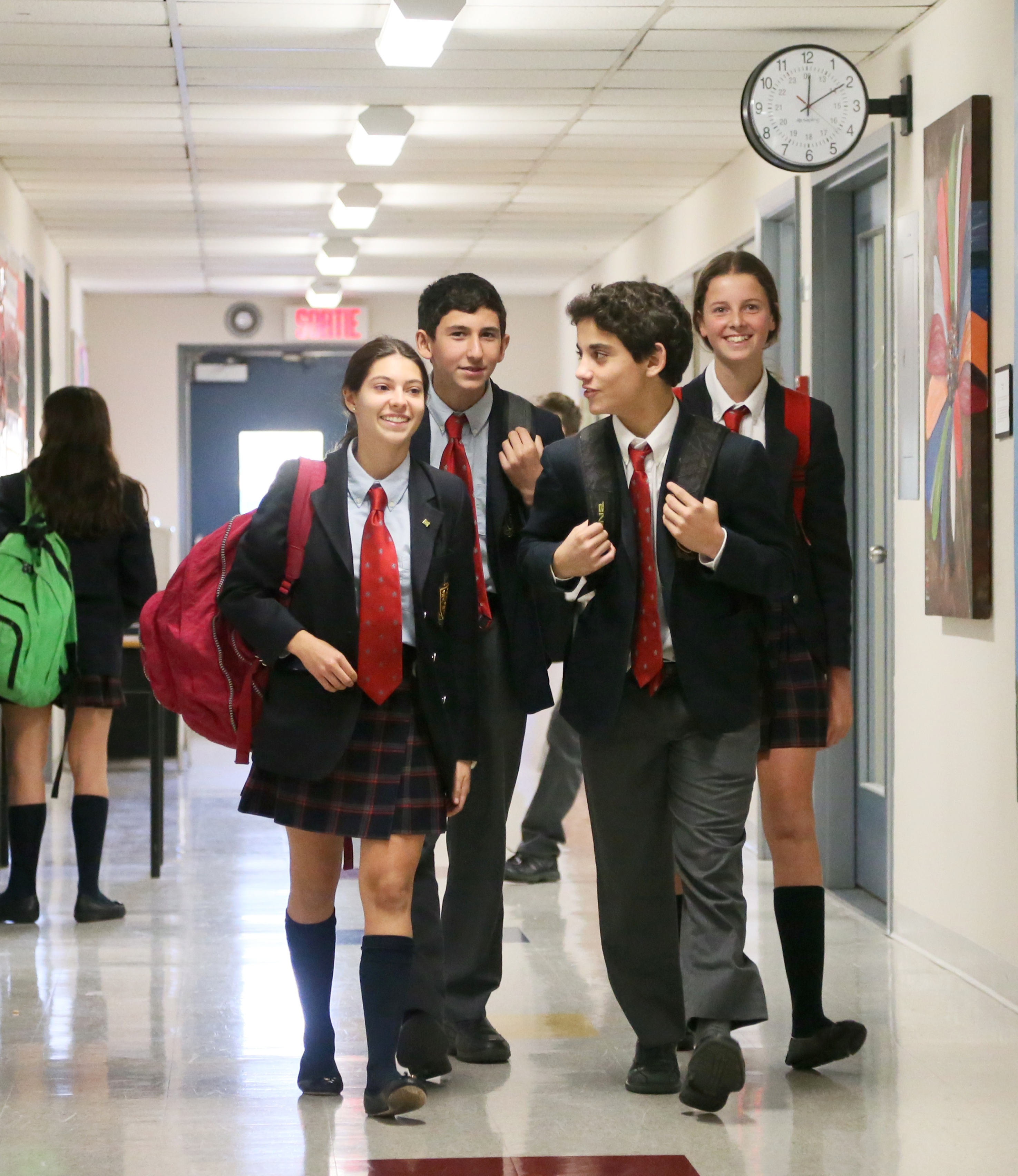

In the spirit of Valentine’s Day, an activity called “Candy Grams” is being held this week. Candy grams are notes that are bought by Middle School students for the purpose of writing a message to another student of their choice in grades 7 and 8. The notes can be anonymous (or not). They cost $1 each and attached to the note is a piece of chocolate! All money raised will be sent to the foundation Madagascar in My Heart, along with the money collected from previous activities, to bring educational opportunities to underprivileged children of Madagascar and help brighten their future.

À ce jour, notre expérience de leadership a été magnifique. C’est un excellent apprentissage. Nous sommes très fières des efforts investis pour faire les activités et de l’argent collecté pour cette fondation. Nous croyons que nous faisons un bon travail tout en maintenant l’intérêt des étudiants et en créant des activités amusantes et originales. C’est un privilège d’avoir la chance d’améliorer les expériences des étudiants du Middle School.

Nous espérons planifier les activités suivantes: vente de biscuits, plusieurs activités dans le gymnase, projection de nombreux films et plein d’autres encore!

If you have any questions, comments or suggestions of activities you would like us to plan in the near future, please do not hesitate to contact either one of us by sending us an email at [email protected] or [email protected]!

Merci! Thank you! We look forward to hearing any thoughts or ideas on how to make your Middle School experience more fun and enjoyable!

Thinking About Gender

Blog_Gender_05Feb2013Over the past several years I have been struck by how few young women – or young men for that matter –feel true affinity to the “F” word.  I am not thinking about our teens’ tendency to use foul language. Rather, I’m thinking about a term that seems to have become almost dead, but certainly outdated amongst the young: the word “feminist.”  In the past several years in the classroom and at student leadership conferences, young women 14–18 years old have been frank with me on this topic.  They’re not feminists; they contend that’s just for radicals.  Today’s teens see gender equity as a given, as part of the new normal their mothers and grandmothers fought for on their behalf.

I bring this up because this past week marked the 50th anniversary of a pivotal book in the feminist movement.  The Feminine Mystique was written in 1963 by American, Betty Friedan. It was a lightning rod for frustrated wives and mothers and was an inspiration to a whole generation of feminists who were proud to wear that label. The 50th anniversary has sparked interesting articles in the mainstream media and much discussion.

Reading and listening to some of this discussion in recent days made me think about LCC students today.  Only 20 years ago our school was available only to boys, and in my view, becoming coed in the mid 1990s was a brilliant decision.  I speak to alumni and community groups all the time and remind them that many independent schools in Montreal remain single sex.  I believe adopting a coed learning environment simply helped to make LCC a more progressive and improved school.  Although our students probably rarely think about it, a coed environment is a powerful learning platform. It’s a key part of their daily curriculum –the sharing of ideas, perspectives – the capacity for girls and boys to collaborate, debate, agree, disagree and learn together shoulder to shoulder.  It’s a real world experience, part of what I refer to with alumni and parents as the “coed advantage.”

Let me back up for a moment and present you with the Webster dictionary’s definition of the word “feminist.” It is defined as “the theory of political, economic and social equality of the sexes – with a focus on organized activity on behalf of women’s rights and interests.”

From a historical point of view, some of us could name a couple of so-called “first wave” of Canadian feminists like Nelly McClung and Emily Murphy who around 1915 worked at gaining women the right to vote and hold public office.

American women such as Betty Friedan and Gloria Steinham were part of the so-called “second wave” of feminists who concentrated on women’s reproductive rights and parity in the workplace in the 1960’s and beyond. And here we are today where teenagers regardless of gender generally believe that gender equity has been achieved. No need for feminists. Perhaps that’s a good thing.

However, I thought I would check some facts. Is gender equity really such a slam-dunk?  Is gender equity actually a practical reality across modern Canada? I consulted recent Statistics Canada & Status of Women Canada documents and discovered some interesting data:

Education & Employment:

  • Women at post-secondary institutions in Canada are dominating. They represent 56% of all registered students and represent almost 60% of graduates
  • Among all Canadian 25-34 year olds, 26% of men hold a Bachelors degree or higher, while 34% of women hold a Bachelor degree or higher (a notable 8% difference). But note only 15% of women held degrees in 1990.  This has more than doubled in 22 years.
  • In the workplace, about 9 million women are employed – more than double the number in 1976. Two-thirds are still in traditional female occupation: nursing, teaching, health, clerical, sales or services.
  • 73% of women with children are employed vs. only 39% in 1976 – a huge societal shift.
  • But despite these notable changes, women still only earn 83% of every dollar earned by a man, but that’s been on the rise for the past 20 years when it was only 75 cents.

One of the ongoing challenges for men and women in a world where there is more equity and opportunity in the workforce is the status of the family.  Clearly, the balancing act of work and family is challenging for all. Census and research data show some interesting trends here as well:

  • Women are having fewer children in Canada and later in life.  In the 1960’s the average woman had her first child at 23, now it’s at 30 years old.  That same woman was likely to have four children, now it’s less than two on average.
  • There are now more single parents than ever, but four times as many are households headed by women than men: 1.1 million vs. 280-thousand men in 2010.
  • In addition to full-time work, women still seem to take on the greatest burden of rearing children: more than twice as many hours a week (51) than men (24). The same trend applies to housework and caring for aging parents. Women still account for twice as much effort in those domains, despite working full time.

Another category that warrants mention is the dark reality of family violence and spousal abuse. It’s a fact of life that needs our attention. Yes, it is a gender issue as in almost 100 % of the cases, women are victims.  Unfortunately, the number of women’s shelters in Canada has grown since 2000 (now 600).  On any given day, they house about 5,000 women, with one-third (1/3) as repeat visitors. This sad state of affairs is everyone’s problem.

A week ago a new premier was named in Ontario, making 6 of our 10 provincial leaders women, including the Premier of Québec, Pauline Marois.  This is an interesting trend given that only 25 % of all members of our federal parliament are women, ranking us as 16th in the world.

So what does this all mean?  In short, gender issues are complicated. I certainly believe that we have moved toward greater gender equity in recent years.  However, the topic of gender roles is messy and rarely obvious.

I’m a feminist. But maybe today that’s an odd generational statement by a man or woman.  I don’t think teenagers need to label themselves as feminists.  However, our students have the benefit of being in a coed school preparing for the realities of life in a coed world.  I think they owe themselves the opportunity to investigate and discuss some of the topics and issues I’ve outlined here.  They’re important and sometimes difficult. Ultimately, I hope that where it matters most, LCC students and LCC grads will do what it takes to defend gender equity and social justice where it matters most.  —Chris Shannon, Headmaster

South Africa Exchange: Experiences & Perspectives

I made the U-15 St Stithians’ basketball team, which means that I can spend my afternoons playing basketball in the sun. There are really worse ways to spend one’s afternoons.

On Saturday, January 26, I play my first basketball game for St Stithians, against St. Peters. Saints win. Later on that day, Dirk, Rickus, Jessica, and I go camping and 4x4ing. It is amazing!  We set up camp in a gorgeous site, and then, South African-style, I am handed a pellet gun, a .22, a shotgun, and a 234 hunting gun. We shoot cans, targets, and clay pigeons, known to us as clay disks. The Canadian in me cannot help but think of NRA debates. I am forced to reflect on the dangers of giving a gun to any boy. It is heady stuff, and I shamefully admit that it is regretfully easy to forget all my previous reservations about holding real guns when I hit my first clay pigeon with my first shot.  If, as I suspect, my career in basketball is cut short, I’m going to the Olympics for shooting discs.

Later that night, we make a campfire and barbecue for supper. It is so cool. I cannot believe I’m on this exchange. The next day, we go to the stream and swim.

And then tomorrow back to school. –David Elbaz ’15

South Africa & Boarding: Feels Like Home

Flag_of_South_Africa.svgHello again from beautiful South Africa. I say “beautiful” because it is astoundingly beautiful. I cannot get used to the beauty of the place. It makes me stop in my tracks  and a dozen times a day, I have the urge to take out my- especially-bought-for-this-trip-camera. I don’t of course, partly because I’m lazy like that, and partly because I know that there is no way I can hope to reproduce in a picture what I see.

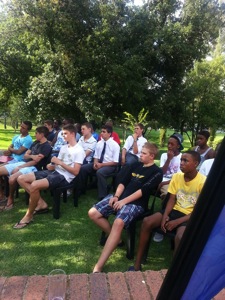
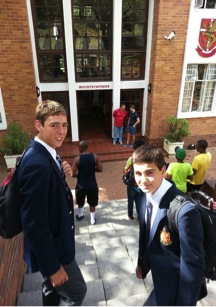
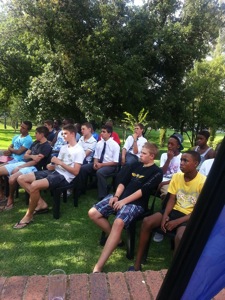
So I’m off to public school. Rickus and I have attended the welcoming tea for students and parents. We are the only two in uniform, and I hope that this is not a sign. People at the school are, extremely welcoming. We sit outside, and it looks more like botanical gardens than a school. I think I’m going to like it here.

I ‘m not going to lie. I’m a little nervous. Benjamin, exercising his right as older brother to torture me, has insisted that I watch, before my departure, every movie ever made about life in boarding school. I have watched them, a little like one watches horror movies, with a sick fascination. So really, I’m just a little apprehensive about this next stage of my South African experience. I really have wasted my time worrying however. Boarding school is so much better than I even hoped for. I hate calling it an experience (which of course it is), because it is so much more enjoyable than what the word “experience ”brings to mind.

In boarding school, there is not a moment in the day that is wasted. Lights are out at 9:30 but the day is so full that I don’t even mind. Of course, we are also woken up at what is for me the crack of dawn (6 am by a bell that makes me feel that I am in the army and that scares me every single time. It is nothing like the army (at least, what I imagine army life is).

Life at St. Stithians is structured, which I love, but it is also warm and relaxed, and I feel at home. There are two boarding houses. Mine is Mount Stephens, and I surprisingly feel an immediate propriety pride. There are sports in the afternoon, and a full 1.75 hours for prep, which just means that for a full hour and forty-five minutes, I have to do homework. No Facebook minutes allowed, no emails, no phones. It’s amazing what one can do with a little less than two hours of concentrated work. I have finished, in less than a week of school, six French and English books. In other words, I realize that back home, I am totally inefficient and less focused than I claim to be.

I am put in several grade 10 AP classes, which fills me with totally undeserved pride. I mean, I am taking AP Afrikaans and AP Accounting, as well as AP Physics, of course only courtesy of my overachiever friend, Rickus. I definitely feel some pressure to keep LCC’s side up. It’s enough that as a somewhat short Canadian in a land of giant and unbelievably athletic South Africans; I will have to work doubly hard on any athletic field. I really don’t want to embarrass LCC in the academic fields. I hold my own in math (thanks Ms. Saunders and Mr. George), but I am going to have to switch out of accounting. I have to choose between IT and French: either another class where I will once again be faced with my ignorance and a class which will no doubt be too easy, but where I can raise my stock a little. OK then, French it is.

Being in a foreign country really means feeling ignorant a dozen times a day. I know very little about SA history or geography. On the other hand, I have just realized that Canadian history is NOT the history of the world, as I had somewhat vaguely thought. Here, no one “se souvient de la conquête,” and no one is familiar with the PQ, the language police, or even –imagine that- our 10 day war with the US back in 1812. It is all very humbling.

St. Stithians is FUN. There are competitions between houses, and games, war cries, and “kidnappings” of lowly grade 8s. There are friends, lots of friends, and St. Stithians is more diverse than I had thought. I made friends with two Columbian students.

Friday afternoon, Rickus and I go back home- and yes, that was a slip of the tongue, but really, it says it all. On Saturday, January 19, we visit the Maropeng and Sterfontein caves in Gauteng, which are called the cradle of Humankind and which are classified as World Heritage Sites. There are hominid and animal fossils, which date back more than 4-million years. I feel totally insignificant, and young. They force me to rethink my importance in the world. (I will have to call my parents very soon to restore my feeling that I matter tremendously). It is all very wonderful. Unfortunately, there will be no pictures to document my visit for posterity. Hannelie’s pictures got erased when uploading, and I, well, I did not take pictures.

Sunday. January 20. Rainy, and homework. Lots and lots and lots of homework. LCC and Saints homework. More homework. I have to tell you that homework in any country is just homework.

And so ends my first week at Saints. –David Elbaz ’15

Very “Lekker” South Africa

I am delighted to report that after two weeks in South Africa, I have accumulated remarkable vocabulary—at least a dozen words in Afrikaans, which rivals the vocabulary painstakingly learned during six years of Hebrew day school! I now know how to say dankie (thank you), baie (very), and lekker (a nice Dutch word which means nice). It is a word used verryyyyyy often. It is used to describe a beautiful place, food that tastes good, and anything enjoyable. For example, “My time in South Africa has been very lekker. Very lekker indeed.”

January 2, 2013

I arrived in South Africa after a 20-hour trip. I am not sure what I expected. I had dimly thought that, since I was arriving from sunny Florida and not from buried-under-metres-of-snow Montreal, I would not be disoriented. I was wrong. I right away noticed that the country- lush, green, HOT- was very different from any place I’d ever been before.

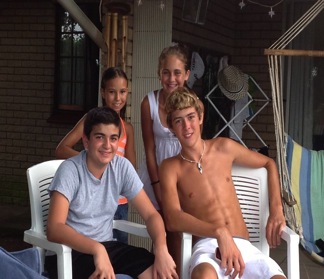
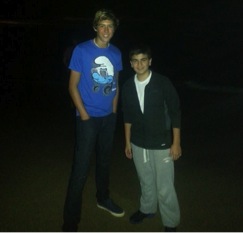
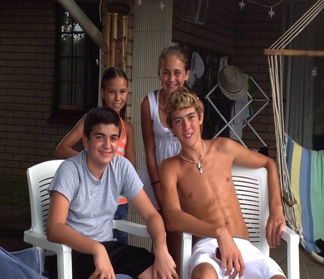
My host family, Hannelie, Dirk, Jessica and Rickus Van Biljon picked me up in Durban. I knew right away that the difference in height between Rickus and I would be an endless source of amusement for my family and friends. In spite of that, Rickus and I instantly got (and still get) along exceptionally well. The whole family was welcoming, warm, just lekker. It’s a funny thing, that. You travel half way across the world, farther than Timbuktu even, and you find that people are just people.

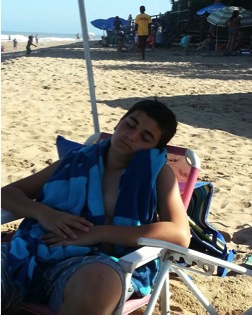
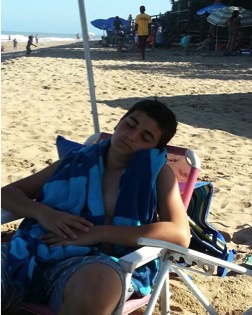
I spent the next few days getting acclimatized and spent the balance of my winter holiday in one of the most beautiful countries in the world. The Van Biljon’s summer beach house is just 30 km from Durban, in Zinkwazi beach. I went to the beach the very first day, swimming in an ocean at once refreshing and warm, lazily talking with Rickus. I enjoyed myself very much, especially when I paused to think about home and what I would have been doing in Montreal. Napping at the beach is the best way to get over jet lag. During that first day, I met the Van Biljon’s family friends, Gustav, Sanelle, and their children Emma and five-year-old Duncan. They say that you can know a person by the company that he keeps. Well, Gustav, Sanelle, Emma and Duncan are extremely nice, which confirmed my opinion that the Van Biljon are great people.

The next few days—still my vacation—were just as “taxing” as the first. We took long walks on the beach, swam at least three times a day, debated the relative merits of American football and South African rugby. Rickus and I are both fluent in sports talk. I was introduced to cricket when the family watched the South African-New Zealand game. I must have been in hockey withdrawal, because I totally enjoyed that.

January 5, 2013

We went to Crocodile Creek, where the welcoming sign “ Nice to eat you” has been thoughtfully corrected to read “ nice to meet you,” no doubt to soothe the tender sensibilities of tourists like me. The crocodile farm was la lot of fun (and instructive too). When our tour guide wanted to introduce us to a crocodile that was hiding in the water, he would tap the crocodile in the face until the crocodile would try to bite him and in effect leap out of the water. South African crocodile tour guides are a different breed. I was able to hold a newly hatched crocodile, and a four-year-old crocodile. It was a little scary, but pretty cool too. The bottom of crocodiles is unbelievably soft, which, as the guide thoughtfully pointed out, explains why people want shoes, handbags, and belts made of alligator skin. We then went to check out the snakes, a definite highlight for me. Snakes are just soooooooo cool. My favourites were the black and green mambas. The inside of their mouths is black, and when they attack, it is truly scary.  When they move, a full third of their body is off the ground. Just the stuff nightmares are made of. Another favourite is the vine snake, the most poisonous snake in South Africa.  The vine snake is so good at camouflage that it took me a full five minutes to spot it. I had a fantastic time, but then I thought of all the times that I visited zoos in Montreal. I’d always think, “ thank goodness those snakes and animals are not indigenous to Montreal. Thank goodness they live in far away places like South Africa.”  Of course, my very next thought was “Um. But right now, I’m in South Africa”… Like I said, just the stuff nightmares are made of.

I am so comfortable here, so happy, that I am always a little surprised when I realize that there are endless differences, some subtle, some not so subtle between South Africa and Canada.  This is the coolest thing about this trip, the way I at once feel adventurous, disoriented, foreign and comfortable and familiar. It sounds like an oxymoron, but it is not. It is just great. But definitely, not every cultural reference that we take for granted in Montreal is a reference here. Les Miserables is not a classic here, but is simply a very new movie, and To Kill A Mockingbird is unknown. Robert Munsch does not exist here. Imagine that! As for me, well, I cannot tell you all the things I don’t understand. I very smoothly try to pass my ignorance for jet lag.

Right after the crocodile farm, we went to see The Life of Pi (very, very good). Just when I think that there are too many cultural differences between our two countries, I see something that reminds me that there are plenty of universal interests, like any Hollywood movie.

I also saw a movie called Spud, which is also a story about a kid going to a boarding school in SA

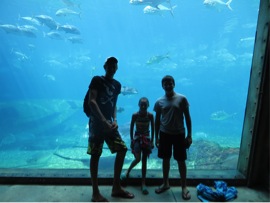
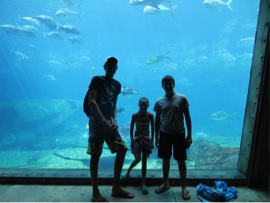
On one of our last days on the coast, we went to Ushaka Marine Land and Water Park in Durban. That was extremely fun. The aquarium was a vast shipwreck, very original. The fish were fantastic. We went to see a seal show, which was good, and a dolphin show, which was really VERY cool. The dolphins threw balls, and even played basketball under water. Very impressive. I heard that from the Van Biljon’s deck in Zinkwazi, you could catch dolphins swimming. There are things like that, which make me so happy to have chosen South Africa for my exchange.

January 9, 2013

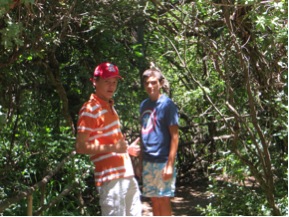
Back in Jo’burg. I met Rickus’ friends from St. Stithians, explored the neighbourhood, and went on a hiking trail in the botanical gardens around the estate. I had a really amazing time on the hike. The scenery on the hike was amazing. I went with Rickus and on of his friends Kyle who is also extremely nice and with whom I get along very well.

January 14
Going to pre-tea at St. Stithians before the first full day of school starts. Definitely an adventure. Tomorrow, I’ll be sleeping at the Mount Stephens boarding house, and Wednesday, I’ll actually start school. It is all a little surreal, very exciting, and a little daunting. I’ll keep you posted.—David Elbaz ’15