
The Need to Develop IDEALS in Children

RoundSquareLast Saturday was the 9th anniversary of 9/11; the tragic attack on the World Trade Center in New York that took the lives of over three thousand innocents. A solemn memorial service took place at Ground Zero to commemorate those who died and to offer condolences to families for their losses. However, while most of us across North America offered thoughtful reflection, the “crazies” also came out of the woodwork.

Unfortunately, leading up to Saturday’s anniversary, a little-known Christian preacher from Florida publicly threatened to burn the Muslim Holy book, the Koran, on the anniversary of 9/11. This was to be his personal form of protest against radical Islamists. Yet it was simply an unfortunate public statement of intolerance. The burning did not happen, but we certainly learned a few lessons from the threat.

Lesson # 1: Freedom comes with responsibility. Although in Canada and the USA we have freedom of expression, the Florida Minister’s overt video threat was insensitive, provocative, incendiary and disrespectful—unacceptable from my perspective and he should still face criminal charges.

Lesson # 2: This incident was a clear example of the extraordinary capacity of the Internet to spread nasty messages globally. Although coming from a very questionable source, the message still went viral and provoked riots in Muslim communities and upset people on worldwide.

Lesson # 3: Schools need to be proactive about helping students develop genuine sensitivity and empathy for others. We need to expose young people to difference so that the ignorance and bigotry the minister displayed do not dominate their lives.

That’s why we speak so much about respect—for oneself and others—at LCC. It’s also why we are a part of the Round Square association of schools; a network of more than 80 schools around the world that promote respect and international understanding through exchanges, service projects, conferences, and leadership development.

Also, all 80 schools adhere to core pillars or IDEALS: Internationalism, Democracy, Environmentalism, Adventure, Leadership and Service. In fact, it was no coincidence that these were the themes we chose for our Middle and Senior School Experience field trips to start the year.

 Grade 7 – Orientation/ Environment & Adventure @ Camp Nominingue
 Grade 8 – Environment
 Grade 9 – Outdoor Adventure
 Grade 10 – Community Service & Philanthropy
 Grade 11 – Leadership

We constantly ask our students to consider how they can reach beyond their comfort zones through experiences at school, in the community and at the international level. We see it as our job to help students develop empathy and sensitivity in a world which is crying for more citizens who possess those important qualities. Only then will we drown out the crazies. –Chris Shannon, Headmaster
Dealing with Too Much of a Good Thing

TooMuchGoodThingLast week dozens of Assistant Heads from independent schools from across the country gathered in Montreal to share and learn during an annual four-day conference. On one of these days this group of educational administrators had the privilege of working directly with Dr. Dan Kindlon, a renowned clinical and research psychologist and professor at Harvard University in Boston. Dr. Kindlon is also a reputed author. His first book, Raising Cain: Protecting the Emotional lives of Boys saw both he and his co-author, Dr. Michael Thompson, jump to the top of the NY Times Bestseller List. It was published around the time of the tragic Columbine high school shootings in Colorado in 1999, and tens of thousands of parents bought the book in an effort to better understand what could trigger such violence among teenage boys.

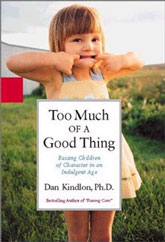
Dr. Kindlon’s latest book Too Much of a Good Thing: Raising Children of Character in an Indulgent Age presents some simple but key messages to parents today. He spoke at LCC last Thursday evening, and I would like to pass on a few key takeaways.

As the title of Dr. Kindlon’s book indicates, he is concerned about the degree to which today’s parents indulge their children. His clear advice: don’t give children or adolescents everything they want, set clear limits and stick to them. This sounds simple, but Dr. Kindlon’s research shows that an absence of appropriate boundaries and too little delayed gratification have had a negative impact on young people across North America. He also noted that in our busy lives with demanding schedules for work and activities, family time has decreased by half since the 1980s—a rather startling development. Evidence shows that regular family activity, in particular family dinners, has a direct correlation to keeping children focused and positive.
This actually leads to better results at school.

Finally, Kindlon reiterated the impact of the North American crisis in youth sleep deprivation. The average teen now gets less than seven hours of sleep per night, while needing at least eight and ideally nine hours to function effectively. He noted that the cumulative physiological effect is equivalent to the teen smoking one pack of cigarettes a day, with a host of harmful effects, including a diminished capacity to embed learning after a day of schooling.

This may not be new information. However, it’s important to remember the importance of boundaries and limits, family time, and sleep in the growth, development and good health of our children. For all parents, awareness is important, but acting on our knowledge is critical if students are to meet their true potential. —Chris Shannon, Headmaster

Global Perspectives

GlobalPerspectiveThere is an old adage that school is about the three R’s—Reading, wRiting and aRithmatic—the core subjects that support every young person’s success in the world. But in the modern world, I now see a fourth R that we have to add to the mix: Respect. For me this is a key element of every student’s education. In my view there are two primary elements to truly understanding respect: first, a focus on continuous character education, the molding of engaged and involved citizens and, second, respect for differences—primarily ethnic and cultural differences that are so common in today’s multicultural Canada. Both are important, but I would like to focus here on the second component of respect….respect for diversity. This is much more than simply building a sense of tolerance for others different than yourself. The notion of tolerance is simply not enough – tolerance should be a given between people, even people lacking education. I am thinking about something much more profound than tolerance. I want every student in our school to be intrigued by difference, not afraid of it, not ignorant of difference. To call oneself truly educated, one needs to learn to reach out, be proactive and want to know about “the other.” Who is “the other” you ask? Those who are profoundly different than ourselves.

This is exactly why the development of a global perspective is one of the most important attributes one can develop while in high school. In addition to reading, writing and arithmetic, the capacity to be familiar with and navigate the waters between different cultures is a key set of skills that will contribute to success in life as adults. Historically, this has been a hallmark of Canadians—bilingual, rooted in French and British colonial roots and traditions, close to our American friends and open to the world through generations of immigrants coming to this land of opportunity. However, in recent years, I think teenagers in Canada have actually become too spoiled, too soft, too complacent, and too comfortable with our high standard of living and the many blessings of this very special country. Unfortunately, in Canada at large, actively reaching out and learning about different cultures and investigating things foreign is not seen by enough young people as necessary. It’s not on enough personal agendas.

However, such a perspective just won’t do anymore. As we move forward into the second decade of the 21st century, youth need to be sure how to read, write and calculate. However, I assert that perhaps most important, students need to stop and consider how they are building their own sense of global awareness. This is the global toolbox that will equip young people to navigate the currents of multiple cultures intersecting on a daily basis during the balance of their lives.

This will require youth to step into new and sometimes difficult situations outside their Canadian comfort zones. With increasing frequency, they will be forced to define and question core values and what really matters to them. In short, to gain a truly global perspective, students must be proactive, outward-looking and willing to test themselves through active learning experiences. In the process they will likely change, but likely for the better—more insightful, wiser and resilient.
Here at LCC we have created many opportunities for students to enhance their global perspectives. Our classrooms, clubs and activities, community fundraising initiatives, international exchanges and service projects abroad present a host of amazing opportunities that can be life-changing.

So a new core component of our curriculum is a desire to be better connected to the many cultures and historical traditions that weave across the tapestry we call earth—an active celebration of differences. On a personal level, this requires some courage, but students find the journey fulfilling, challenging, exciting and full of the unexpected. If you don’t believe me, just ask one of the dozens of LCC students who have actively developed a stronger global perspective. I am proud to say, they are the best ambassadors for our unique programs that develop actively engaged global citizens. —Chris Shannon, Headmaster