The Senselessness of Locking Horns

LockingHornsBlogThere’s an old adage that “temper is what gets most of us into trouble, but it is pride which keeps us there.” This can be an issue at school where students are in close quarters and face the daily challenge of balancing demands from parents, teachers, friends and acquaintances.

We can learn something about the combination of unbridled temper and pride from an old monastery in a place called Bebenhausen, Germany. Hanging on the wall are two large pairs of deer horns. What’s unique is that the horns are tightly interlocked and permanently stuck together. The horns were found in that position many years ago. Apparently two mature bucks had been fighting for territorial superiority and, in their jousting, their horns became jammed together. Ultimately, they died in a fighting position. Unable to find a way to cooperate they were literally stuck, yet disabled.

These locked horns form a valuable symbol for the the many relationships found in today’s homes, schools, arenas, city traffic jams, and the list goes on. Unfortunately, like those two bucks in Germany, far too many people become entrenched in their positions on emotional topics and angrily oppose those who confront them. In the process, they find ways to figuratively “lock horns,” and the more they insult or abuse one another, the horns lock together tighter.

So if you’re at odds with someone today, go to that person, bury your false pride and find a way to reconcile and make amends. You may be surprised to find that the other person wants reconciliation as much as you do.

Let’s face it, reconciliation and compromise are not easy. Our students need to learn that life is about a series of compromises. No one is always right and we cannot always get our own way. The more we embed an understanding of that into our daily lives, the more successful we will be. –-Chris Shannon, Headmaster

Asleep at the Ballot Box

canadian_flagThe Muslim states of North Africa have undergone a fair amount of turmoil in the past two months—people clamoring for a political voice in largely one-party states. This began with significant protests in February in Tunisia. It swiftly moved to Egypt and what some are calling the “Twitter Revolution” , which led to the resignation of long-serving President Mubarak.

In most of North Africa’s kingdoms or one-party states, the Arab world is experiencing what the Economist magazine last week described on its cover as “The Awakening” —a thrust toward democratic principles and rights, and a desire, especially by young people, to have their voices and opinions heard. It’s amazing to see how powerful the yearning is in so many countries for democratic rights and the acceptance of diverse political voices. The “awakening:” it’s an interesting label for this phenomenon.

Here in Canada, we all possess the hard-won rights of a democracy. This includes the rule of law, a host of freedoms, the right to disagree with our government and even to protest peacefully when we want to take a particular position on a particular topic.

Last Saturday our federal parliament was dissolved and our political parties are now on the campaign trail from coast to coast to coast, with an election day slated for Monday, May 2— just a few weeks from now. However, with all our rights and freedoms— and an electoral process that allows us to do battle in the political arena rather than solve problems with the end of a gun— large segments of our population seem disengaged from the political process.

Too often, political issues have become someone else’s concern. In fact, when it comes to voting in Canada, voter turnout has dropped consistently since the mid 1980s, from about 75% of eligible voters participating in national elections to just above 60% in the last election. Unfortunately, the youngest sector (18-24 year-olds) seems to be the least engaged in the political process. Just above 40% bothered to go to the ballot box in Canada during the last election, close to 20% below the national average.

So blood is spilling in Arab states in north Africa over the right to participate in the political process and here in Canada we are paying less and less attention to the political process. What a sad paradox. I guess we don’t need to be concerned. Someone else will run our democracy! No need to accept the responsibilities that come with our democratic rights!

I think we should call the Economist magazine and ask who really needs an awakening, the countries of North Africa or perhaps it’s us, the sleep walking citizens of Canada. I suggest we all wake up. I asked our senior students this week to pay attention to the issues in this election campaign. They need to become familiar with our political processes as many of them will be voting next time. We will all be better off if they connect with their local communities, their Canada. —Chris Shannon, Headmaster

Celebrating the Arts

CelebrateArts_blog_04Mar2011While in grade 3 or 4, I had a fascination with the cliffs of Acapulco, Mexico. I had seen diving competitions on television and thought it was the perfect scene to try and recreate in a painting in art class. I paired up with another keen young boy and we worked diligently on our painting for a couple of weeks. We each had pretty limited artistic talent. Although we received minimal direction, we were determined to depict a scene that was colourful, vibrant and alive in our minds.

In those days some teachers were a little less focused on encouragement and specific skill improvement than they are at today’s LCC. Unfortunately, my art teacher was also a real grouch. So to our shock, when our tableau was finished, she approached the painting, expressed immediate dissatisfaction and ripped it in half. Art trauma!

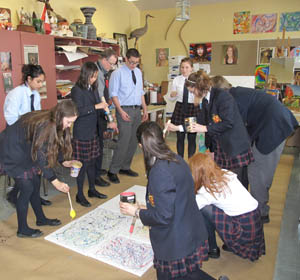
I remember that moment so well. In fact, it is more firmly embedded in my mind than the details of most of the classes I attended in primary and middle school. Why is this significant to me today? This story reinforces that the arts provide for active and meaningful experiences, which embed themselves in each person and are critical to building personal identity. Artistic activities tend to be more active learning experiences and draw on students’ creative juices. For good or ill, artistic ventures are particularly memorable. Do you remember the first time you performed in a play or performed music in public? In short, the arts allow for creativity, expression and meaningful personal growth—and studies have shown that the development of work habits in art, music and drama simply make people smarter. Over time, students become more able to see the complex connections between disparate information —what one writer, Daniel Pink calls the “symphony of life.”

I am proud of what I would like to call the renaissance of the arts at LCC. In recent years, we have placed a significant emphasis on the value of the arts in education. Through this, we are helping to educate more confident and capable students, ready for the complexity of modern life.

I commend LCC’s outstanding arts teachers for providing inspiration and creative skill development to so many students. The many arts and cultural opportunities available here are notable difference-makers in our students’ school experience.

What is your art?—Chris Shannon, Headmaster

Service Learning

ndgfeeddepotIt was a great opportunity to spend some time with students last week at the NDG Food Depot. It is a short distance from LCC in the heart of NDG. We have worked in partnership with the food bank for several years, raising funds and sending student volunteers. This past December our senior students impressively brought food here for the food bank in large quantities: more than 100 large boxes, compared to only 35 only two years ago. This is an impressive outreach for families in need prior to the onset of winter.

In the past couple of years demand at the food depot has increased. So who are the individuals and families in need? Along with a group of Middle School students from the Round Square Conference we hosted, I learned that we are often misguided by our assumptions/biases about those who are in need. The homeless who sometimes beg on our street corners are not the primary customers of our local food bank. The regular clientele is actually somewhat surprising. There are a host of categories: recent immigrants who are having a tough time adapting to Quebec culture and language requirements, refugees from all over the world who have desperately fled countries that are politically dangerous, the elderly on small incomes, the disabled, unemployed, and the working poor.

In fact, before the students helped to sort and pack food into single baskets, the people at the food bank had our students complete a very effective exercise to learn more about the food bank’s regular clientele. In teams, the students reviewed the small incomes of various categories of clients and were asked to make choices about how they would budget their money if they were to find themselves in the same circumstances. This meant looking at a chart of costs for essentials: apartment rental, food, heating, basic transport and other expenses. The students attempted to budget, and interestingly, not one group was able to get by on the small monthly incomes that reflect the real incomes for many people in our community, but not the visible homeless who struggle on our streets. Most striking perhaps for all of the students was the realization that if you have a full time job at minimum wage in Montreal ($ 9.50/hr.), your total income per month after tax and other deductions is below $1,400/month—which is considered to be below the poverty line. In doing their calculations, students realized that even those working people are trapped in a cycle of poverty where they cannot afford nutritious food—and what we might consider as basics. Phone, Internet, computer, and TV were not part of their budgets as they are unaffordable.

Why are so many people become dependent on handouts twice a month from the NDG Food Depot. They are the old, the lonely, the disabled and minimum income earners with children who cannot get by on what they earn, even though they do their best and have full-time employment

We cannot live in a bubble here at LCC. Within in our local community there are many needs, and we have the energy, disposition and capacity to help assist in many ways. Also, as students there is much to be gained by being exposed to the difficult challenges faced by so many in our city. What can our students learn from the resilience of others? What are the social challenges of hunger, housing shortages, youth disconnected at school? These are the realities you see when you are at the NDG Food Depot or one of the other 40 agencies our students are currently involved with through active service learning. There is much to be gained from this curriculum of life and extending a welcoming hand in service of others. “Non Nobis Solum” —it was the founding ethos of our school. I believe we need to recommit to it today as an essential educational principle to help students develop as aware, capable and involved citizens.

Service learning is surely about opening eyes, and it is perhaps one of the most important pillars of our curriculum at LCC. I hope our extended school community will fully embrace the opportunities that service learning offers. —Chris Shannon, Headmaster

The Value of an International Perspective

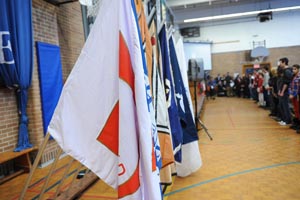
Blog_17feb2011Our gym has been adorned this week with 20 flags from various Round Square member-schools attending the Junior Round Square Conference. Most participating schools are from Canada, the USA and South America. However, some are from as far away as Denmark, South Africa, and Singapore. The flags are symbols of difference and diversity in schools in different countries with unique histories, cultures, languages and orientations.

A core objective of both LCC and the Round Square is to open students’ eyes to the broader world and create a sense of comfort with diversity and a genuine interest in developing an international perspective. This requires a focus on language skills, an appreciation of cultural traditions, as well as an awareness of key international historical and current events.

I cannot emphasize enough how important it is for each of our students to seek to know more about diversity at home and abroad. If education can be looked at as a tool kit, every student needs the tools to be a craftsman for success in the future. In addition to a comfort and interest with diversity, each needs another important set of tools: an awareness of major events in the world and major international trends and current events. Our world has become completely entangled and interdependent. We all need to be informed and take positions on a host of issues well beyond our back doors. For teenagers, there’s no time for “duck and cover” or avoidance because the issues are too complicated, and the world will catch up to them.

This past weekend we all saw amazing images and footage of the culmination of a people’s revolution in Egypt; swarming throngs of everyday people demanding their voices be heard after 30 years of living under conditions of virtual martial law with very limited personal freedoms. The resilience of the street protestors reflected a fantastic example of the depth of the desire for democracy. The events in Egypt send a powerful signal to other countries that have never had a democratic tradition.

Consider for a moment, what the impact will be on many other old monarchies and strongmen in the region of the Middle East & North Africa. Already since the weekend and the resignation by Egyptian leader Hosni Mubarak, people in Tunisia, Yemen, Bahrain and Iran have openly protested in the streets even though their governments frown on it. In several other countries without democratic traditions, rulers are nervous.

Note that authorities in those places did everything in their power during the past three weeks to make sure that their citizens could not witness the elation of the ecstatic freedom street dance in Cairo. In those authoritarian countries, state-run television refused to show the images of the Egyptian street protest and, in Iran in particular, Persian-language BBC International was scrambled to prevent the flow of information. State control and limitations on the Internet and cell phone networks have also prevented the sharing of images and ideas from Egypt.

But you know as well as I do that governments cannot shield their people from the truth. In this day and age, the images and information will eventually surface. They will surely see the images of the Egyptian peoples’ democracy dance, just as the Chinese people did following the events in Tiananmen Square in Beijing the late 1980’s.

So how do the events in Egypt impact relations with Israel? What are the broader implications for the region? What is Canada’s role in all this?

Students may have no idea how to approach these complicated questions – and if they’re in grades 7, 8, and 9, that’s probably excusable. However, if they’re in grades 10, 11 and certainly Pre-U, I believe they should take a view, form an opinion, and quite simply, care. Our times mandate it.

So I offer students this simple piece of advice: pay attention to world events or risk being marginalized in the long term. So maybe we all should take a fresh look at those diverse flags again in our gym and see them as a starting point. Interesting, aren’t they?! —Chris Shannon, Headmaster