 1. Smiles need no translation
2. Less is more
3. The appreciation of a toilet seat
4. How to make concrete & cement
5. How count to 100 in Thai
6. Commuting to school in the morning can get a lot more difficult
7. It ain’t easy being a teacher
8. It’s possible to eat rice every meal of the day
9. Bridging the gap between cultures and language barriers
10. More than I could ever describe…
After 36 hours of flying to the other side of the world and a night spent arguing with the local marketers in Chiang Mai, we awoke bright and early to begin our trek through the Thai mountains. Expectations varied from person to person; everyone had their own ideas about what the school would look like, how the people would act, and whether or not they had enough Nature Valley bars to last them the trip. Unexpectedly, we were all wrong. No one could have predicted the life-changing experience before us.
The five-hour trip through the mountains was eventful to say the least. From muddy roads to evasive spare tires, we began to settle into our surroundings and got to know the 30 other students who had come together from around the world to rural village of Ban Maelid.
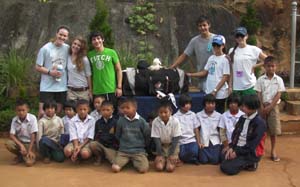
Upon arrival, the principal and the 150 students who had readied their traditional hand-woven bracelets for each of us greeted us with incredible hospitality and generosity. We proceeded to set up our beds (though Hutch and I couldn’t figure out the mosquito net until Day 3) and all took notice of the unprecedented guy to girl ratio (7 boys and 27 girls). Over the remainder of the day, our bodies began to adjust to the unfamiliar Thai cuisine (rice and pineapple replace pizza and fries), and our hearts began to warm to the omnipresent feeling of community and togetherness that was immediately vibrant and welcoming to all.
We awoke to the familiar meal of Corn Flakes and white bread, followed by the daily morning assembly in the courtyard/soccer field. We stood quietly while the members of the school recited the national anthem and their morning prayer. Needless to say, we understood nothing of the principal’s welcoming speech, but the Regent’s School (the host school) teacher, Kun Mina, translated for us.
We then broke off into two separate groups: those who would do construction work in the morning and teach in the afternoon, and vice-versa. We learned a lot about building and cement and concrete, and it was a pretty solid workout to say the least. It was awesome how everyone was working together and helping each other to reach one common goal. Though the language barrier made it really hard to communicate with the Thai people, we were able to work around it because of everyone’s willingness and patience.
In the afternoon (or morning for others), we went to go teach the kids in groups of 2 or 3. I ended up with a girl named Leah from Victoria, BC, and a guy named Bian from Indonesia (he goes to Regent’s now). The lesson plan varied from class to class (depending on their age), but it mostly consisted of teaching them some English (whether it be counting, shapes, animals, weather, etc.) and then playing some games when we felt they’d learned enough for one day. I am forever grateful to Ms. Hart, without whom I would have never learned the awesome drama games that everyone loved and made class exciting and fun. I must admit that it wasn’t easy teaching class after class. Keeping students busy and engaged while having fun is hard work. It definitely elevated my respect and appreciation for all teachers who do this on a daily basis.
Service ended each day at 4 pm (with two snack breaks and lunch in between), at which point most of the kids would walk back home to their villages while some stayed behind to play some soccer following the end of the day assembly. For the first two days, this would be the time when we “chilled” or played soccer with the kids. Either way, a cold bucket shower was unavoidable before our 6:30 pm dinner. After dinner was all done, we’d watch a slideshow of the day’s photos and relaxed until bedtime at 9:30 pm. During that time, we got to learn how to make bracelets and weave baskets from the kids who boarded at the school. It was great to experience their culture like that, and it was relaxing and lots of fun.
Speaking of showers, the bathrooms were not quite what we were used to. There was only one North American-style toilet at the school, while the others were located on the floor and were flushed by pouring buckets of water into them until it was clean. These stalls also doubled as the showers, which consisted of a bowl and a water tap. It was a tough transition to get over for everyone, but by the 3rd or 4th day it wasn’t too bad.
After service was done on the 3rd day, we had the privilege of walking back with the kids to their village. Each one of us partnered up with someone and took on the task of walking them home. To say it was the most genuine and powerful thing I’d ever experienced would be an understatement. Past the language barrier and the massive cultural contrast, we were all simply human beings connecting on the most basic of levels. They took us to their village and welcomed us into their homes and treated us with a respect and politeness lie I had never before experienced before. To really see how these people lived and how different our lives are from their own was a huge shock, and it really instilled a profound appreciation in me for all that we have and take for granted. At the same time though, it felt so unfair that we have so much and they have so little. Then I realized just why we were there: to be together as human beings, no matter where we were from. We were there to help and to learn how easy is was to live with and love each other. Round Square 2010: We Walk Together.
On the last day, we went for an hour-long hike up the mountain (the regular commute to school everyday for some of the kids), and went to see another village. The people were incredibly friendly and welcoming as always, and it was amazing to once again see how they lived and to be truly immersed in their everyday lives. The kids guided us up the slippery trail and were so excited to show us around. I was really lucky to go hang out with my new friend Kasen’s grandparents and really see what it was like for them to live in their home. They were very kind and eager to show me their home and they loved taking pictures with us.
In the afternoon, we all came up with games to play with the whole school, and everyone was having a great time (“What time is it Mr. Wolf,” “Indian Chief,” “Monkey in the Middle,” etc.). At night, we had a big celebration of the last few days and finished it off with a disco party, which was amazing. Everyone was dancing and happy and it was really a celebration of the world coming together as one. It was an appropriate end to an unforgettable experience that really changed my life.
If you’ve read this far, you have probably inferred what I’m about to say, but I think it’s really important to reiterate this. The people of Ban Maelid were the kindest and most polite individuals I have met in my life. They treated us all with immeasurable respect and hospitality that exceeds anything I’ve ever seen. They fed us and sheltered us like kings compared to how they have to live. For example, they eat meat only about once a week due to limited availability, while we had it almost every meal because they felt it would make us more comfortable. Every time you would walk by someone down the hall they bow and say hello (“Sawadeekap” for guys, “Sawadeeka” for girls) and make you feel so welcome in a land most of us had never seen. Their love, respect and all of their gestures motivated us to reciprocate in the same way, which in turn created the atmosphere at this pre-conference that we have all come to love and deeply miss.
As I sit on the bus from Bangkok to the real conference in Pattaya writing this, I can’t help but feel sad that the past week is behind me. However, I am thankful for the privilege to partake in something as powerful as the experience I had in Ban Maelid and for the opportunity of meeting their wonderful people. I’m VERY excited for the next week to come. —Greg Sigler ’11