
Community Service Reflection in Lima, Peru – Duke of Edinburgh Gold Trip 2011

Blog_Peru2011_StairsEver since I was first introduced to the concept of community service in grade 7, I have attempted to draw a closer connection to why students were asked to allocate 15 hours minimum every year to help their community. With so many community service opportunities available to students, as well as such a busy extra-curricular life, it seemed to me that students often felt unattached to the reasons behind their efforts. When I was told that as part of my Duke of Edinburgh Gold trip I would have to complete four days of grueling community service in a small community named Las Palmas, I had no way of predicting that this experience would mark me and radically force me to rethink my preconceived notion of what it meant to help another.

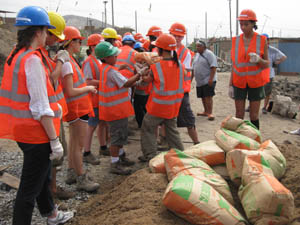
The day after our arrival in Peru, we met students from Markham College, in Lima, who had volunteered their time to help us perform our community service, building a set of stairs upon a steep hill, which would allow the members of said community to reach their houses and get around with ease. It all seemed like a valiant effort on our parts. The arrival of the Canadians would improve the lives of the people in need. Little did we know that the next fours days would probably have a larger effect on our lives than of those people in Las Palmas. Upon our arrival at the work sight, we debriefed, talked about the needs of the community and what we expected to gain from our experience and, very soon after, we commenced what I’m sure was the most grueling work any of us had ever undertaken.

Our stay in Las Palmas challenged us to reconsider our reasoning behind why we chose to take part in this project. Working alongside the locals who took pride in the work that we were to accomplish in the next few days, we gathered sand and stone, carried enormous bags of cement up steep, sandy hills, made concrete and poured it into molds that we had previously created for the stair, prepared the platform for the stairs, etc. I can honestly say that this was the most demanding work that we had ever undertaken and although many of us questioned why we had accepted to perform such exhausting work, there was a single moment that for many of us, made it all worthwhile. After the first series of steps were built and dried, the students from the nearby school, all under the age of 10 years, joined us to relish in our accomplishments. Amazed by our work they began to run up and down the stairs with a look of sheer joy plastered on their faces.

I am sure that all of the students lucky enough to go on this trip will never forget their experience and how much they were affected by the chance to help a community in need. The work was not pretty nor was it prestigious, but never have I taken part in something so gratifying. It was so evident to us how much the community had appreciated our work and although our time was limited, how much our relationships with the people we encountered will sculpt our upcoming years.

Looking upon those steps on the last days, I could not help but feel a sense of pride, not only in our work, but in our attempt to learn about a new culture, to unquestioningly be prepared to undertake any of the work that needed to be completed, but most importantly, I was proud in our readiness to leave all comfort zones aside in the effort to create something so much bigger that a few flights of stairs in a small community in Peru. –Noah Schouela ’11
Celebrating the Arts

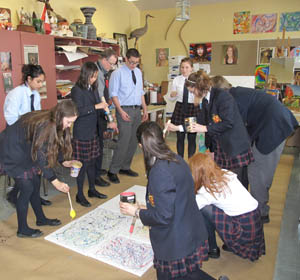
CelebrateArts_blog_04Mar2011While in grade 3 or 4, I had a fascination with the cliffs of Acapulco, Mexico. I had seen diving competitions on television and thought it was the perfect scene to try and recreate in a painting in art class. I paired up with another keen young boy and we worked diligently on our painting for a couple of weeks. We each had pretty limited artistic talent. Although we received minimal direction, we were determined to depict a scene that was colourful, vibrant and alive in our minds.

In those days some teachers were a little less focused on encouragement and specific skill improvement than they are at today’s LCC. Unfortunately, my art teacher was also a real grouch. So to our shock, when our tableau was finished, she approached the painting, expressed immediate dissatisfaction and ripped it in half. Art trauma!

I remember that moment so well. In fact, it is more firmly embedded in my mind than the details of most of the classes I attended in primary and middle school. Why is this significant to me today? This story reinforces that the arts provide for active and meaningful experiences, which embed themselves in each person and are critical to building personal identity. Artistic activities tend to be more active learning experiences and draw on students’ creative juices. For good or ill, artistic ventures are particularly memorable. Do you remember the first time you performed in a play or performed music in public? In short, the arts allow for creativity, expression and meaningful personal growth—and studies have shown that the development of work habits in art, music and drama simply make people smarter. Over time, students become more able to see the complex connections between disparate information —what one writer, Daniel Pink calls the “symphony of life.”

I am proud of what I would like to call the renaissance of the arts at LCC. In recent years, we have placed a significant emphasis on the value of the arts in education. Through this, we are helping to educate more confident and capable students, ready for the complexity of modern life.

I commend LCC’s outstanding arts teachers for providing inspiration and creative skill development to so many students. The many arts and cultural opportunities available here are notable difference-makers in our students’ school experience.

What is your art?—Chris Shannon, Headmaster

Weeks 3&4: Adelaide, Australia – Just Can’t Get Enough

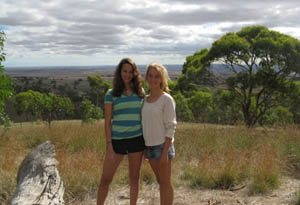
Australia2011_Blog_wk_3_4_smTwo more sunny weeks have gone by, and although I can barely believe it, I have now been in Adelaide for one awesome month. I nearly feel Australian, as I have picked up some new lingo and some new favourite foods. Unfortunately, no accent yet, but I have been working on it.

Geared with my iPod loaded with my new Australian tunes, my exchange family and I headed for the breathtaking countryside of South Australia. Our destination was the little town of Clare, where the farms are plentiful and the vineyards stretch for kilometers. We went to a winery for “afternoon tea” and enjoyed scones and juice while overlooking the grape vines and the picturesque garden. Afterwards we drove up to the lookout of the valley, where the view was magnificent. The next day we were off to a friend’s farm and got to go horseback riding and motor biking.

The past week has been spent getting organized and excited for the 12-day outdoor adventure trip we are going on with a group of students in our “year” here at Westminster. There is much planned, including lots of running, kayaking, sailing, group activities, games and overnights at spectacular sights. It is, for most, the highlight of their experience at the school, and I am so happy I get to take part in the trip. All in all, it will be “heaps good.”–Sarah Salzman ’13

Dernier blogue!

HelenBlog_24Feb2011Cette dernière semaine d’école était excellente. Capucine a dû étudier plusieurs examens, mais nous avons quand même eu le temps de regarder beaucoup de films français et de nous amuser. Il ne fait pas très chaud, pas de soleil en ce moment. En fait, ce matin, j’avais du mal à distinguer l’école à travers la brume !

Ce jeudi, je suis allée encore une fois à Paris. Le matin, nous avons fait des courses. À midi, j’ai rencontré ma cousine et nous avons passé le reste de la journée ensemble. Alexandra a 21 ans et vit à Paris depuis un an. Elle m’a emmené dans tous ses endroits préférés, j’ai réalisé qu’elle connaissait tout le monde ! Nous nous sommes promenées dans le Marais, nous avons visité la Place des Vosges et nous avons acheté de délicieux chocolats chez François Pralus, un chocolatier bien reconnu.

La semaine prochaine, ma dernière en France, sera folle ! Samedi, nous allons visiter les plages du débarquement de Normandie. Puis, de dimanche à mardi nous serons à Londres. Finalement, jeudi nous irons à Disneyland.

HelenBlog_24Feb2011_2Je dois dire que ces cinq semaines ont passé beaucoup trop vite. J’ai rencontré plein de personnes sympathiques, avec qui (grâce à Facebook) je resterai en contact. Tout le monde me dit que je ne suis pas restée assez longtemps, il va falloir que je revienne. Ils ont définitivement raison !

Chère France, à bientôt !—Hélène Osterman ’12

Service Learning

ndgfeeddepotIt was a great opportunity to spend some time with students last week at the NDG Food Depot. It is a short distance from LCC in the heart of NDG. We have worked in partnership with the food bank for several years, raising funds and sending student volunteers. This past December our senior students impressively brought food here for the food bank in large quantities: more than 100 large boxes, compared to only 35 only two years ago. This is an impressive outreach for families in need prior to the onset of winter.

In the past couple of years demand at the food depot has increased. So who are the individuals and families in need? Along with a group of Middle School students from the Round Square Conference we hosted, I learned that we are often misguided by our assumptions/biases about those who are in need. The homeless who sometimes beg on our street corners are not the primary customers of our local food bank. The regular clientele is actually somewhat surprising. There are a host of categories: recent immigrants who are having a tough time adapting to Quebec culture and language requirements, refugees from all over the world who have desperately fled countries that are politically dangerous, the elderly on small incomes, the disabled, unemployed, and the working poor.

In fact, before the students helped to sort and pack food into single baskets, the people at the food bank had our students complete a very effective exercise to learn more about the food bank’s regular clientele. In teams, the students reviewed the small incomes of various categories of clients and were asked to make choices about how they would budget their money if they were to find themselves in the same circumstances. This meant looking at a chart of costs for essentials: apartment rental, food, heating, basic transport and other expenses. The students attempted to budget, and interestingly, not one group was able to get by on the small monthly incomes that reflect the real incomes for many people in our community, but not the visible homeless who struggle on our streets. Most striking perhaps for all of the students was the realization that if you have a full time job at minimum wage in Montreal ($ 9.50/hr.), your total income per month after tax and other deductions is below $1,400/month—which is considered to be below the poverty line. In doing their calculations, students realized that even those working people are trapped in a cycle of poverty where they cannot afford nutritious food—and what we might consider as basics. Phone, Internet, computer, and TV were not part of their budgets as they are unaffordable.

Why are so many people become dependent on handouts twice a month from the NDG Food Depot. They are the old, the lonely, the disabled and minimum income earners with children who cannot get by on what they earn, even though they do their best and have full-time employment

We cannot live in a bubble here at LCC. Within in our local community there are many needs, and we have the energy, disposition and capacity to help assist in many ways. Also, as students there is much to be gained by being exposed to the difficult challenges faced by so many in our city. What can our students learn from the resilience of others? What are the social challenges of hunger, housing shortages, youth disconnected at school? These are the realities you see when you are at the NDG Food Depot or one of the other 40 agencies our students are currently involved with through active service learning. There is much to be gained from this curriculum of life and extending a welcoming hand in service of others. “Non Nobis Solum” —it was the founding ethos of our school. I believe we need to recommit to it today as an essential educational principle to help students develop as aware, capable and involved citizens.

Service learning is surely about opening eyes, and it is perhaps one of the most important pillars of our curriculum at LCC. I hope our extended school community will fully embrace the opportunities that service learning offers. —Chris Shannon, Headmaster