Cultural Intelligence

Earlier this week I asked our high school students if down deep they believe they are smart. Are they confident they are bright, intelligent, capable, insightful and competent?  Do they genuinely believe in their own capacity to learn, to grow, to lead and to truly maximize their potential?

As our students progress through school and life, various factors contribute to their perception of their own abilities and potential.  We are all familiar with IQ (Intelligence Quotient) as a test that has long been used as a supposedly objective measure of one’s brain capacity. In recent years IQ has been criticized as having limitations. People with high IQs are sometimes accused of lacking  “people skills.”  So in an effort to better understand the complexity of intelligence, about 20 years EQ (Emotional Quotient) gained credibility.  In a world where social interaction, teaming and group work are more prevalent, EQ stresses the importance of social intelligence and genuine interest in the welfare of other people, kindness, empathy and a capacity to naturally bring people together.  For the past two decades we have been told that we can’t simply depend on IQ as a dependable measure; EQ is also key to success in today’s world.

Now there’s a new kid in town.  Enter CQ—“Cultural Quotient” or “Cultural Intelligence.”  It reflects a genuine desire to overcome cultural barriers and a confidence in one’s ability to communicate with people from different cultural backgrounds.  Supporters of CQ assert that a heightened awareness and sensitivity to different cultures are critical tools in a world that is increasingly multicultural and interconnected.

Last fall the Association for Canadian Studies conducted a large study of CQ in the world’s four most multicultural countries:  Canada, USA, Britain and France. Good news, Canada rated highest on the CQ scale! It has a lot to do with our culturally diverse population.  Here at LCC it also reinforces the importance of cultural international exchanges and service projects outside of Canada.  Experiential learning trumps all in the 21st century, as learning by doing tends to be most memorable   So what are our students doing to expose and challenge themselves in this important domain?  Are they taking steps to explore new cultures with genuine curiosity and actively develop their own Cultural Intelligence?

Back to the original question: are our students smart?  Of course they are, but they need to strike a balance between the three domains:  IQ, EQ, and CQ. —Christopher Shannon, Headmaster

Teen Mantra: I am Enough

Fried_Blog_03Feb2011Scott Fried is a professional motivational speaker who had a positive impact this week on all of our students from grades 6-12.  He also met in the evening with a large group of engaged parents.  His primary focus was coping with the challenge of life for pre-teens and adolescents and the importance of mutual acceptance.

Scott stressed that words do hurt and can have a lasting and negative impact.  While urging students to be respectful and accepting of peers, he reminded his audiences that all children feel pain on the long and often lonely road to adulthood. As children grow and change, we adults need to acknowledge the pain that teens sometimes feel because inevitably life does hurt; indeed, life itself can be a bully.  Scott urged us to openly acknowledge the feelings of our students and children and not neglect hurt feelings or try to wash them away.

What seemed to resonate most with our students was the phrase “I am enough.” Scott wants us to meet, accept and cherish young people in the moment for who they are.  We should not bury them in a sea of seemingly endless expectations. This only reinforces the implicit message that they are never good enough. Teens also have secrets during this critical period of “becoming” on their journey to adulthood.  Mistakes will be made along the way, which is normal.  As teachers and parents, our role as key adults in their lives is to help children develop a healthy posture of self-acceptance before they can move on confidently toward a path of self-improvement.

I had an opportunity to speak with Scott at the end of a very long day.  He strongly complimented our school and the initiatives we are taking.  I noted that our success is rooted in a faculty of dedicated educators who generally see our students as “more than enough.”  We have many trusted adults here. They proactively bear witness to the hurdles and challenges of so many young people.  When we team and partner with our parents in a positive way; that’s what truly makes a difference! – Chris Shannon, Headmaster

Preoccupied Montreal

IPhoneI spoke to students recently about a phenomenon I call “Preoccupied Montreal.” Exactly what is ”Preoccupied Montreal”? It is my way to describe our collective obsession with cell phones, smart phones,  BlackBerries—or “CrackBerries” as the slang goes. Cell phone/smart phone use can actually be addictive and I have some concerns; in my view too many teenagers and adults are suffering and need to change their habits.

This generation of teenagers has a timeless desire to do what every teenager has ever wanted: to be closely connected to friends. It’s cool and feels good to be “in the know.” So carrying a cell phone makes sense; they quite simply help to make our lives a little easier.  However, the temptation to carry the phone wherever you go and check it incessantly rules way too many lives in ways that have become unhealthy.

With the capacity to contact anyone, anywhere anytime comes the odd compulsion among many teens to text, tweet or post statements, opinions, observations, photos or videos on social media, just because they can. The feedback is instant, so clearly someone is listening: someone cares.

Recent studies show that teenagers across North America send on average 100 texts/day, more than double just a few years ago. Most teens surveyed say that the cell phone is now the key to their social lives.  In fact, data shows that on average, when out of school, teens spend just as much time texting as they do talking with friends.  In fact, texting has become so second nature, about 60% of teens surveyed claim to be able to text blindfolded.

However, the 24/7 compulsion to connect without boundaries is unhealthy and can steal balance from young lives.  Some of these digital addicts are even losing sleep, even though sleep is one of the most important elements of their lives they can control. Notably, sleep has a direct correlation with better performance in school.  Eight or more hours of sleep per night can translate into a 10% improvement in achievement simply because sleep stabilizes and protects memory and other brain functions.

There are now a lot of studies that show that a lack of “down time” is detrimental to us—teens and adults alike.  We all need to be out of reach sometimes and avoid being interrupted. This shield of protection should also extend to family meals, quiet discussions with friends, outdoor activities.

I don’t suggest we throw away the technology.  We need it. I think it can really help out lives.  But who’s “driving the bus“ here, you or the cell phone?  We’ve allowed it to seep into every corner of our lives.  It’s time to create some no-go cell use zones and times in our lives beyond school.  Limit its use and call back later.  By then you’ll have something more interesting to say anyway.

Seize the now.  Be in the moment. This applies to adults as well. We adults are often the worst offenders. Blurring borders between work and family/personal time generally means more stress and more unwanted cranky moments.  So take steps to define better  boundaries.  Make this the topic of discussion at tonight’s family dinner table.  But first, turn off the “CrackBerry” more often in 2012 and enjoy not being interrupted! —Chris Shannon, Headmaster

Shannon’s Top 10 Reasons to Read

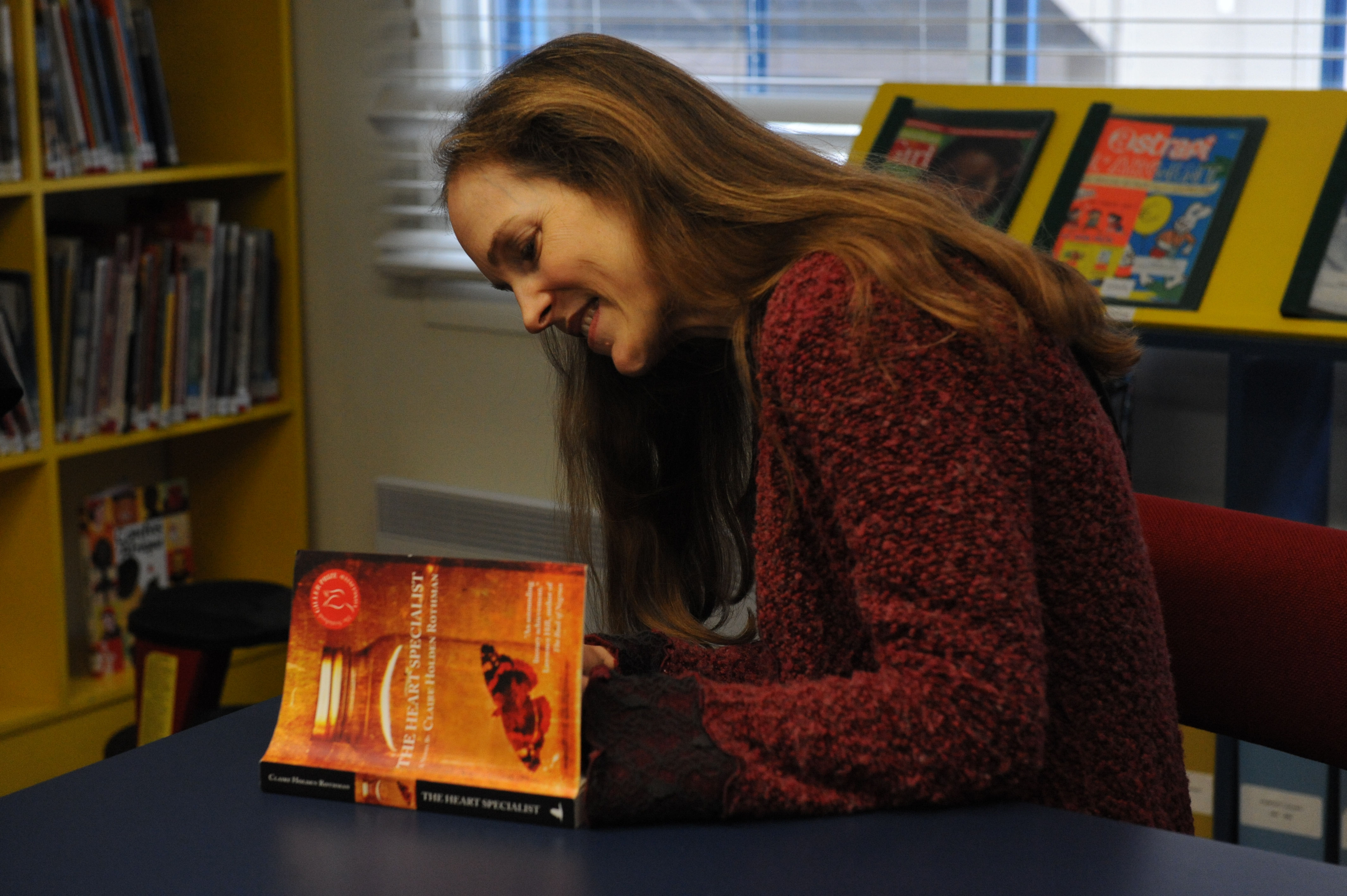
ClaireHodenRothmanThis week we welcomed Claire Holden Rothman, author of this year’s LCC Reads book The Heart Specialist as well as Dr. Ariane Marelli, Director of the MAUDE Cardiology Unit at the Montreal General Hospital (Lib_LCCReadsAssembly_01Dec2011).  In the spirit of discussing this book, I put together my own Top Ten list about the importance of reading (view LCC Reads photos).

1. Academic Success – Research confirms that the greatest single predictor of success in senior high school and post-secondary programs is the capacity of a student to read.  Reading builds knowledge and makes students smarter.

2. Vocabulary Development – Reading helps put words in context and broadens our word recognition ability.

3. Imagination – Reading takes us to new and imaginary places and helps us to be more creative; it certainly helps develop more colourful ideas.

4. Quiet and Calm – The opportunity to quietly pause and focus in a busy/noisy world is an important attribute of focusing on a text.

5. StorytellingStorytelling is so powerful that many ancient cultures continue to stress key stories as the foundations of their cultural identity.  This remains the case with many aboriginal nations in Canada.  Consider also how in mainstream culture the Harry Potter series excited and engaged a whole generation of young people.  The release of every new book in the series caused pandemonium around the world.

6. Choice – Read whatever interests motivates or excites you.  Whatever makes you think and develop original ideas, develop solutions to problems, or create a greater awareness of the complexities of the world is meaningful.  Reading can actually lead to discoveries and have a “wow factor” that motivates us to achieve.

7. Inspiration – Martin Luther King’s “I have a dream” speech, John F. Kennedy’s inaugural address “Ask not what this country can do for you, ask what you can do for your country,” Nelson Mandela’s inaugural address as the first black President of South Africa… these are all examples of how the written word can awaken deep feelings in all of us. Also, stories of courage can motivate us and the written word presents the opportunity for a clear voice by people who are somewhat shy in groups and less inclined to speak out.

8. Meaningful – In our Junior School we use an active reading methodology called “AIM” which focuses on students’ meaningful personal connections to texts.  While students are quietly reading they employ gestures that indicate what the material makes them feel, think, predict, connect and remind them of. Each sentiment has a quiet gesture.  One-on-one, the classroom teacher listens to the student’s oral explanation of why something is personally meaningful.  In short, the reading material becomes more relevant – and young students become more actively connected to the content.

9. Power of Words – Words resonate deeply.  Remember that two winters ago Canada’s Olympic team chose a simple word to motivate our athletes and a whole nation – “Believe.”  It was Canada’s mantra, “Believe.”  The word inspired athletes, teams, and a whole country as we earned the greatest medal haul in our history.

10. Reading Builds Community – We begin young by reading some common texts/stories in school and continue to share stories in English classes in high school.  Beyond school, book clubs are very popular in Canada (at LCC as well at various levels).  Our LCC Reads program has helped to bring hundreds of people together over a single book.

Thanks to all of our English teachers for their support of reading and literacy skills here at LCC.  A special thank you to Mr. Moore, Head of our English department and co-chair of the LCC Reads committee, along with our chief librarian Mrs. Varvarikos and dozens of students who are active members of our LCC Reads Club. Continue to read, learn and be inspired by the written word. Remember, literacy is timeless!– Christopher Shannon, Headmaster

Duke of Excellence at LCC

If you read the “news” section of our website you will note that pomp and ceremony paid a visit to LCC last weekend – and it was impressive (see:  Students receive Duke of Ed Silver Award)!  LCC was the site of a special ceremony to recognize Silver Duke of Edinburgh Award winners across the province of Quebec, hosted by His Honour Pierre Duchesne, Lieutenant Governor of Quebec.

At the provincial level the Lieutenant Governor represents the Queen and our collective heritage – and also actively promotes Canadian values and programs that are symbolic of what we value in our country.

Mr. Duchesne is an ardent supporter of the Duke of Edinburgh Award Program as it has a strong reputation and operates across Quebec, Canada and around the world in 130 countries.  It is a program that recognizes youth leadership, commitment and personal initiative beyond academics.  More than 7 million young people have participated since its inception in 1956.

All participants challenge themselves by involvement in four specific areas. A large emphasis is placed on skill acquisition and learning through service.

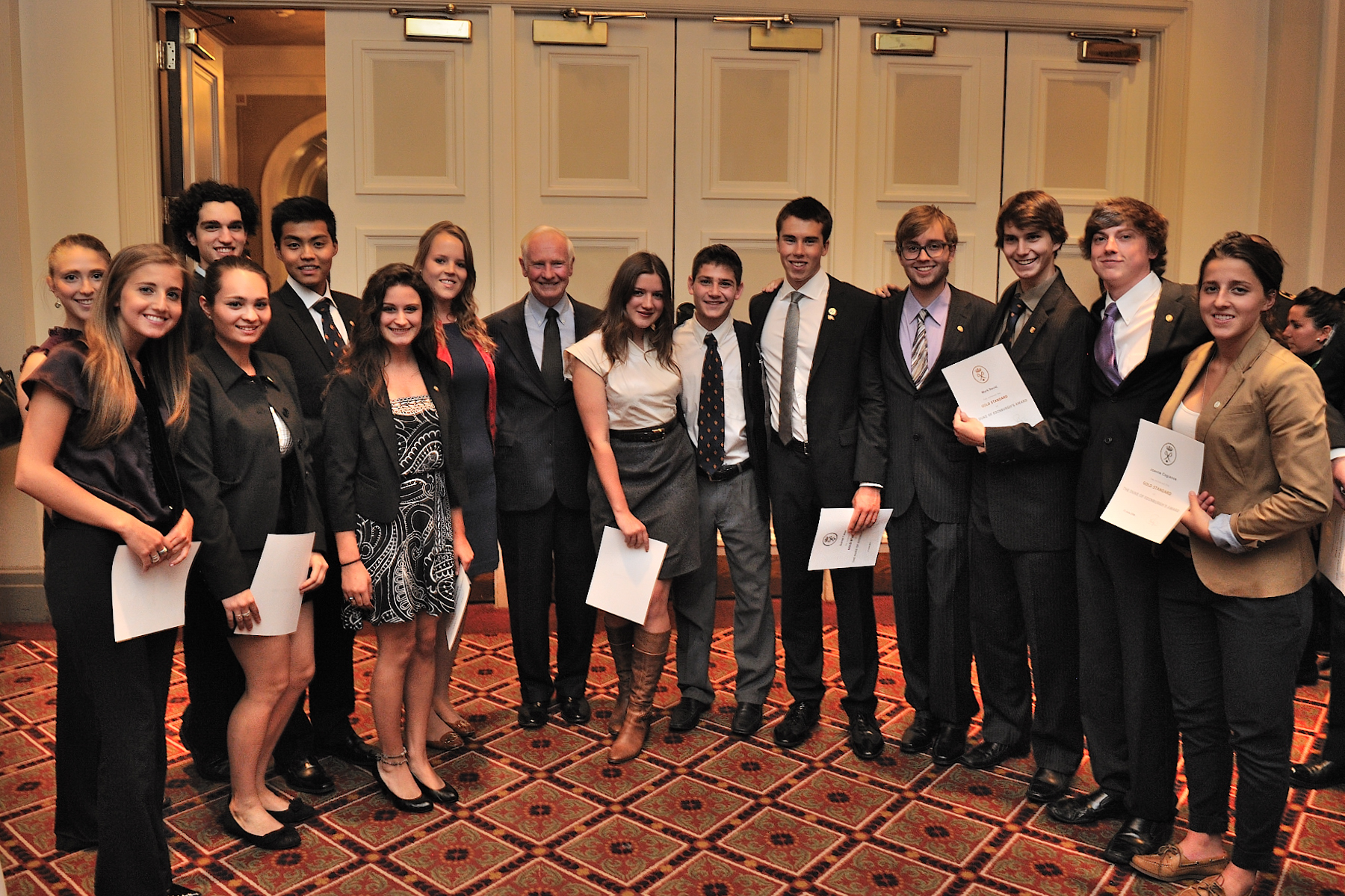
There are three levels of the award:  bronze, silver and gold – and last Saturday’s awards were all at the silver level.  Sixty-five were given to young Quebecers; impressively, more than 40 of them went to LCC students.  Earlier this fall, the Governor General of Canada, David Johnson, presented the coveted gold Duke of Edinburg awards in Québec City.  Thirty-eight LCC students were there to receive their Gold Award – significantly more than any high school in Canada.  What a fantastic indicator of achievement in our school.

We have outstanding students with a collective commitment to be leaders today and throughout their adult lives.  My personal congratulations to all award winners – very impressive!—Christopher Shannon, Headmaster