
LCC Going Local

GoLocalGiven that what we eat has a large impact on the environment, the LCC Sustainability Committee is reviewing LCC’s food sources.

Thanks to the efforts of five graduating students from the Class of 2008, as well as our excellent chef Alain Thirion, we already have much of the data we need for this project. Make no mistake, in this day and age, it is challenging for a North American to figure out where their food comes from. We take it for granted that we can get fresh fruit in the middle of a Canadian winter. This luxury comes at a steep cost to the environment.

LCC is in the process of setting long-term sustainability goals, and we are attempting to create a balance between optimism for what can be achieved and realism for what may be expected. Ideally, we would like the vast majority of the food served at LCC to come from within 250 km of the school. This is not as difficult as it might seem. For example, Première Moison (bread) already gets all of its flour from Quebec. Much of the beef and chicken is from within the province as well.
Vegetables and fruits are another matter. They are one of the reasons we will likely not reach our 100% local food goal, at least until there are enough greenhouses supplying mid-winter fruit. Thus it is here that we face our key challenge.

To get a quick view of some locavore ideas, check out this link. –Chris Olive, Green team Faculty Liaison

The Visit of the Composting Display

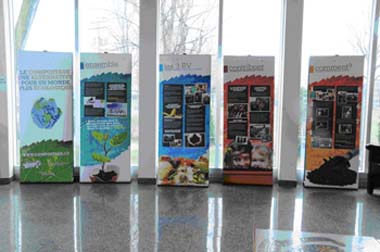
Fortunately for all of us, despite Quebec’s so-so performance on large environmental issues, there are many excellent programs of a smaller nature that are making themselves felt around the province. One such example is the L’Interre Actif compostage display that came to LCC thanks to the efforts of faculty member Jean- François Maurice.

CompostingDisplay

As many people know, LCC already has a composting program at the school. Vegetable and fruit scraps from both the dining room and the kitchen are directed into either our own (somewhat restricted) composting bins or alternatively, into the much larger program of Compost Montreal. — Chris Olive, Green Team Faculty Liaison

Earth Week: Biodiversity – “We are the World” (April 19-23)

EarthWeek2010It was an interesting experience to brainstorm with the Green Team on biodiversity –this year’s theme for Earth Week. Most of the websites that we researched revealed how important biodiversity is for humans since the many living beings on our earth allow us to obtain food, shelter, medicine, leisure, etc.

What’s wrong with this picture? As humans we are one among millions of species that exist on Earth. We are not the most significant part, yet we have a very egocentric idea of our place on our planet. True we depend on other species for our survival, so shouldn’t other species depend on us for their survival? We need to start looking beyond our own concerns and look at the world around us as full of energy, beauty and strength; characteristics that we should be incorporating in our own beings.

Our chosen theme of “We are the World” stresses how we can make a difference in the world not only in terms of caring for fauna and flora, but also with a concern for social justice.

We have a number of fundraisers set for Earth week in hopes not only to raise money for important causes, but also to raise awareness.

EarthWeek2010_ChildWorldWe will hold a raffle for a metal wall decor, which was made by an artist from Haiti entitled “children of the world.” Tickets will be available at the Front Office and proceeds will go toward relief efforts for Haiti.

EarthWeek2010_GreenGenTshirtsWe will sell “Green Generation” T-shirts with the slogan: “Reuse the Past, Recycle the Present, Save the Future,” written on the back. The money raised will be given to our local SPCA.

EarthWeek2010_TapWaterAidWe will have a “Fill the Water Jug with Coins” campaign to raise money to buy a gift from Water-Aid, such as a water pump, that will help a third world community obtain access to safe water.

We hope that you will be part of our celebration!

–Vilma Scattolin (Faculty Advisor) & the LCC Student Green Team

Just Fruits!

compost_binLCC has embarked on a new phase of the composting initiative. Although the worms in the vermi-composting bins in our greenhouse have been busy in the last years devouring some of the vegetable food scraps, as an initiative intended for educational purposes, the time has come to do more.

The student green team has launched a “Just Fruits Campaign” to assist everyone, from Junior School to faculty, in easing into this new phase. Bins have been placed in strategic places throughout the school to collect fruit wastes from snacks and lunches. Four bins have been placed near the existing garbage in the dining hall, one larger brown bin outside of the dining hall, and a brown bin in the Junior School area. These bins are emptied into the three wood composters located outside by the old rink. The composters were supplied by “Les ateliers d’Antoine,” a local organization that not only promotes social inclusion through training in cabinetmaking, but also promotes an ecological use of wood that would otherwise be deemed as waste wood.

The decision to use “Just Fruits” as an initial measure was two-fold. First, we wanted to avoid the presence of the “wrong” items making their way into the outdoor composters. Grease present in sauces and salad dressing, for example, can be an unwelcome and open invitation to our furry friends in the area. Second, by keeping it simple, we can all concentrate on making a concerted effort to compost, without any confusion.
The vegetables have not been ignored in all this, however. A second, behind-the-scenes-measure has also begun which involves the vegetable wastes that the kitchen produces in the making of the meals. Every week, vegetable wastes, that fill a 360L container to the brim, are collected by Compost Montréal.

If all goes well and everyone does their share, we will soon be leaving this phase behind and looking forward to new solutions.
—The LCC Student Green Team

The Student’s Voice

One of the goals of being digital literate citizens is to be involved and share thoughts on issues that impact each one of us. One of the recent assignments in the Digital Media Communications course was to have every student add their thoughts, via an audio file, after viewing a single photograph.  As each student adds their opinion regarding the image, the program continually records their voice to build an archive on this issue. Each student now has an audio record of their thoughts,  leaving a Voicethread on this topic.  Take a moment to listen to what they had to say.

Each student has a voice and only when they are willing to express their concerns on environmental or global issues will they impact change.

Vincent Jansen – Director of Information Systems
Instructor – Digital Media Communications